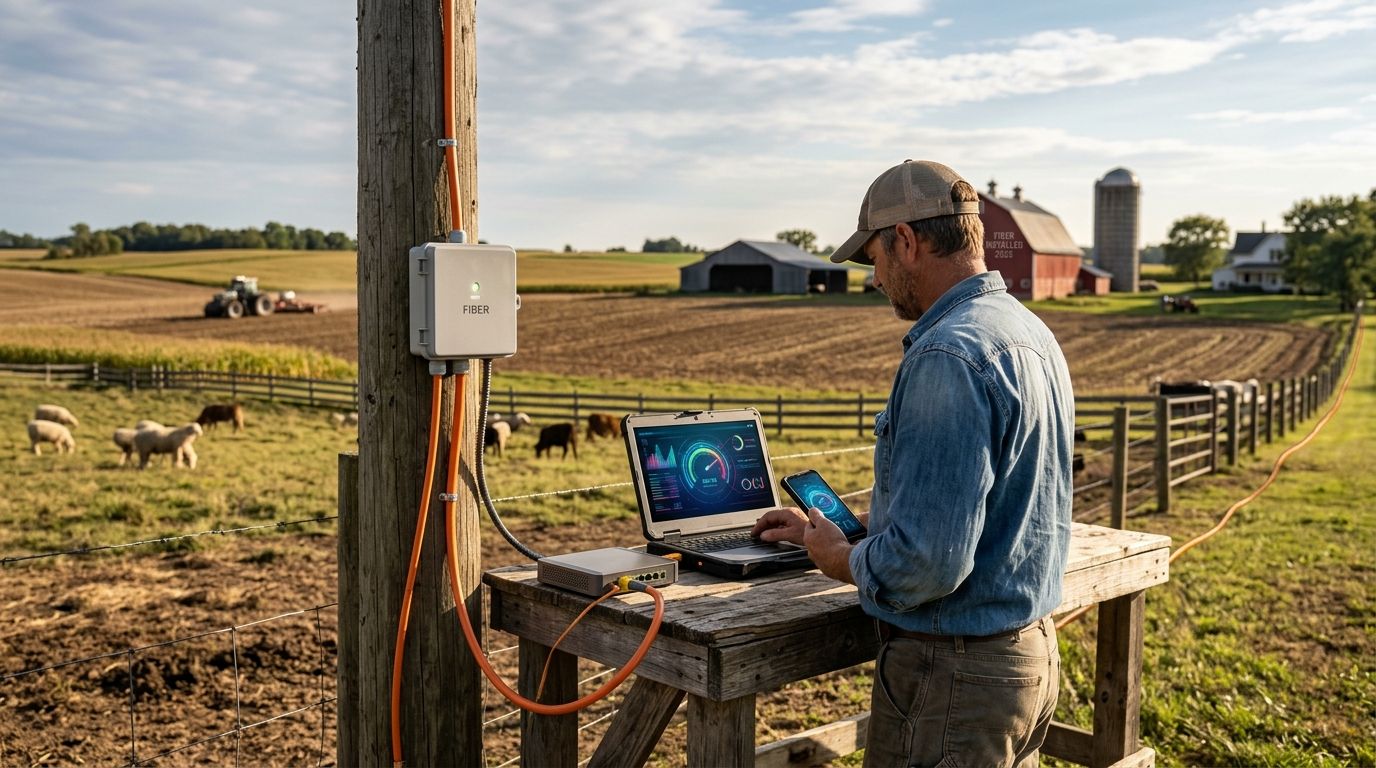

A fiber speed test tells you what's arriving at your router. It doesn't tell you what's reaching the couch, the kids' bedroom, or the laptop on a video call — that gap is almost always WiFi, not the fiber line. This guide walks through testing your connection the right way, then tuning your WiFi so the speed you're paying for actually shows up where you use it.
- Run a fiber speed test wired first — WiFi numbers alone will mislead you about what your plan actually delivers.
- Test room by room after the wired baseline to find exactly where WiFi coverage drops off.
- Band steering, channel width, and node placement fix most of the gap between wired and wireless speeds.
- Re-run the fiber speed test any time you add a new device — smart TVs and consoles are common slowdown triggers.
- SumoFiber connections are symmetrical, so upload speed deserves the same testing attention as download.
Why this matters
Most people run one speed test, standing next to the router, on WiFi, and call it done. That test measures the best-case scenario in your house — not the bedroom two walls away where a kid is trying to stream, or the kitchen where someone's on a work call. In 2026, with more households running smart TVs, video doorbells, and multiple work-from-home laptops on one network, the wired-to-wireless gap is the single biggest source of "my internet is slow" complaints that have nothing to do with the fiber line itself.
A proper fiber speed test workflow separates two questions: is the connection SumoFiber delivers to your router correct, and is your WiFi spreading that connection through the house without losing half of it along the way. Fixing the wrong problem wastes time and doesn't fix the real one.
Before you start
- A laptop or desktop with an ethernet port (or a USB-to-ethernet adapter) — you need a wired test to get an honest baseline.
- Login access to your router or the SumoFiber WiFi app, so you can check band settings and connected devices, not just run a browser-based speed test.
- The gotcha: never trust your first WiFi speed test if you ran it right after connecting. Devices need a few seconds to negotiate the best available channel — a test run within 10 seconds of joining a network reads low even on a healthy connection. Wait 30 seconds, then test.
Set up your wired baseline test
This is the number everything else gets compared against. Skip it, and you'll spend an afternoon blaming WiFi hardware for a problem that's actually upstream.
- Connect your computer directly to the ONT or router with an ethernet cable — bypass WiFi entirely.
- Open a browser-based speed test and run it three times: once in the morning, once in early evening (peak usage hours), and once late at night.
- Record download, upload, and ping for each run.
- Compare the average to your SumoFiber plan speed. A wired result within roughly 10% of your plan speed most of the day means the fiber line is doing its job — any shortfall from here on is a WiFi problem, not a fiber problem.
Expected result: three wired test runs that land close to your plan speed, with upload nearly matching download — fiber connections are symmetrical, unlike cable.
Test your WiFi coverage room by room
Now you're testing distribution, not delivery. This step is where most households find their real problem.
- Disconnect the ethernet cable and join your WiFi network on the same device.
- Run a speed test standing next to the router — this should come close to your wired baseline.
- Walk to each room you actually use and repeat the test: bedrooms, home office, kitchen, garage.
- Write down where results drop below roughly half your wired baseline — that's your dead zone.
Expected result: a room-by-room map showing exactly where signal degrades, instead of a vague sense that "the WiFi is bad upstairs."
Configure your router's band and channel settings
Once you know where the drop-offs are, the fix usually lives in settings you've never opened.
- Log into your router admin panel or the WiFi app tied to your service.
- Find the Band Steering or Smart Connect setting — turn it on so devices automatically pick 2.4GHz or 5GHz based on signal strength instead of sticking to a weaker band.
- Check Channel Width — a narrower channel width reduces interference in dense neighborhoods with lots of other networks nearby.
- Open the Connected Devices list and count how many devices are active. More than 15-20 devices on one router, especially older hardware, can bottleneck throughput even on a strong fiber connection.
Expected result: fewer devices stuck on the slow 2.4GHz band by default, and a cleaner channel with less neighbor interference.
Fix the wired-to-wireless gap with mesh placement
If your dead zones are still showing up after the settings pass, hardware placement is next.
- Add a mesh node or extender roughly halfway between the router and your weakest room — not at the edge of the dead zone, but before it.
- Prioritize wired backhaul for mesh nodes where possible; a node connected by ethernet performs better than one relying on wireless backhaul.
- Re-run the room-by-room speed test after each node placement to confirm the fix actually closed the gap.
Managed WiFi service takes this configuration off your plate entirely if you'd rather not troubleshoot channel widths — worth a look if this is the second time you've had to fix a dead zone. See the managed WiFi guide for businesses for how that setup differs from a standard home router.
Re-test whenever a new device joins the network
This is the workflow variant most people skip, and it's the one that catches slowdowns before they turn into a support call. Every time a gaming console, smart TV, or new laptop joins your network, run the wired baseline and one WiFi test again.
- After setup, connect the new device and let it run for a few minutes.
- Re-run your WiFi speed test in the room where the device lives.
- Compare against your last recorded baseline — a drop of more than 15-20% usually means the new device is pulling more bandwidth than expected, or it's defaulting to the crowded 2.4GHz band.
Doing this once per new device, in 2026, takes less than five minutes and prevents the slow buildup of "everything got slower" that's actually five separate small causes stacked on top of each other.
Troubleshooting
- Wired speed matches your plan, but WiFi is slow everywhere, even close to the router. Check for firmware updates on the router — outdated firmware is a common, overlooked cause of throughput caps.
- Upload speed lags behind download on video calls. Since fiber upload and download should be close to symmetrical, a consistent upload shortfall points to a device defaulting to 2.4GHz — force it to 5GHz manually.
- Speed test results swing wildly by time of day. Run tests during your household's actual peak hours (usually 7-10pm) rather than mid-morning — that's when congestion, if any exists, will show up.
- One room is dead no matter what you try. Concrete walls, metal ductwork, and mirrors block WiFi signal more than distance does — a mesh node needs line of sight or a wired backhaul to punch through, not just proximity.
- Old router hardware caps speeds even though the fiber line tests fine. Routers older than 4-5 years often can't handle gigabit-class throughput regardless of the plan — this is a hardware ceiling, not a settings problem.
Customize your workflow
Once the basic wired-to-wireless workflow is dialed in, tune it further based on what the house actually does. Households running multiple 4K streams at once should check the best internet providers for streaming guide for how sustained throughput differs from burst speed test numbers. Gamers care more about ping consistency than raw download — the best internet providers for gaming guide breaks down why a lower, steadier ping beats a higher peak speed. And if you're comparing plan tiers against actual delivered speed across providers, the fiber providers ranked by speed guide is a useful cross-check.
Check your SumoFiber account and speeds
See your plan speed and manage your connection in one place.
FAQ
What's the best way to run a fiber speed test?
Connect a device directly to the router with an ethernet cable and run the test three times across the day. Wired testing removes WiFi interference so you're measuring the actual fiber connection, not the wireless signal spreading it around your house.
Is a wired speed test always faster than a WiFi speed test?
Yes, in almost every case. Wired connections don't lose signal to walls, distance, or interference from other networks, so a WiFi test result below the wired baseline is expected — the question is how far below, not whether there's a gap.
How much does WiFi placement affect speed test results?
Significantly. A room on the far side of a concrete wall or two floors up from the router can show speed test results 50% lower or more than the same device sitting next to the router, even on a fully functioning fiber line.
Why is my upload speed lower than my download speed on a fiber connection?
Fiber connections are typically symmetrical, meaning upload and download should be close to equal. A persistent gap usually means the testing device is on the 2.4GHz band instead of 5GHz, or an older router is capping upload throughput.
How often should I run a fiber speed test?
Run one any time you add a new device to the network, notice a slowdown, or move a router or mesh node. Outside of that, a monthly check during peak evening hours is enough to catch gradual drift before it becomes a real problem.
Does the number of connected devices affect fiber speed test results?
Yes. Once a router is handling 15-20 or more active devices, especially older hardware, throughput can bottleneck even though the fiber line itself is delivering full speed. Checking your connected devices list is part of a full speed test workflow, not an extra step.
Can old router hardware limit fiber speeds even on a fast plan?
Yes. Routers older than about 4-5 years frequently can't process gigabit-class throughput regardless of what the fiber line delivers, which is why a wired test matching your plan doesn't guarantee your WiFi can keep up.
What time of day gives the most accurate speed test results?
Test during your household's actual peak usage hours, typically 7-10pm, since that's when any real congestion shows up. A test run at 6am will look great and tell you almost nothing about the experience that matters.
One last thing
Most households never test upload speed on purpose — they only notice it when a video call starts freezing. Because fiber connections run symmetrical, in 2026 that upload number is worth checking with the same attention as download every time you run a speed test, not as an afterthought after the download number looks fine.