
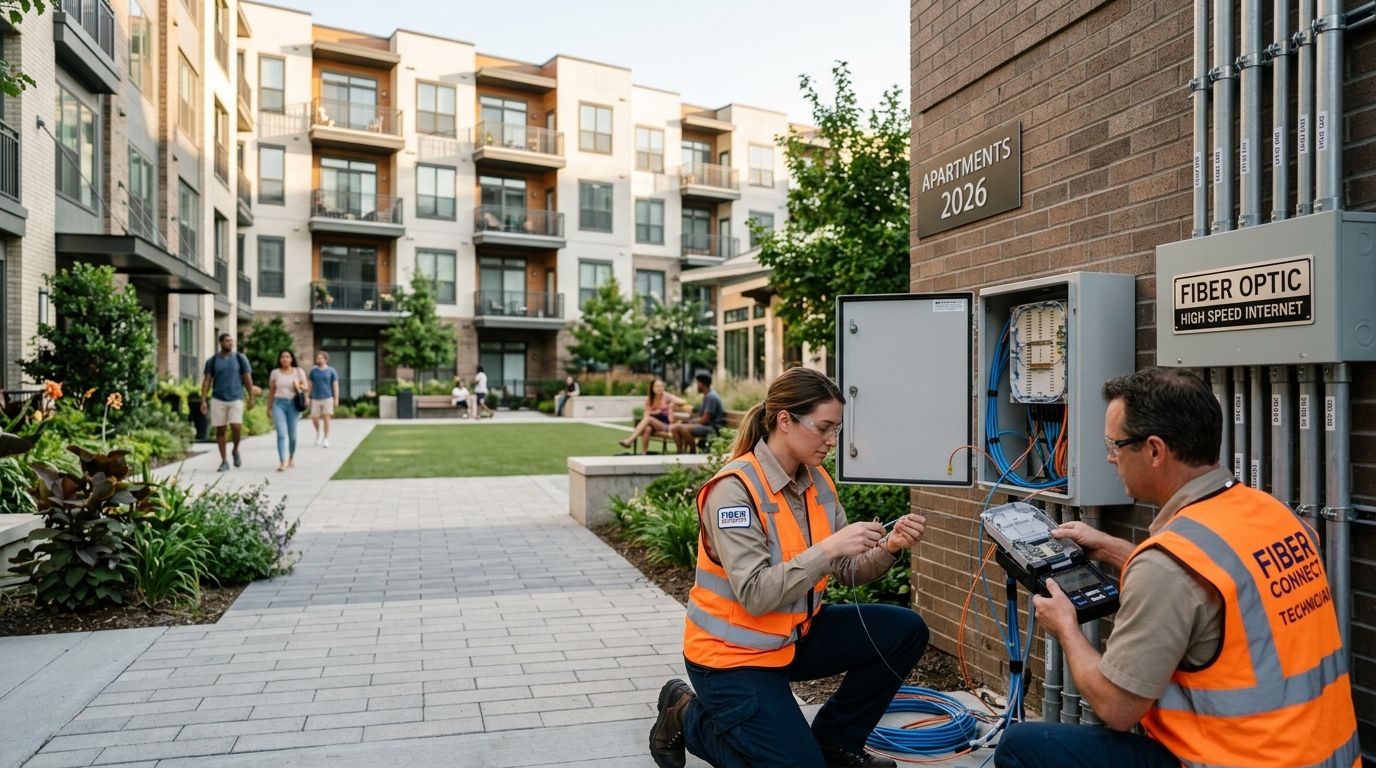
Fiber internet for apartment complexes means picking a delivery model, a wiring plan, and a provider that keeps every unit online at once — not just the unit that calls in first when the WiFi drops. Property managers need something different than single-family homeowners: shared wiring, one negotiated agreement, and a single point of contact when 200 units lose service on the same Friday night.
- Fiber internet for apartment complexes works best on a bulk-billing model rolled into rent, not a separate opt-in fee.
- Test wiring in 3-5 sample units before signing a property-wide agreement for 2026.
- No-contract terms protect property owners if service quality drops after move-in.
- Common areas — pool decks, gyms, leasing offices — need their own bandwidth plan, not leftover capacity.
- SumoFiber serves multi-family properties across Utah, Idaho, Montana, Colorado, California, Wisconsin, Illinois, and New York with 24/7 human support.
Why fiber internet matters for apartment complexes
Renters shopping for a unit now check internet quality the way they check parking and laundry — before they check closet space. Listing an apartment with fiber internet for apartment complexes already built in removes a decision from move-in day and removes a truck roll from the parking lot during the resident's first week.
SumoFiber works with property managers across Utah, Idaho, Montana, Colorado, California, Wisconsin, Illinois, and New York, and the draw for multi-family buildings is 24/7 human support and no data caps, not a top-line speed number nobody in the leasing office can verify. A property with reliable shared internet also removes one recurring complaint category from the front office's week: "my WiFi is down."
How to set up fiber internet for apartment complexes
Audit your building's wiring before you shop for a provider
Don't sign anything until you know what's actually in the walls. A 1990s building with old coax runs behaves differently than a 2020 build with conduit already staged for fiber, and that difference changes your installation timeline and cost.
- Check whether existing wiring is coax, Cat5, or open conduit
- Ask each unit's age and whether wiring was upgraded during any past renovation
- Identify the demarcation point for each building on the property
- Note any existing bulk agreement and when it expires
- Walk common areas separately — pools, gyms, and leasing offices often have no wiring at all
Decide how residents will pay for internet
This decision shapes everything downstream: your contract terms, your marketing, and how many support calls your leasing office fields. Most multi-family properties land on one of four models, covered in the comparison table below.
- Bulk billing rolled into rent, so every resident gets internet without opting in
- Door-fee opt-in, billed separately from rent
- Resident-choice, where each unit picks and pays their own ISP
- Hybrid, with a basic bulk tier included and a paid upgrade tier available
Vet providers for property-wide reliability, not a single unit's speed test
A speed test in one unit tells you nothing about what happens when 150 units stream at 8pm on a Tuesday in 2026. Ask providers how they handle peak-load capacity across a full building, not just headline speed numbers.
- Ask if support is available 24/7 by phone, not just chatbot or ticket queue
- Confirm the provider services every building on your property, not just the front units
- Check whether the agreement locks you into a multi-year contract
- Request references from other multi-family properties the provider already serves
- Ask what happens to service quality during a building-wide outage
This is the same vetting logic property managers use for other shared commercial buildings — see how it plays out for fiber internet for real estate offices, another setup where one provider serves many separate tenants under one roof.
Negotiate the contract terms before you sign
The contract you sign in 2026 outlives most lease cycles on the property, so read the exit clauses as carefully as the price. A no-contract agreement is worth more to a property owner than a marginally lower rate locked in for three years.
- Push for month-to-month or short-term terms instead of a multi-year lock-in
- Get an exit clause tied to a defined uptime commitment
- Clarify who's liable for wiring damage during installation
- Get a named escalation contact for property-wide outages, not a general support line
- Confirm installation timeline commitments in writing
Plan installation to minimize disruption
Installation day is the first impression residents get of the provider, and a bad one generates complaint calls for months. Schedule by building, not all at once.
- Notify residents at least two weeks ahead through the property portal or email
- Schedule common-area installs after leasing office hours
- Test each unit before the install crew leaves the building
- Keep a punch list of units needing a follow-up visit
- Stagger installation across buildings instead of one blanket property-wide date
Manage WiFi across units and common areas
One router in the leasing office closet doesn't cover a four-story building. Multi-family properties need a managed approach that treats common areas and individual units as separate networks with separate capacity planning.
- Run a separate SSID for common areas versus individual units
- Plan capacity per unit count, not a flat property-wide number
- Set up a guest network for leasing office visitors and tours
- Monitor bandwidth during peak hours, typically evenings
- Compare options on the managed WiFi providers for business page before standardizing on one platform property-wide
Market internet as a leasing amenity
Once it's live, use it. Fiber internet for apartment complexes is a real differentiator on listing sites, but only if the leasing team actually mentions it during tours instead of burying it in the welcome packet.
- List it as a named amenity on rental listing sites, not a footnote
- Have leasing agents mention it during in-person tours
- Include setup details in the resident welcome packet
- Compare your offering against nearby properties' internet setup
- Avoid promising speeds the contract doesn't actually guarantee
Comparison: internet models for apartment complexes
| Model | Best for | Key limitation |
|---|---|---|
| Bulk billing (rolled into rent) | Properties that want internet built in as a standard amenity | Requires negotiating one property-wide rate with a single provider |
| Door-fee opt-in | Properties testing resident demand before committing | Uneven adoption leaves some units still shopping for their own provider |
| Resident-choice (BYO provider) | Older buildings that can't standardize wiring | Multiple installers and truck rolls disrupt hallways and residents |
| Hybrid (basic bulk + paid upgrade) | Larger complexes wanting a baseline plus an upsell tier | Adds billing complexity for the leasing office to track |
The verdict: bulk billing wins for most stabilized multi-family properties in 2026 — it removes the "my WiFi is down" complaint category entirely and turns internet into a marketed amenity instead of a resident headache.
Common mistakes apartment complexes make with fiber internet
- Skipping the wiring audit and assuming every building matches the model unit
- Signing a multi-year exclusive contract before confirming the provider actually services every building on the property
- Forgetting common areas — pool decks, gyms, leasing offices — in the bandwidth plan
- Not naming one escalation contact for outages, so residents call the front office instead of the provider
- Rolling out installation without a two-week notice, causing missed appointments and a wave of complaint calls
Get fiber internet for your property
Talk to SumoFiber about bulk billing, managed WiFi, and no-contract terms.
FAQ
What's the best internet setup for apartment complexes in 2026?
Bulk billing rolled into rent is the best setup for most stabilized multi-family properties in 2026 because it removes per-unit shopping and gives every resident working internet on move-in day. Door-fee and resident-choice models work for properties still testing demand or dealing with older wiring.
Is bulk internet billing better than resident-choice for apartment complexes?
Bulk billing is better for reducing truck rolls, complaint calls, and marketing friction, since every unit gets internet without opting in. Resident-choice fits older buildings that can't standardize wiring across every unit.
How much does fiber internet cost for apartment complexes?
Cost depends on unit count, existing wiring condition, and whether the property chooses bulk, door-fee, or hybrid billing. Get a property-specific quote directly from a provider rather than relying on a per-unit estimate.
Does apartment fiber internet require a long-term contract?
It doesn't have to — no-contract agreements exist and protect the property owner if service quality drops after move-in. Push for month-to-month or short-term terms during negotiation instead of accepting a multi-year lock-in by default.
How long does fiber installation take for a multi-building apartment complex?
Installation timing depends on unit count and existing wiring, so schedule building-by-building instead of one blanket property-wide date. Staggering installs also keeps disruption contained to one building at a time.
Can residents use their own WiFi router with apartment fiber internet?
Yes, in most setups residents can connect their own router to the in-unit connection unless the property has standardized on a managed WiFi platform across the building. Check the specific agreement terms before assuming either way.
What happens if fiber internet goes down at an apartment complex?
The contract should name a specific escalation contact for property-wide outages rather than routing residents through a general support queue. Confirm this before signing, since outage response time is the biggest driver of resident complaints.
Does SumoFiber serve apartment complexes outside Utah?
Yes, SumoFiber works with multi-family properties across Utah, Idaho, Montana, Colorado, California, Wisconsin, Illinois, and New York. Coverage varies by building, so confirm service at the specific property address.
One last thing
The biggest driver of resident satisfaction with property-wide internet isn't the top-line speed number on the contract — it's whether a real person picks up the phone when the WiFi drops during a Sunday night in 2026. Before signing anything, call the provider's support line at 9pm on a weeknight and see who answers. That single test tells a property manager more than any spec sheet.