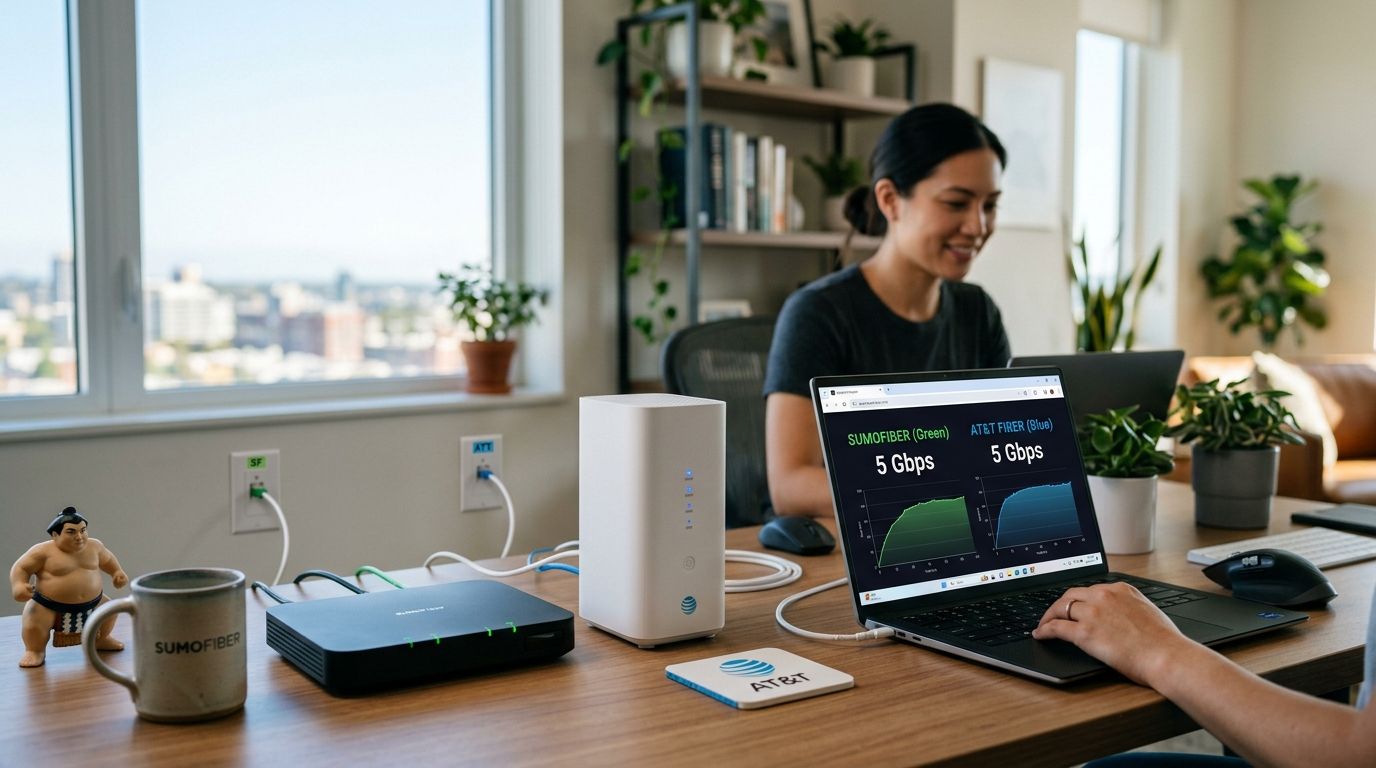

AT&T Fiber built one of the largest fiber footprints in the country, and its symmetrical speeds - up to 5 Gbps in many metro markets in 2026 - are a real reason people stick with it. The ceiling shows up the moment you live outside its build map, want your internet, WiFi, TV, phone, and mobile on one bill, or need a person on the phone instead of a call-center queue. The best AT&T Fiber alternative in 2026 is SumoFiber if you're in Utah, Idaho, Montana, Colorado, California, Wisconsin, Illinois, or New York and want no contracts with 24/7 human support; Quantum Fiber or Google Fiber if raw multi-gig speed outside AT&T's footprint is the only thing you're chasing.
- SumoFiber wins for households in Utah, Idaho, Montana, Colorado, California, Wisconsin, Illinois, and New York wanting no contracts and 24/7 human support.
- AT&T Fiber still runs the broadest multi-gig footprint with symmetrical speeds up to 5 Gbps in 2026.
- Quantum Fiber and Google Fiber compete on speed tiers but cover far fewer metro areas than AT&T.
- Xfinity beats AT&T on raw availability but runs mostly on cable, not symmetrical fiber.
- None of the AT&T Fiber alternatives bundle internet, WiFi, TV, phone, and mobile into one account the way SumoFiber does.
Why this matters
AT&T Fiber's territory is enormous, but it's not everywhere, and it never was built to be a one-stop shop for TV and phone the way it used to be. When AT&T unwound its ownership of DirecTV, its internet plans stopped coming with an in-house TV product, which means shopping AT&T Fiber alternatives in 2026 usually starts with a simple question: do you want speed alone, or do you want one provider handling everything from WiFi to mobile.
That question is what separates this list. Some alternatives chase AT&T on raw megabits. SumoFiber competes on what happens after the install - who answers the phone, whether you're locked into a contract, and whether you need three logins to manage your internet, TV, and phone.
AT&T Fiber alternatives at a glance
| Provider | Best for | Standout feature | How it differs from AT&T Fiber |
|---|---|---|---|
| AT&T Fiber | Multi-gig speed inside its metro footprint | Symmetrical upload and download up to 5 Gbps | The benchmark every alternative on this list is measured against |
| SumoFiber | Local support across UT, ID, MT, CO, CA, WI, IL, NY | One account for internet, managed WiFi, TV, phone, and mobile | Real person answers around the clock, no contracts, no data caps |
| Quantum Fiber | Newer fiber builds chasing multi-gig parity | Fast self-install and app-based network management | Smaller footprint, similar speed-first pitch |
| Xfinity | Widest raw availability, fiber or not | Bundled mobile line pricing options | Mostly cable infrastructure, not symmetrical fiber |
| Google Fiber | Straightforward, flat speed tiers | No equipment rental fees on most plans | Limited to a short list of metro markets |
1. SumoFiber: best for local support across eight states
SumoFiber runs fiber internet, managed WiFi, TV, home phone, and mobile service across Utah, Idaho, Montana, Colorado, California, Wisconsin, Illinois, and New York. The pitch isn't the fastest number on a spec sheet - it's a household or small business getting internet, WiFi, phone, and TV handled by one company that picks up the phone in the same towns customers live in.
Where SumoFiber shines:
- No contracts or data caps on residential or business internet plans
- 24/7 support answered by a real person instead of a phone tree
- One account covers internet, managed WiFi, TV, home phone, and mobile
Where SumoFiber falls short:
- Footprint covers 8 states, a fraction of AT&T Fiber's national reach
- Not an option yet if your address sits outside SumoFiber's current build areas
Best for: households and small businesses in SumoFiber's 8-state footprint who want one bill and a human on the line.
| Dimension | SumoFiber | AT&T Fiber |
|---|---|---|
| Contract terms | No contracts | Varies by plan and promotion |
| Support model | 24/7 human support | Call-center, tiered support |
| Bundled services | Internet, WiFi, TV, phone, mobile in one account | Internet plus mobile; TV runs through a separate streaming or DirecTV partner |
| Footprint | 8 states | Broader multi-state build map |
2. Quantum Fiber: best for chasing multi-gig speed in new fiber builds
Quantum Fiber is the fiber arm pushing into newer residential builds with app-based network management and quick self-install kits. It's a fair pick if the only thing on your list is a fast symmetrical connection and Quantum happens to already run fiber down your street.
Where Quantum Fiber shines:
- Fast self-install process with app-based router management
- Competes directly on multi-gig speed tiers
Where Quantum Fiber falls short:
- Footprint is smaller and newer than AT&T Fiber's established territory
- No managed WiFi, TV, phone, and mobile bundled under one account the way SumoFiber offers
Best for: buyers in a newly-built fiber neighborhood who only need internet, nothing bundled. A side-by-side breakdown lives on the Quantum Fiber alternatives page if that's the provider you're actually comparing against.
3. Xfinity: best for widest raw availability
Xfinity covers more addresses than almost anyone on this list, but most of that footprint still runs on cable, not fiber. That matters for upload speed - video calls and cloud backups lean on upload bandwidth, and cable connections are rarely symmetrical the way fiber is.
Where Xfinity shines:
- Available in areas where neither AT&T Fiber nor SumoFiber has built out yet
- Mobile line bundling options tied to the internet account
Where Xfinity falls short:
- Cable infrastructure in most territory means asymmetrical speeds, not true fiber
- Equipment and network congestion during peak hours is a known cable-network tradeoff
Best for: addresses where fiber simply hasn't arrived yet and cable is the fastest option available. Skip it if fiber is available from any other provider on this list.
4. Google Fiber: best for simple, flat pricing tiers
Google Fiber keeps its plan lineup short and skips equipment rental fees on most tiers, which appeals to anyone tired of add-on charges. The tradeoff is geography - Google Fiber sits in a short list of metro markets and isn't an option for most of the country.
Where Google Fiber shines:
- Flat, easy-to-compare speed tiers
- No equipment rental fee on most plans
Where Google Fiber falls short:
- Metro footprint is narrow compared to AT&T Fiber or Xfinity
- No bundled TV, phone, or mobile service
Best for: renters and homeowners in a Google Fiber metro who want internet only, nothing else bundled. Wait if you're outside its build list - it's simply not buildable yet.
Why people switch from AT&T Fiber
- TV isn't bundled the way it used to be. AT&T no longer owns DirecTV outright, so pairing internet with TV now means juggling a separate streaming or satellite partner instead of one bill.
- Support is centralized, not local. Call-center support handles a huge customer base spread across many states, which means longer queues during outages compared to a provider working a smaller footprint.
- The footprint has real edges. AT&T Fiber's build map stops at certain neighborhoods and towns, leaving plenty of addresses - including much of SumoFiber's 8-state territory - without AT&T fiber as an option at all.
Check what's available at your address
See SumoFiber internet, WiFi, TV, phone, and mobile options in your state.
When staying with AT&T Fiber is the right call
If you already live inside AT&T's high-speed footprint, only need internet, and don't care about bundling TV, phone, or mobile under one provider, AT&T Fiber's multi-gig tiers hold up fine in 2026. Switching only makes sense when the gap is support, contracts, or the number of separate bills you're managing - not raw speed.
FAQ
What is the best AT&T Fiber alternative in 2026?
SumoFiber is the best AT&T Fiber alternative for households and small businesses in Utah, Idaho, Montana, Colorado, California, Wisconsin, Illinois, and New York who want no contracts and 24/7 human support. Outside that footprint, Quantum Fiber or Google Fiber are the closer speed-for-speed comparisons.
Is SumoFiber better than AT&T Fiber?
SumoFiber beats AT&T Fiber on contract terms, support model, and bundled services within its 8-state footprint, but AT&T Fiber covers far more addresses nationally. The better pick depends on whether SumoFiber serves your address.
Does AT&T Fiber still bundle TV service?
AT&T no longer sells an in-house TV service the way it did when it owned DirecTV outright, so TV now runs through a separate streaming or satellite partner. That's a common reason households look at bundled alternatives instead.
How fast is AT&T Fiber compared to its alternatives?
AT&T Fiber offers symmetrical speeds up to 5 Gbps in many of its metro markets as of 2026, which is among the fastest residential tiers available. Alternatives like Quantum Fiber and Google Fiber compete on similar speed tiers but in far smaller footprints.
Which AT&T Fiber alternative has no contracts?
SumoFiber runs internet plans with no contracts and no data caps across its 8-state footprint. Contract terms on AT&T Fiber and its other alternatives vary by plan and promotion.
Is Xfinity a fiber alternative to AT&T?
Xfinity is available in more places than most fiber providers, but most of its network runs on cable rather than symmetrical fiber. It's a fallback option where fiber hasn't reached yet, not a direct fiber-for-fiber swap.
Does Google Fiber cover the same areas as AT&T Fiber?
No. Google Fiber operates in a much shorter list of metro markets than AT&T Fiber, so it's only a realistic alternative if your address happens to sit inside its build area.
What should I compare besides speed when picking an AT&T Fiber alternative?
Look at contract terms, whether TV, phone, and mobile bundle into one account, and how support is staffed - call center versus a direct line to a person. Speed tiers across fiber providers are often close enough that these differences decide the switch.
One last thing
The detail that trips people up most isn't speed - it's realizing mid-switch that their AT&T internet and their TV service are two separate accounts with two separate support lines. Before switching anywhere in 2026, ask any provider on this list, SumoFiber included, exactly how many logins and bills you'll end up managing.