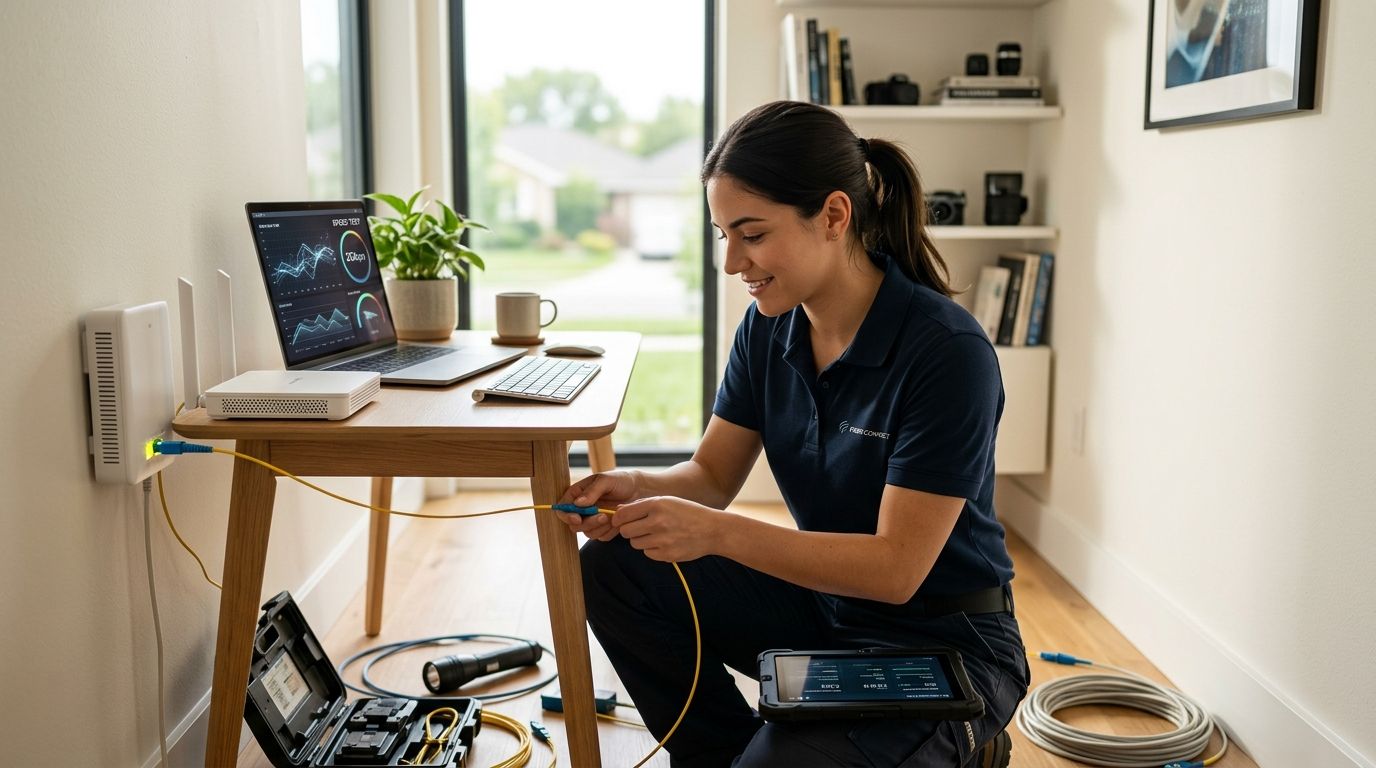

No-contract internet providers let you cancel or switch plans without eating an early termination fee, and in 2026 that flexibility matters as much as the speed number on the box. This guide ranks five internet providers with no contract by cancellation terms, real-world footprint, and what happens when you actually need to call support.
- Best overall internet provider with no contract: SumoFiber, live across Utah, Idaho, Montana, Colorado, California, Wisconsin, Illinois, and New York.
- Best for renters who move often: T-Mobile Home Internet, a 5G box with no install crew required.
- Best no-contract fiber in the Northeast: Verizon Fios.
- Best no-contract cable where fiber isn't built yet: Spectrum.
- Every pick on this list lets you cancel in 2026 without an early termination fee.
Why this matters
SumoFiber built its plans around one idea: a contract is a bet the provider makes that you'll stay even if the service disappoints you. Drop the contract and the provider has to earn your business every single month.
That shift matters more in 2026 than it did five years ago, because more households are stacking internet, TV, phone, and mobile under one roof and don't want four separate cancellation clocks running. A no-contract internet provider means you can downgrade after a move, pause service during a slow season, or walk if the WiFi drops every time someone starts a video call.
What makes the best no-contract internet provider
- No early termination fees or hidden cancellation clauses buried in a PDF
- Month-to-month billing that starts and stops on your schedule, not a 12- or 24-month cycle
- Real availability at your address, not just a shaded zone on a coverage map
- Support you can reach at 2 a.m. when the router dies, not a chatbot loop
- Bundled services — WiFi, TV, phone, mobile — available without stacking separate contracts
- Clear equipment and data cap policies published before you sign up, not discovered on bill number three
At a glance: internet providers with no contract in 2026
| Provider | Best for | Standout feature | Key limitation |
|---|---|---|---|
| SumoFiber | Bundling fiber, WiFi, TV, phone & mobile with no contract | 24/7 human support across an 8-state fiber footprint | Fiber lines aren't built in every neighborhood yet |
| T-Mobile Home Internet | Renters who move often | 5G box you can unplug and take with you | Speeds depend on nearby cell tower congestion |
| Verizon Fios | No-contract fiber in the Northeast | Symmetric upload and download speeds | Limited to a handful of Northeastern states |
| Spectrum | No-contract cable before fiber arrives | Cable reaches many areas fiber hasn't hit yet | Upload speeds lag behind fiber competitors |
| Xfinity | Households already on Comcast mobile | Bundle discounts for multi-service Comcast customers | Contract-free plans often cost more month to month |
1. SumoFiber: best no-contract internet for bundling fiber, WiFi, TV, phone, and mobile
SumoFiber runs fiber internet, managed WiFi, TV, home phone, and mobile service to households and businesses across Utah, Idaho, Montana, Colorado, California, Wisconsin, Illinois, and New York, without locking any of it behind a contract. Support runs 24/7, and the pitch is straightforward: no contracts, no data caps, one provider handling everything instead of four separate bills and four separate cancellation windows.
SumoFiber pros:
- No contracts or data caps across residential and business plans
- 24/7 human support instead of a scripted bot
- One provider for internet, managed WiFi, TV, phone, and mobile
- Fiber lines built for symmetric upload and download speeds
SumoFiber cons:
- Fiber availability depends on buildout in your specific area
- Newer footprint means fewer third-party reviews than legacy national carriers
Best for: households and businesses that want fiber speed and every service under one no-contract roof.
Verdict: Buy if SumoFiber fiber reaches your address — the no-contract, no-data-cap combination with round-the-clock human support is hard to match on this list.
2. T-Mobile Home Internet: best no-contract internet for renters who move often
T-Mobile Home Internet runs on the same 5G network as T-Mobile's phone plans, delivered through a self-install box instead of a technician visit or a buried cable line. There's no annual contract — you sign up, plug it in, and cancel whenever your lease ends.
T-Mobile Home Internet pros:
- Self-install box, no technician appointment required
- No annual contract, cancel anytime
- Portable enough to bring to a new address if coverage holds
T-Mobile Home Internet cons:
- Speeds shift with cell tower load, especially during peak evening hours
- Not built for households running multiple 4K streams plus heavy video calls at once
Best for: renters and frequent movers who don't want a wired install tied to one address.
Verdict: Buy if you move often and your address gets strong 5G signal; Wait if you've got a household of heavy simultaneous streamers.
3. Verizon Fios: best no-contract fiber for the Northeast
Verizon Fios delivers fiber-to-the-home service across parts of the Northeast, and like most fiber players by 2026 standards, it doesn't require an annual contract to activate service. Fios is built on fiber rather than copper or cable, which is why its upload speeds match its download speeds instead of trailing behind them.
Verizon Fios pros:
- Fiber network with symmetric upload and download speeds
- No annual contract on standard residential plans
- Established network with a long fiber track record
Verizon Fios cons:
- Footprint limited to a handful of Northeastern states
- Bundled TV and phone options vary by exact address
Best for: Northeastern households that want fiber without a contract and already fall inside Verizon's build zone.
Verdict: Buy if Fios reaches your address and you're in its coverage states; Skip if you live outside the Northeast footprint entirely.
4. Spectrum: best no-contract cable where fiber hasn't arrived
Spectrum has marketed itself for years on the promise of no contracts, and that policy carries into 2026 across its standard residential cable plans. Cable still reaches more zip codes than fiber does nationally, which makes Spectrum a fallback where fiber providers, including SumoFiber, haven't finished building out yet.
Spectrum pros:
- No-contract policy across standard cable plans
- Cable footprint extends into many areas without fiber access
- Widely available equipment and self-install options
Spectrum cons:
- Upload speeds trail fiber providers noticeably
- Cable performance can dip during peak neighborhood usage hours
Best for: households in areas fiber hasn't reached who still want a no-contract option.
Verdict: Hold — solid no-contract fallback, but switch to a fiber provider like SumoFiber the moment it's available at your address.
5. Xfinity: best no-contract internet for existing Comcast households
Xfinity offers contract-free plans alongside its traditional term agreements, and the no-contract tier makes the most sense for households already using Comcast mobile or cable service and looking to consolidate. The tradeoff is straightforward: skipping the contract usually means skipping the promotional-rate stability that comes with a term agreement.
Xfinity pros:
- Contract-free plan tier available in most service areas
- Bundle options for households already on Comcast mobile
- Wide cable footprint across many U.S. metro areas
Xfinity cons:
- Contract-free plans typically cost more than term-locked equivalents
- Cable-based speeds still trail fiber providers on upload
Best for: current Comcast mobile or cable customers who want to drop the contract without switching providers entirely.
Verdict: Hold for existing Comcast households; Skip if you're starting fresh and fiber is available where you live.
How this list was ranked
Each provider was measured against the criteria above: contract terms and cancellation clauses, real service footprint, support access, bundled-service availability, and equipment or data cap policies. Providers that hide fees behind a no-contract label, or that only serve a narrow footprint, lose ground here even when their advertised speeds look competitive on paper.
“If a provider needs a contract to keep you, the provider is the one taking the risk, not you.”
Which no-contract internet provider should you choose?
If fiber reaches your address in Utah, Idaho, Montana, Colorado, California, Wisconsin, Illinois, or New York, SumoFiber is the default pick — fiber speed, no contracts, no data caps, and one bill covering internet, WiFi, TV, phone, and mobile. Renters who relocate every year should look at T-Mobile Home Internet first. Everyone else falls back to whichever cable or fiber option actually reaches their street, checked against the table above rather than a marketing map.
Check fiber availability at your address
See if no-contract SumoFiber fiber, WiFi, TV, phone, and mobile service reaches your home.
FAQ
What are the best internet providers with no contract in 2026?
SumoFiber, T-Mobile Home Internet, Verizon Fios, Spectrum, and Xfinity all offer month-to-month plans with no annual contract in 2026. SumoFiber ranks highest for households wanting fiber speed bundled with WiFi, TV, phone, and mobile under one no-contract account.
Is no-contract internet more expensive than contract internet?
Sometimes, since term contracts often come with a locked promotional rate that a no-contract plan skips. The tradeoff is flexibility — you can cancel or downgrade anytime instead of paying an early termination fee.
Does no-contract mean no data cap?
Not automatically. Some no-contract cable and 5G home internet plans still cap or throttle data after a threshold, so check that policy separately from the contract terms.
Can I get fiber internet with no contract?
Yes. SumoFiber, Verizon Fios, and other fiber providers commonly offer no-contract residential plans in 2026, though availability depends on whether fiber lines have been built to your address.
Is T-Mobile Home Internet a good no-contract option?
It's a strong option for renters and frequent movers because the 5G box is self-install and portable, though speeds can dip during peak cell tower congestion.
How much does it cost to cancel a no-contract internet plan?
Providers on this list don't charge early termination fees on their no-contract plans, since that's the entire point of a month-to-month agreement.
Does SumoFiber require a contract?
No. SumoFiber runs its residential and business internet, managed WiFi, TV, phone, and mobile service without contracts or data caps.
One last thing
A no-contract label only covers the cancellation clause — it says nothing about data caps or equipment fees, and those two line items are where cable and 5G plans quietly claw back the savings. Read the equipment and data policy separately from the contract terms before you sign up in 2026, no matter which provider you pick.