
You get a credit for a fiber internet outage only when your provider approves a billing adjustment under the terms that apply to your service; an outage alone does not guarantee a credit. A service credit also does not automatically cover missed work, lost sales, or other expenses. For a 2026 claim, document the interruption, report it, and ask which credit policy applies to your account.
- A credit for fiber internet outage depends on the applicable service terms and the provider’s decision.
- Keep outage timestamps, a support ticket, and written confirmation of any billing adjustment.
- Business SLA credits follow the agreement’s eligibility rules, exclusions, and claim process.
- Sumofiber offers residential and business fiber internet; confirm account-specific outage credit terms before relying on reimbursement.
Do you get a credit when fiber internet has an outage?
An outage is a reason to request a credit, not proof that a credit is owed. Your service agreement determines whether an interruption qualifies, how the provider measures it, and what you must submit. Ask for the applicable policy rather than assuming that every disconnected hour receives the same treatment.
If you use Sumofiber for fiber internet, ask which terms govern your particular account. Residential service, business service, and other services on the same bill should not be treated as interchangeable when requesting an adjustment.
| Situation | What to establish | Useful evidence | Limit to keep in mind |
|---|---|---|---|
| Residential internet interruption | Whether the provider’s billing policy covers the event | Outage timestamps, ticket number, restoration notice | A request does not establish eligibility |
| Business service with an SLA | Whether the interruption meets the agreement’s definition | Incident records and the required claim information | Exclusions and submission requirements still apply |
| WiFi problem inside your building | Whether the internet connection or local wireless network failed | Results from multiple devices and a wired connection | A WiFi problem is not proof of a fiber outage |
| Several services stop working | Which services were affected and which terms cover them | Separate notes for internet, phone, and TV | An internet adjustment does not establish credits for other services |
The table separates the questions you need answered. It does not establish a credit policy for any provider or promise that a particular event qualifies.
Why this matters
When the internet stops during a video call or a restaurant cannot use an online system, getting connected again comes first. Billing is a separate task. Keep the repair request and the credit request connected by the same incident record, but make both requests explicitly.
For an outage in 2026, save the terms that apply to your account alongside the support correspondence. A current sales page is not a substitute for the agreement governing your service. You need the policy that explains the claim, not just a description of the connection.
This distinction also keeps expectations realistic. Restoring service, adjusting a bill, and paying for business losses are different outcomes. Do not assume that approval of one establishes a right to another.
How do I request a credit for a fiber internet outage?
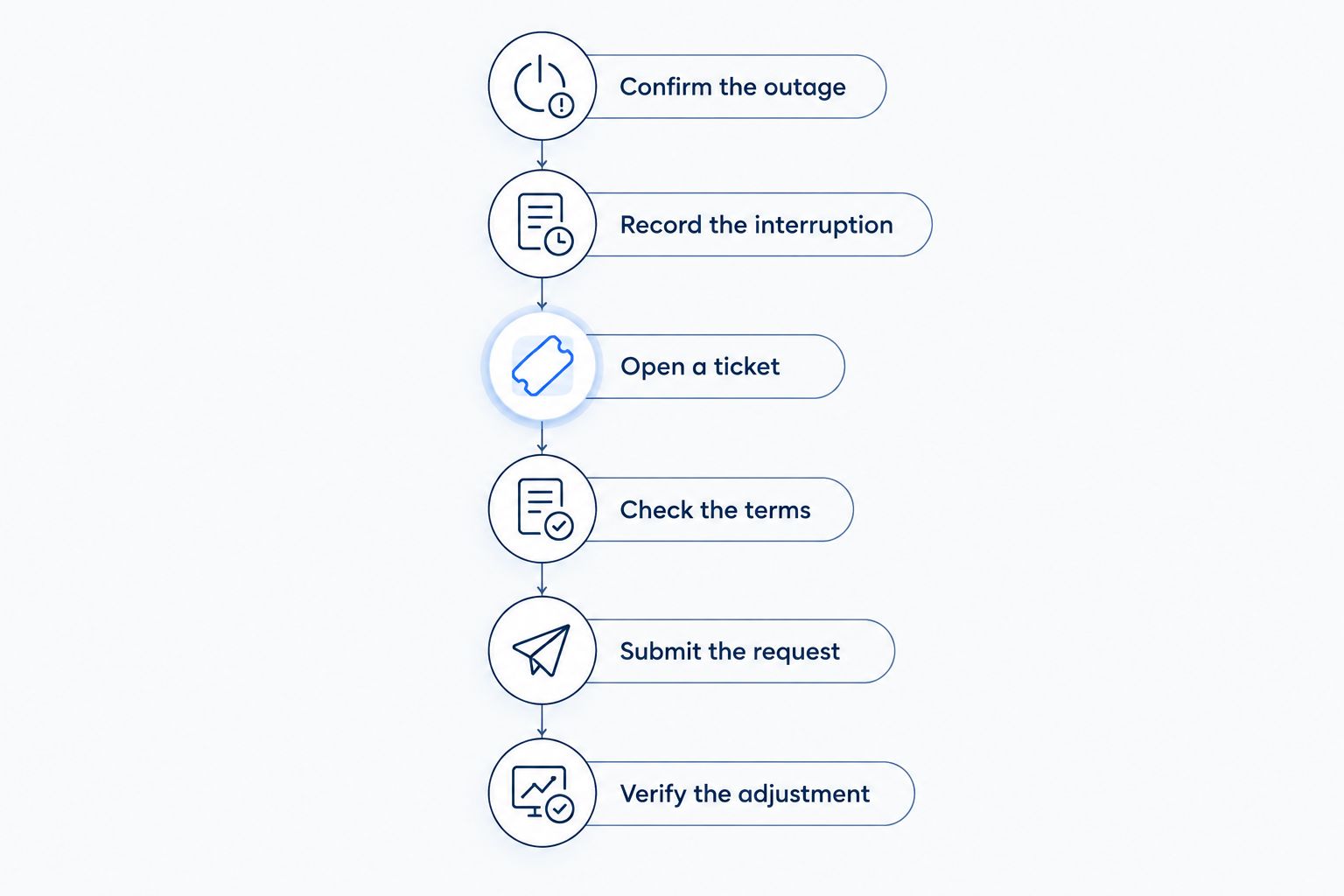
Use the following steps to build a clear request. You do not need a technical report. You need a record that connects your account, the interruption, and the adjustment you are asking the provider to review.
1. Confirm the outage
First, check whether the problem affects the connection or just one device. Try 2 devices and, if your equipment supports it, 1 wired connection through the router. These are diagnostic checks, not eligibility thresholds for a credit.
A working wired connection with failing WiFi points toward a local wireless problem. A failed wired connection still needs investigation; it does not identify the cause by itself. For a fuller troubleshooting sequence, see how to check whether your internet service is down.
2. Record the interruption
Write down when you first noticed the problem and when usable service returned. Include the date, local time, and time zone. Distinguish what you observed from what the provider confirmed.
For example, if you discovered the outage after waking up, record the discovery time rather than guessing when it began. If service returns briefly and then fails again, record those interruptions separately. That gives the provider a clearer timeline to compare with its incident records.
3. Open a ticket
Report the problem through the provider’s supported channel and save the ticket number. Explain whether all devices are affected, whether a wired test failed, and whether the equipment has power. Ask whether the provider has identified an outage affecting your address.
Do not rely on a neighbor’s report as the record for your own account. It supplies context, but your request needs to identify your service. Keep screenshots or messages confirming the interruption without assuming they replace the provider’s claim requirements.
4. Check the terms
Ask for the outage credit policy that applies to your service. Read its definition of a qualifying interruption, any exclusions, how downtime is measured, and the submission process. Ask for clarification wherever the wording does not match your situation.
If the policy sets a deadline, follow that deadline. Do not substitute a deadline found in another provider’s help article or a different service agreement. Your account’s terms are the reference point.
5. Submit the request
Send a concise request with your account details, incident dates, ticket number, and the affected service. Ask the provider to review eligibility and explain the decision in writing. Use an official support channel when sharing account information.
A request template you can adapt:
Please review my account for an outage-related billing adjustment. The affected service, interruption dates, and support ticket are listed below. Please confirm which policy applies, whether this incident qualifies, and how any approved adjustment will appear on my bill.
This asks for a decision without claiming an entitlement you have not established. Add your observations below it, including any uncertainty about the interruption’s exact start or end.
6. Verify the adjustment
If the request is approved, save the written confirmation and check the bill identified by the provider. Confirm which service the adjustment covers and whether the entry matches the approval. If it does not, follow up using the original ticket.
An approved adjustment and a posted adjustment are not the same record. Keep both. Do not assume that submitting a request changes a payment due date or authorizes you to withhold payment.
Why outage credit eligibility varies
The connection technology does not settle the billing question. For a 2026 request, check these factors in the terms governing your account:
- The covered service. Identify whether the claim concerns internet access, managed WiFi, phone, TV, or several services. Ask which policy covers each affected service.
- The definition of an outage. Complete loss of connectivity, degraded performance, and intermittent service are different conditions. Match your observations to the policy’s wording.
- The cause and exclusions. Check how the agreement treats maintenance, power interruptions, customer equipment, and other excluded events. Do not assume that any particular exclusion applies without reading it.
- The measurement method. Establish whether eligibility depends on provider records, your report, or another stated method. Your discovery time and the provider’s incident start time need not be identical.
- The claim requirements. Check the reporting channel, supporting information, and any submission deadline. An otherwise relevant incident still needs to follow the applicable process.
- The remedy. Read what an approved claim actually provides. A billing adjustment, refund, and payment for consequential losses are not interchangeable.
Use this list to ask focused questions. A provider’s answer should connect its decision to the applicable terms, rather than leave you guessing which part of the request mattered.
Is a residential outage credit different from a business SLA credit?
A residential credit request and a business SLA claim follow the terms of their respective accounts. A service-level agreement, or SLA, sets out defined service commitments and the associated remedies. The business label alone does not establish that your connection includes one.
If you operate a business in 2026, locate the actual agreement before describing an interruption as an SLA breach. Check the covered service, the measurement period, the exclusions, and the claim process. Marketing language about reliability does not replace those provisions.
A written SLA helps you evaluate a claim against stated conditions. Its limitation is equally important: the remedy is the remedy described in the agreement, not whatever loss your business experienced.
For a household, the practical task is more direct: report the outage and ask whether the applicable billing policy provides an adjustment. Keep the same quality of evidence, even without a formal SLA claim.
Does slow WiFi count as a fiber internet outage?
Slow WiFi alone does not establish a fiber internet outage. The wireless connection between your device and router is separate from the internet connection serving your property. Identify which part failed before describing the incident in a credit request.
If a laptop loses its video call while other devices remain connected, document that pattern. If both wired and wireless devices lose internet access, report that instead. The difference helps support investigate the right problem.
Managed WiFi is relevant when you want help with the wireless network as well as the internet service. Sumofiber is best suited to households and businesses seeking fiber internet and related services from one provider. Its stated service range includes managed WiFi, TV, home phone, and mobile; that range does not establish outage credit eligibility or compensation terms.
The benefit of considering those services together is that you can ask about your full setup when choosing service. The limitation is that you still need to confirm which service failed and which agreement governs the request.
Does an outage credit cover lost work or sales?
An internet billing adjustment does not automatically compensate you for lost work or sales. Do not treat a service credit as insurance against every effect of an interruption. Read the agreement’s remedy and liability provisions before claiming a broader payment.
If you run a business, keep operational losses separate from the service incident log. A record of missed appointments or interrupted transactions describes business impact; the outage record describes the connection failure. Neither record, by itself, establishes reimbursement.
For your next planning decision, separate two questions: what adjustment is available after an outage, and how you will keep essential tasks running during one. A credit addresses billing. A continuity plan addresses the interruption itself.
What should I do if the credit request is denied?
Ask for the reason in writing and the policy provision supporting the decision. Then compare that explanation with your timestamps, support ticket, and account terms. Challenge a specific mismatch, not just the fact that the outage was frustrating.
If the provider used a different interruption period, ask how it measured that period. If an exclusion was applied, ask which facts support it. If required information was missing, supply it through the stated process.
Keep the follow-up concise and request another review through the provider’s escalation process. Do not assume that a complaint guarantees a different outcome, and do not describe a discretionary adjustment as a contractual obligation unless the terms support that claim.
FAQ
Do I automatically get a credit when my fiber internet goes down?
An outage alone does not establish an automatic credit. Check the terms governing your account and ask whether the provider requires a separate billing adjustment request.
How much credit can I get for a fiber internet outage?
The applicable policy determines the adjustment for an eligible outage. Ask the provider to explain the calculation and identify the service charges covered.
Does Sumofiber give credits for internet outages?
Confirm outage credit eligibility directly with Sumofiber for your account. Ask for the applicable policy, required evidence, and the process for requesting a billing adjustment.
Can I request a credit if only my WiFi stopped working?
A WiFi failure alone does not prove that the fiber internet connection failed. Report the symptoms and check whether the affected service is covered by the applicable adjustment policy.
Do I need to report the outage before requesting a credit?
Follow the reporting requirements in your service terms. Reporting the interruption and saving the ticket number gives your billing request a clear incident reference.
Does business fiber internet always include an SLA?
Do not assume that business fiber internet includes an SLA. Check your agreement for defined service commitments, eligibility conditions, exclusions, and claim requirements.
Can an outage credit cover lost income from working at home?
A service credit does not automatically cover lost income. Check the agreement’s remedies and liability provisions rather than assuming an internet billing adjustment includes other losses.
One last thing
Check that the approved credit actually reaches your bill. For a 2026 outage claim, the useful final record is not just a support message saying the request was accepted. It is the approval plus the corresponding billing entry.
Save that pair with the incident ticket. If another interruption happens, you will have a clear record of the earlier decision without mistaking it for a guarantee about the next claim.