
Business internet does not automatically come with a guaranteed uptime SLA. An SLA applies only when your agreement states an availability commitment and explains how the provider measures downtime and handles a missed target. In 2026, ask for the written terms before you treat an advertised reliability claim as a guarantee.
- Does business internet come with an SLA? Not automatically; the written agreement decides.
- An uptime percentage means little until you check exclusions, measurement rules and remedies.
- SumoFiber business internet is worth discussing if you need internet, managed WiFi and phone service; confirm SLA terms separately.
- A second connection can keep critical work online during an outage, but it does not replace an SLA.
Why this matters
A restaurant can lose access to cloud-based tools while its dining room WiFi still appears connected. An office can keep its local network running while its internet connection is down. In either case, the question is not just how quickly someone answers the phone. It is what the provider has committed to do under your agreement.
SumoFiber offers internet service for households and businesses, alongside managed WiFi, phone, TV and mobile services. Those offerings do not, by themselves, establish an uptime SLA for a particular business connection. Get the terms for the service at your address in writing.
Does business internet come with a guaranteed uptime SLA?
No. Business internet comes with a guaranteed uptime SLA only if the applicable agreement includes one. The word business on a plan does not establish an availability target. Neither does a promise of responsive support.
| What the agreement says | What you can conclude | What to check next |
|---|---|---|
| No stated uptime commitment | You cannot claim a guaranteed uptime target from the agreement | Ask whether a separate SLA applies to your service |
| A stated availability target | You have a target to assess, subject to its terms | Check the measurement period and exclusions |
| A target plus a remedy | The agreement describes a response to a missed target | Check how to document downtime and request the remedy |
A target, a repair commitment and a remedy answer different questions. The target says how much availability the agreement promises. A repair commitment addresses response or restoration. A remedy says what happens if the provider misses a covered commitment. Read each clause rather than treating any one of them as a blanket promise that your business will never lose its connection.
What does an uptime percentage actually mean?
An uptime percentage needs a measurement period. In a hypothetical 30-day month, a 99.9% availability target allows 43.2 minutes of downtime under a simple calculation; a 99.99% target allows 4.32 minutes. These are illustrations, not SumoFiber commitments or quotes from any provider agreement.
The calculation is only a starting point. A contract can define when an outage begins, when it ends and which events count. If the contract excludes a period from its calculation, the percentage alone will not tell you whether that outage triggers a remedy.
| Illustrative target | Downtime in a 30-day month | What the figure does not tell you |
|---|---|---|
| 99.9% availability | 43.2 minutes | Whether the outage qualifies under the agreement |
| 99.99% availability | 4.32 minutes | Whether the agreement excludes maintenance or other events |
Use this arithmetic to understand a proposed term, not to infer one. If a sales page says reliable without stating an availability percentage, there is no percentage to calculate.
How to check an SLA before you sign
Ask for the document that applies to the specific connection you are considering. Then read it in this order:
- Find the availability target. Look for a stated percentage and the period over which it is measured. If there is no target, ask directly whether the service has an uptime commitment.
- Find the service boundary. Identify what the provider is promising to keep available. An internet access commitment is not automatically a promise about your WiFi, devices, applications or power supply.
- Read the exclusions. Check how the agreement treats maintenance, equipment at your premises and events outside the provider's stated responsibility. The wording controls what counts.
- Read the remedy process. Look for reporting requirements, deadlines and the remedy for a qualifying failure. A remedy you cannot request correctly is not useful when a connection fails.
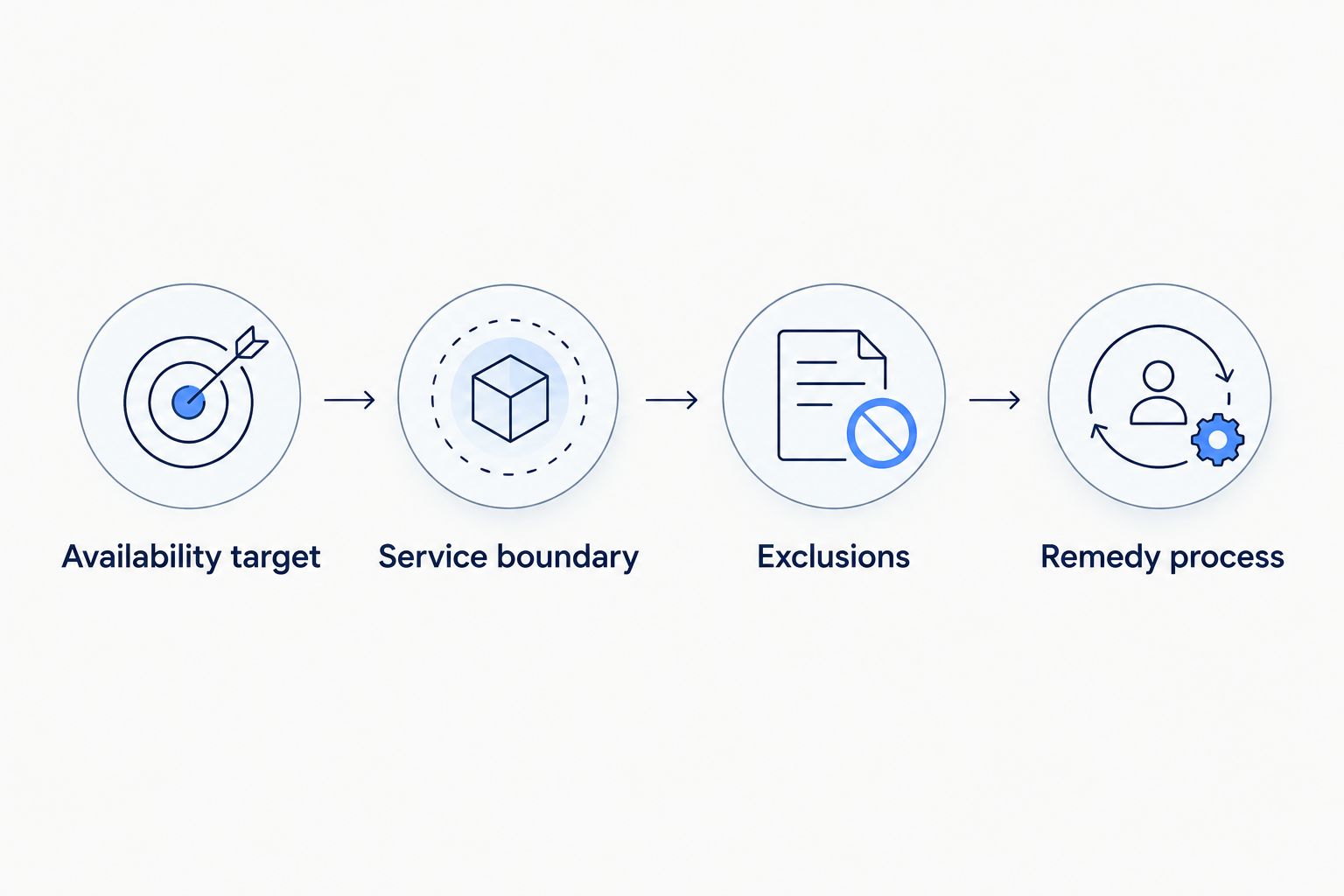
Keep the agreement where the person handling an outage can find it. In 2026, the useful question for a provider is precise: which written SLA applies to this address and service? Ask for the answer before an outage, not while your team is trying to get back online.
Check what the clock measures
Suppose staff report that a payment application stopped working. That does not, on its own, show that the internet circuit was unavailable under an SLA. The problem might sit with the application, a local device, the WiFi network or the connection itself. The agreement's service boundary determines which failures belong in its availability calculation.
Ask how the provider records the start and end of a covered outage. Also ask what evidence you need to supply. Your own incident log can record when staff first noticed a problem and when work resumed, but those times do not necessarily match the contract's measurement method.
Check what a remedy does not do
An SLA remedy does not restore a connection during an outage. If the agreement provides a service credit, that credit addresses a qualifying missed commitment after the event; it does not put a restaurant's systems or an office's calls back online. Read the actual remedy clause rather than assuming compensation will match your business interruption.
That distinction changes your next move. Use an SLA to hold a provider to defined terms. Use a continuity plan to decide how work carries on when the primary connection fails.
Why an uptime guarantee varies between agreements
There is no single SLA attached to every service called business internet. The terms that matter are specific to the agreement you receive:
- Availability target: A written percentage gives you a measurable commitment; an adjective such as reliable does not.
- Measurement period: A monthly target and a target measured over another period can produce different results for the same outage.
- Service boundary: The agreement determines whether it covers the access connection alone or another stated component.
- Exclusions: The contract defines which interruptions count toward missed availability.
- Reporting rules: The process can require you to notify the provider and submit a claim in a particular way.
- Remedy: The agreement states what you receive, if anything, when a qualifying commitment is missed.
Do not compare two percentages without comparing these clauses. A higher stated target with broad exclusions does not tell you more about your remedy than a lower target with clearly defined coverage. In 2026, put the terms side by side and mark every difference that would affect a real outage at your premises.
Does 24/7 support mean guaranteed uptime?
No. Round-the-clock support and guaranteed uptime are separate commitments. Support describes when you can reach someone; an uptime SLA defines an availability target and its conditions. One does not establish the other.
SumoFiber positions its business service around 24/7 human support. That can matter when you need to report a problem outside office hours. It is not evidence of a specific SumoFiber uptime percentage, repair deadline or outage remedy. Ask for each commitment separately and keep the written answers with your service agreement.
For a business that also needs managed WiFi or phone service, ask where support responsibility begins and ends. A connected device, a local WiFi issue and a loss of internet access are different problems. Knowing who handles each one helps staff report the fault clearly, even when only some of those components fall under an SLA.
Is an SLA enough for a business that cannot stop work?
No. An SLA sets contractual expectations; a backup connection is what gives you another route when the primary connection fails. Whether that route keeps a particular task working depends on your equipment and the services that task uses.
Write down which work must continue: taking payments, answering calls, reaching cloud applications or giving staff internet access. Then ask how each task behaves if the primary connection drops. A backup that helps staff open web pages is not, by itself, proof that every phone or payment workflow will continue.
You can also decide who reports the outage and who checks whether a remedy applies. Those are separate jobs. The first gets the problem in front of support; the second checks your rights under the written agreement after the event. In 2026, test your continuity plan against the work people actually do, not just the status light on a router.
What should you ask before choosing business internet?
Start with the service you need at your address, then ask for the applicable terms. A short, direct list keeps the conversation focused:
- Does this specific business internet service include an uptime SLA?
- Where is the availability target written, and what measurement period applies?
- Which equipment and parts of the connection fall within the promise?
- What interruptions are excluded?
- How do I report an outage and request a remedy?
- Who supports the WiFi and phone services if I use them alongside internet access?
SumoFiber is a fit to discuss when your business wants internet alongside managed WiFi or phone service, but its SLA terms must be confirmed for the service you choose. That is the useful verdict: assess the service mix and support, then judge any guarantee by the agreement itself. Do not let one answer stand in for the other.
Check the service options
Review SumoFiber services, then ask which written SLA applies to your business connection.
If you receive proposed terms, have the person responsible for outages read them too. The agreement should answer questions they will face under pressure: what counts as down, who they contact and what record they need to keep. A percentage without those instructions is hard to use.
FAQ
Does business internet come with an SLA in 2026?
Not automatically. Business internet has an uptime SLA only when the applicable written agreement includes one; check the target, exclusions and remedy.
Is a business internet SLA the same as guaranteed uptime?
No. An SLA states a commitment under defined conditions; it does not prevent every outage. Read what qualifies as downtime and what happens if the provider misses the target.
What does 99.9% uptime allow in a 30-day month?
A 99.9% target allows 43.2 minutes of downtime in a hypothetical 30-day month under a simple calculation. The agreement determines which interruptions count toward that total.
Does 24/7 support mean my connection has an SLA?
No. Support hours tell you when help is available, not whether the provider has made an uptime commitment. Ask for the separate written SLA.
Does SumoFiber guarantee business internet uptime?
No SumoFiber uptime guarantee is established by the information on this page. Ask which written SLA, if any, applies to the business service at your address.
Will an SLA cover an outage of my office WiFi?
Only if the agreement covers that part of your service and the failure meets its terms. An internet access SLA does not automatically cover local WiFi equipment or devices.
Do I still need backup internet if I have an SLA?
Yes, if your business needs another connection to keep working during an outage. An SLA defines contractual terms; it does not provide a live replacement for a failed connection.
One last thing
The most useful SLA question is not which provider prints the highest percentage. It is whether the written promise covers the failure that would stop your business. For SumoFiber or any other provider in 2026, ask someone to show you that clause before you decide.