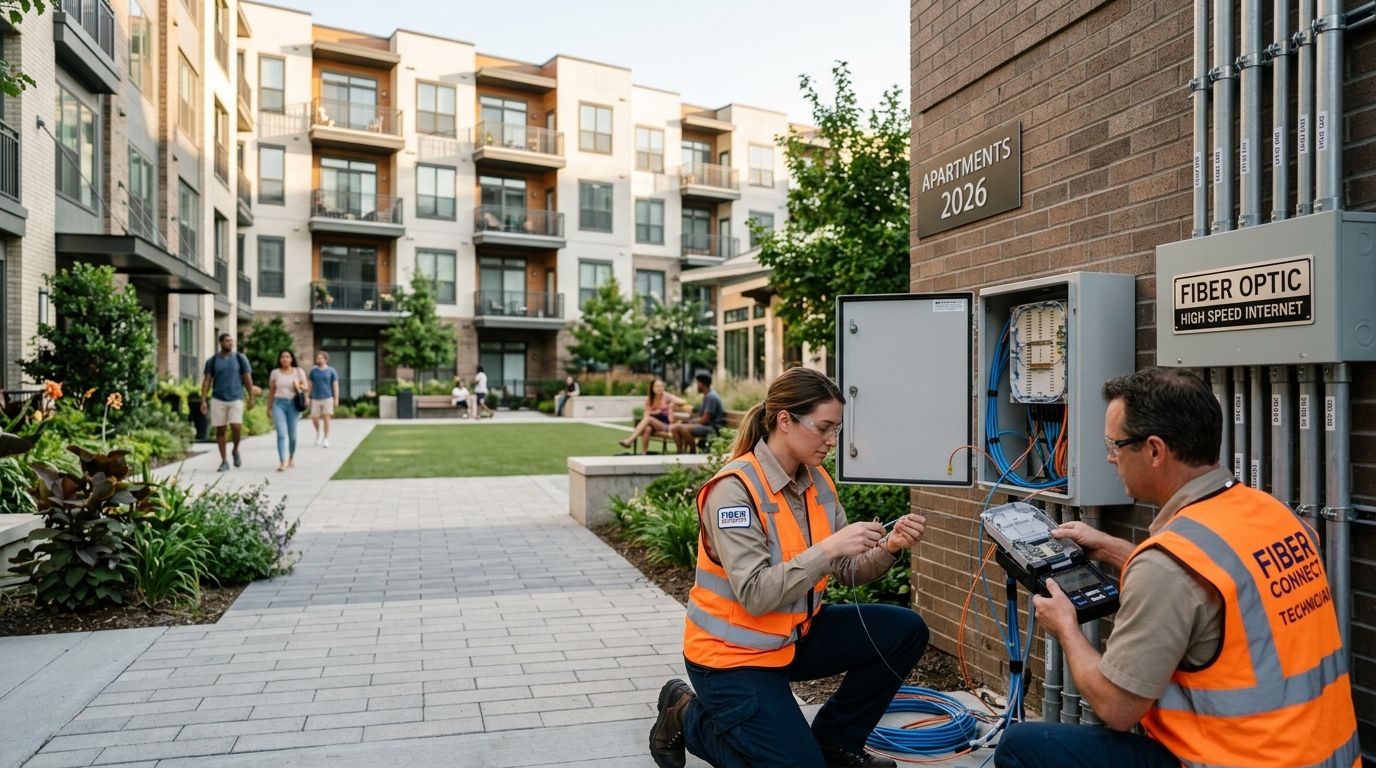
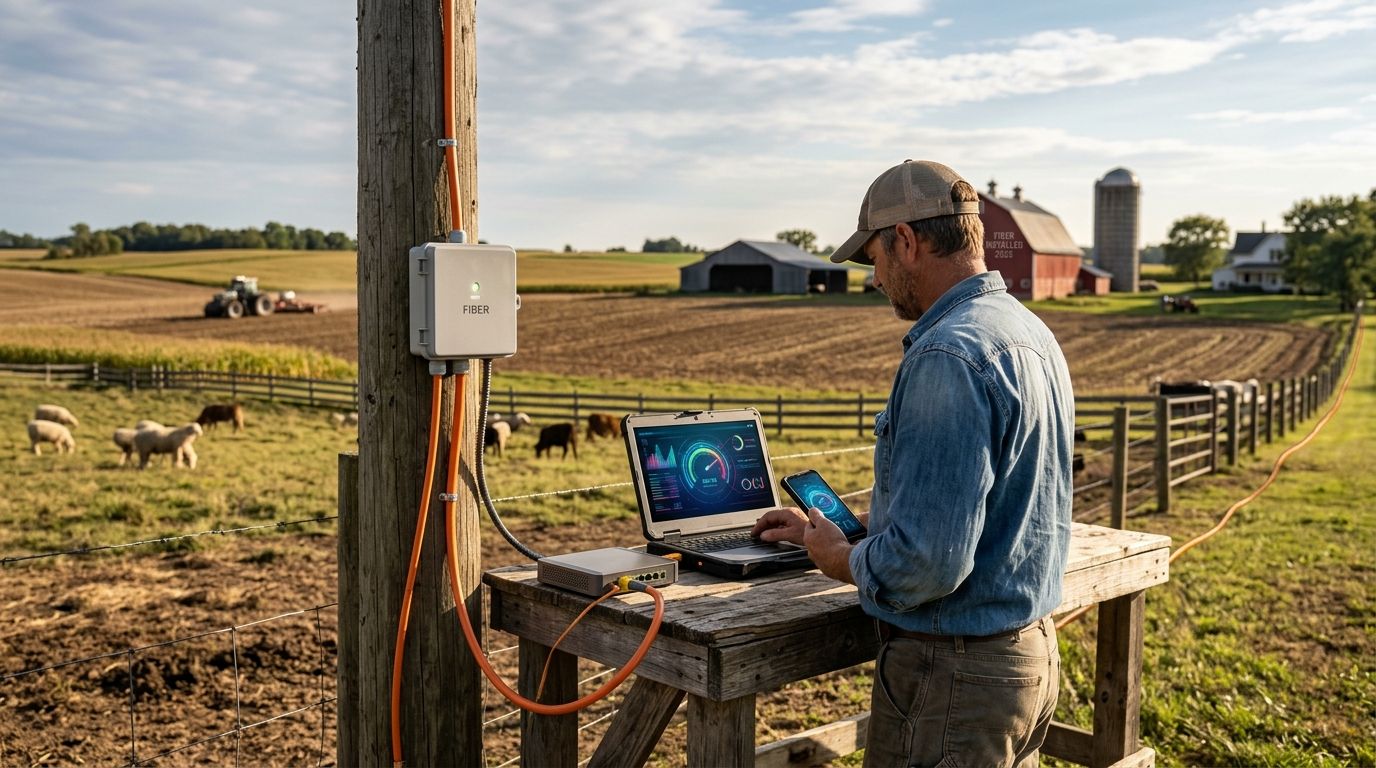
Fiber internet for farms and ranches means running a wired, symmetrical connection out to a rural property so barns, fields, and the farmhouse office all get the same real bandwidth, not the leftover signal from whatever tower or satellite happens to reach the property line. Farm and ranch operations need more than a Netflix-friendly connection: security cameras on equipment sheds, livestock monitors, soil sensors, a POS system for the roadside stand, and video calls with a lender or vet all run at once, often from buildings that are hundreds of yards from the house.
- Fiber internet for farms and ranches beats satellite and fixed wireless on upload speed and storm reliability.
- SumoFiber runs on open-access fiber networks across Utah, Idaho, Montana, Colorado, California, Wisconsin, Illinois, and New York.
- Match bandwidth to actual devices on the property, not just headcount, before picking a plan.
- Managed WiFi extended to barns and outbuildings solves more dead zones than a stronger router ever will.
- No contracts and no data caps matter more on a ranch than raw speed numbers.
Why fiber internet matters for farms and ranches
A farm's internet load doesn't look like a suburban household's. One property might run a calving camera at 2 a.m., a grain bin sensor at noon, and a video call with an ag lender at 4 p.m. — all on the same connection, often with nobody around to reboot anything.
The FCC's current broadband standard is 100 Mbps download and 20 Mbps upload, set specifically because upload speed lags on most rural connections. Satellite and fixed wireless can hit the download number on a good day; they struggle with the upload number, and upload is what a security camera, a video call, or a cloud-synced yield map actually needs.
Fiber runs the same speed both directions. That single fact is why a ranch running four cameras and a video call at once won't watch everything stutter the way it would on satellite.
Fiber internet for farms and ranches is the only connection type built to handle upload-heavy, always-on rural operations without a data cap forcing a slowdown mid-month.
How to get reliable internet on a farm or ranch
Audit your property's connectivity gaps
Before buying anything, walk the property and find out where signal actually dies. Most farms discover the barn 300 feet from the house has never had usable WiFi — nobody just checked.
- Use a free WiFi analyzer app to map signal strength room by room and building by building
- Note every location where a camera, sensor, or POS terminal needs to sit
- Flag buildings with metal siding or concrete — both block WiFi signal hard
- Check cell coverage separately, since it becomes your backup plan
- Write down distances between the router location and each dead zone
Size your bandwidth for actual farm tech load
Don't buy a plan based on how many people live in the house. Count devices.
- Add up simultaneous video streams, since security cameras run 24/7, not just when someone's watching
- Count IoT sensors: soil moisture, grain bin monitors, livestock trackers, irrigation controllers
- Include POS and inventory systems if you sell direct from the farm
- Factor in remote work, because video calls need consistent upload, not just download
- Plan for growth: a farm adding two more cameras next year needs headroom now
Get wired fiber to the house and main outbuildings
This is where the manual approach hits a wall — you can't run fiber cable yourself, but you can control what happens once it's on the property. SumoFiber connects the house and primary outbuildings on a wired, symmetrical line rather than relying on line-of-sight wireless that a snowstorm or a stand of trees can knock out.
- Confirm the fiber drop point reaches the main house, not just the property edge
- Ask whether the barn or shop closest to the house can get its own wired run
- Check for open-access fiber networks already built in the area, since many rural counties have one
- Verify installation includes the fiber terminal placement you actually want, not wherever's convenient
Extend coverage to barns, fields, and equipment sheds
Once the wired backbone is in, the remaining dead zones need engineering, not guesswork.
- Point-to-point wireless bridges carry a fiber signal to a barn hundreds of feet away without trenching new cable
- Mesh access points placed every 150 to 200 feet indoors close most remaining gaps
- Managed WiFi service handles the placement math and monitors uptime so nobody's climbing a ladder during harvest
- Outdoor-rated access points survive the temperature swings a farm building sees across a Utah or Montana winter
A managed WiFi setup from a provider like SumoFiber removes the guesswork here. It's the difference between buying five routers and hoping, versus a system designed around the property's actual layout.
Check fiber availability for your property
See if fiber and managed WiFi reach your farm or ranch today.
Add backup and redundancy for critical operations
No connection is down-proof. The question is what happens to the one system you can't afford to lose — the security cameras during calving season, or the payment terminal on a Saturday market run.
- Keep a cellular hotspot charged and ready as a manual failover
- Put the router and fiber terminal on a small battery backup so a power blip doesn't also kill internet
- Identify the single system that can't go down and give it priority on the network
- Test the failover once a season, not the first time it's actually needed
Set up remote monitoring and management tools
A farm's internet often has nobody watching it during the day. Set it up so problems get caught before they cost a sale or a herd check.
- Enable router alerts for outages or unusual usage spikes
- Use camera apps that send a notification when a feed drops, not just when motion triggers
- Note who you call and when, because a provider with 24/7 human support matters more on a ranch than a chatbot
- Confirm phone and mobile service run through the same provider so one outage doesn't take down calling too
If a security camera buffers for ten seconds during calving, that's ten seconds a rancher doesn't get back.
Comparing internet options for farms and ranches
| Option | Best for | Key limitation |
|---|---|---|
| Fiber internet | Symmetrical upload and download, cameras, remote work | Requires a wired build to the property |
| Fixed wireless | Properties just outside a fiber build zone | Line-of-sight issues, weather sensitivity |
| Satellite internet | Properties with no wired or wireless option nearby | High latency, weak upload speed |
| DSL | Backup connection or low-bandwidth single use | Speed drops sharply with distance from the hub |
| Cellular or 5G home internet | Mobile backup, temporary setups | Data caps, coverage gaps in remote fields |
Verdict: fiber wins for any farm or ranch running cameras, sensors, or a business off the same connection. Satellite and fixed wireless are backups, not replacements.
Common mistakes farms and ranches make
- Sizing bandwidth by people, not devices. A four-person household with 12 IoT sensors and six cameras needs a different plan than a four-person household with none.
- Putting the router in the farmhouse office and calling it done. The barn 400 feet away never gets checked until a camera drops during lambing.
- Treating satellite as good enough for video calls. Satellite's latency makes real-time calls with a lender or vet choppy even when the download speed looks fine on paper.
- Skipping a failover plan for the one system that can't go down. Herd monitoring and POS systems fail quietly until the moment they're needed most.
- Committing before confirming coverage reaches every building. Confirm the fiber build reaches the shop and the barn, not just the house.
FAQ
What's the best internet option for a farm or ranch in 2026?
Fiber internet is the best option when it's available, because it delivers the same speed uploading and downloading, which is critical for cameras, sensors, and video calls. Where fiber hasn't reached yet, fixed wireless is the next best option over satellite.
Is fiber internet available in rural areas?
Fiber reaches many rural areas through open-access networks built by local utilities and providers, though coverage varies by county. SumoFiber runs on these networks across Utah, Idaho, Montana, Colorado, California, Wisconsin, Illinois, and New York.
How much bandwidth does a farm need?
Bandwidth needs depend on device count, not headcount, because cameras, sensors, and POS systems each add continuous load. A property running four security cameras plus daily video calls needs meaningfully more upload bandwidth than a household streaming video alone.
Can fiber internet support precision agriculture sensors?
Yes, fiber's low latency and symmetrical speed handle continuous sensor data from soil moisture monitors, grain bin sensors, and livestock trackers without the lag satellite introduces. Sensors sending frequent small updates depend more on consistent latency than on raw download speed.
Is satellite internet better than fiber for ranches?
No, satellite internet has higher latency and weaker upload speeds than fiber, which shows up during video calls and camera uploads. Satellite works as a backup where no wired connection reaches the property, not as a primary choice when fiber is available.
Does SumoFiber offer service to farms outside city limits?
SumoFiber serves households and businesses across Utah, Idaho, Montana, Colorado, California, Wisconsin, Illinois, and New York, including properties on open-access rural fiber networks. Coverage depends on whether fiber has been built to that specific address.
What happens if my internet goes down during calving or harvest season?
A cellular hotspot kept charged as backup, plus a router on battery power, keeps critical systems like cameras and monitoring running through a short outage. Providers with 24/7 human support resolve outages faster than ones that only staff daytime hours.
Do I need a contract for rural fiber internet in 2026?
No, contracts are not required everywhere in 2026, and no-contract plans let a seasonal operation change service without a penalty. Confirm contract and data cap terms before installation rather than after.
One last thing
Most farms fix the house connection and never touch the barn, then wonder why the calving camera drops every night. The fix isn't a stronger router, it's wiring or bridging the outbuilding separately so it doesn't depend on WiFi punching through 400 feet of open air and a metal roof. That one change does more for a 2026 farm network than any speed upgrade.