
Fiber internet's monthly cost depends far more on which speed tier and contract terms you choose than on the technology itself. Entry-level, mid-range, and gig-plus tiers are priced differently, and add-ons like equipment rental or bundled TV and phone service shift the total that actually lands on your bill. The advertised rate rarely tells the whole story — promotional pricing that expires, installation charges, and equipment fees are the hidden costs that catch most buyers off guard in 2026.
- Fiber internet cost per month depends on speed tier, contract length, and bundled services — not a single industry-wide rate.
- SumoFiber prices fiber internet with no contracts and no data caps across its eight-state footprint in 2026.
- Equipment rental and installation fees add to the rate quoted at sign-up — ask what's included before you commit.
- Bundling fiber internet with TV, phone, or mobile typically lowers the effective per-service cost versus buying each separately.
Why this matters
Most buyers compare fiber internet providers on one number — the advertised monthly rate — and miss the terms that change what they actually pay after month one. A promotional rate that jumps after twelve months, a router rental fee added line-by-line, or an early termination penalty on a locked contract can turn a good-looking offer into a worse deal than a straightforward no-contract internet plan.
Fiber internet itself isn't inherently pricier than cable — the gap is mostly about tier and provider, not the fiber-optic line. Understanding what actually drives the number on your invoice lets you compare offers correctly instead of comparing headline rates that don't include the same things.
How much does fiber internet cost per month?
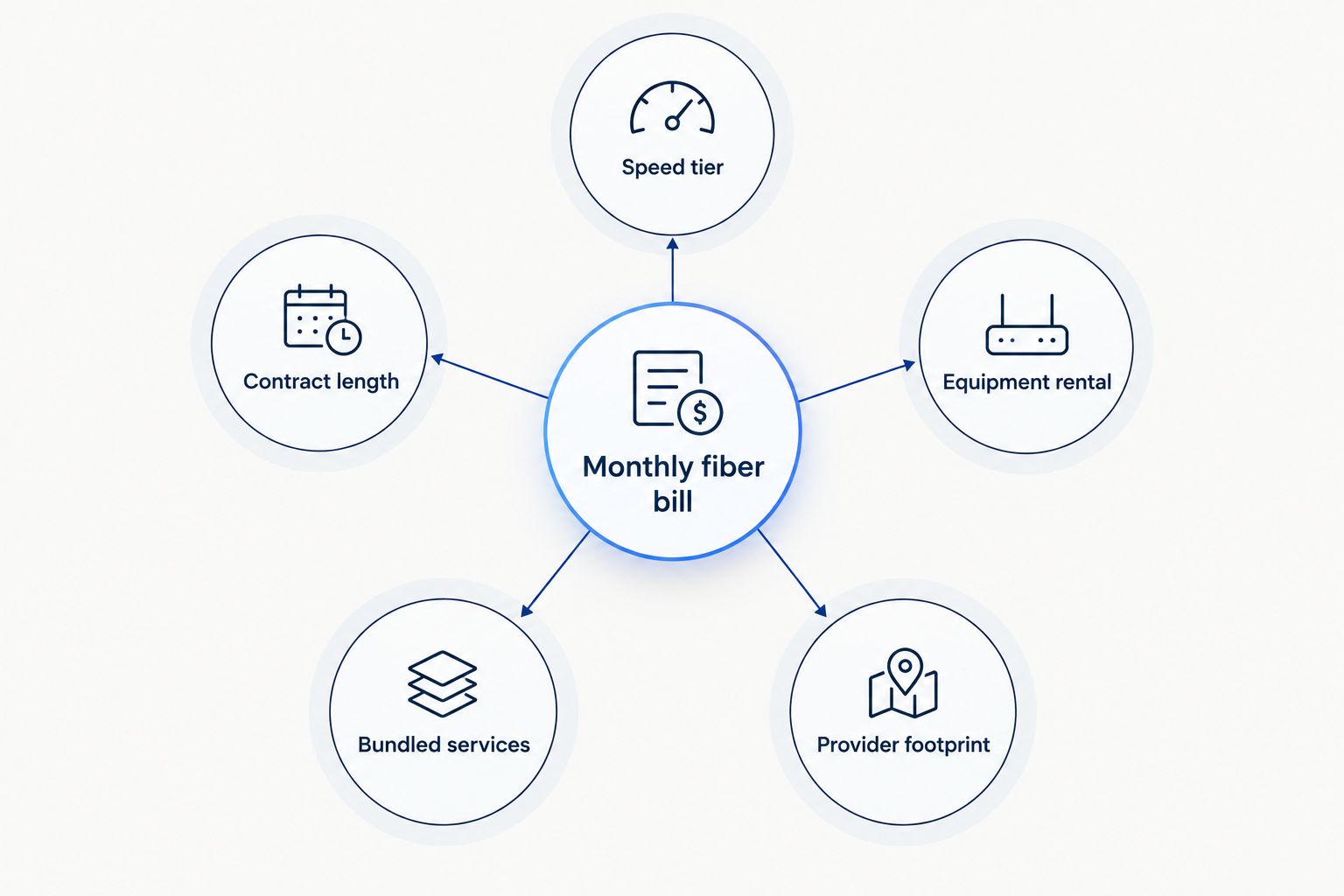
The honest answer: it varies by speed tier, contract structure, and what's bundled in, and providers don't standardize what counts as "included." Here's what typically moves the number on your bill:
| Factor | What it does to your bill | Best for |
|---|---|---|
| Speed tier | Higher tiers (1 Gig, 2 Gig) cost more than entry-level (300-500 Mbps) | Households vs. multi-device offices |
| Contract length | No-contract plans avoid termination fees but may skip promo pricing | Renters, people who move often |
| Equipment/WiFi rental | Router and managed WiFi fees can be billed separately or included | Anyone comparing two "similar" quotes |
| Bundled services | TV, phone, and mobile bundled with internet often costs less than standalone | Households already paying for multiple services |
| Provider footprint | Markets with more fiber competition tend to see sharper pricing | Buyers in newly built fiber areas |
Entry-level speed tiers: what you get
Entry-level fiber tiers, generally in the 300-500 Mbps range, cover a household that streams, works from home on video calls, and runs a handful of connected devices without a lot of simultaneous 4K streaming or competitive gaming. This tier is where you'll find the cheapest fiber internet providers advertising their lowest rates, but confirm the rate holds after any introductory period. Verdict: Buy for single-person households and light-use families.
Mid-range speed tiers: the most common pick
Mid-range tiers, typically 500 Mbps to 1 Gig, are the default recommendation for most households in 2026 — multiple people streaming in 4K, gaming, and working from home simultaneously without buffering. This is where most fiber providers put their best price-to-speed ratio. Verdict: Buy for households with 3+ connected people or a home office plus a streaming household.
Premium speed tiers: built for heavy households and small offices
2 Gig and above tiers are aimed at power users, smart-home-heavy households, or small businesses running point-of-sale, VoIP, and guest WiFi off one connection. The jump in monthly rate from 1 Gig to 2 Gig is usually smaller than the jump from entry-level to mid-range, since the fiber infrastructure cost is largely fixed. Verdict: Hold unless you're actually running multiple heavy workloads — most homes don't need it, but small offices comparing business internet providers ranked by price should look here.
Why fiber internet cost varies
A handful of factors explain most of the gap between two "similar" fiber internet quotes:
- Speed tier selected — entry-level, mid-range, and 2 Gig-plus tiers are priced as separate products, not a sliding scale.
- Contract vs. no-contract pricing — locked-in rates sometimes trade a lower promo price for an early termination fee if you cancel.
- Equipment and managed WiFi fees — some providers fold router rental into the base rate; others bill it as a line item.
- Installation and setup charges — one-time fees at sign-up vary by address and whether the line is already run to the building.
- Bundled services — combining internet with TV, home phone, or mobile can lower the per-service cost versus paying for each separately, as shown on pages comparing internet and TV bundles.
- Market competition — areas with more than one fiber provider tend to see more aggressive pricing than single-provider markets.
Compare fiber internet plans by tier
See SumoFiber's residential and business fiber options across all eight states.
Is fiber internet cheaper with no contract?
No-contract fiber internet isn't always cheaper month-to-month, but it removes the risk of an early termination fee if you move or switch providers — a real cost that a locked contract's lower advertised rate can hide. SumoFiber runs its residential and business fiber internet with no contracts and no data caps, which means the rate you're quoted doesn't change because you used more bandwidth in a given month. If you compare two offers and one requires a term commitment, factor in what breaking it early would cost before assuming it's the better deal.
Does bundling internet, TV, or phone lower your monthly rate?
Bundling fiber internet with TV, home phone, or mobile service generally lowers what you pay per service compared to buying each separately, since providers often discount bundled packages to keep more of a household's spending under one bill. SumoFiber offers fiber internet, managed WiFi, TV, home phone, and mobile as separate or combined services, so the math is worth running against what you're currently paying across multiple providers. Not every household needs every service, so bundle only what you'll actually use.
What fees show up beyond the advertised rate?
Equipment rental, professional installation, and promotional rates that reset to a standard rate after an introductory period are the three most common line items that show up beyond the number in a provider's ad. Ask directly whether WiFi equipment is included, whether installation is a one-time charge tied to your address, and whether the quoted rate is permanent or promotional before you sign up — the answer changes what your real monthly cost looks like after the first bill.
FAQ
Is fiber internet more expensive than cable in 2026?
Fiber internet isn't inherently more expensive than cable in 2026 — pricing depends more on speed tier and provider than the underlying technology. Entry-level fiber tiers often compete directly with mid-tier cable plans on price.
Does fiber internet require a contract?
Not always — SumoFiber offers fiber internet with no contracts, meaning you can cancel without an early termination fee. Some providers still require a term commitment in exchange for a lower promotional rate.
What hidden fees show up on a fiber internet bill?
Equipment rental, one-time installation charges, and promotional rates that expire after an introductory period are the most common hidden costs on a fiber internet bill. Ask upfront whether these are included in the quoted rate.
Is bundling internet and TV cheaper than buying them separately?
Bundling internet with TV, phone, or mobile typically costs less per service than paying for each one separately, since providers discount packages to consolidate a household's spending. Only bundle services you'll actually use.
Do all fiber providers charge equipment rental fees?
No — some providers include a router or managed WiFi in the base rate, while others bill it as a separate monthly line item. Confirm which model a provider uses before comparing two quotes side by side.
How much speed do I actually need for the price I'm paying?
Most households do well on a mid-range tier between 500 Mbps and 1 Gig; entry-level tiers around 300 Mbps suit single-person or light-use homes. Only heavy multi-device households or small offices typically need 2 Gig or above.
Is fiber internet available in rural areas at the same rate as cities?
Availability and pricing both depend on whether fiber infrastructure has been built to a specific address, which varies more in rural areas than in cities. Check a provider's coverage for your exact address rather than assuming a citywide rate applies.
One last thing
The fastest way to spot a bad fiber internet deal in 2026 isn't the advertised rate — it's asking what happens to that rate after month twelve. A plan with no contract and no data caps, like SumoFiber's residential and business fiber internet, avoids that cliff entirely because there's no promotional rate to expire in the first place.