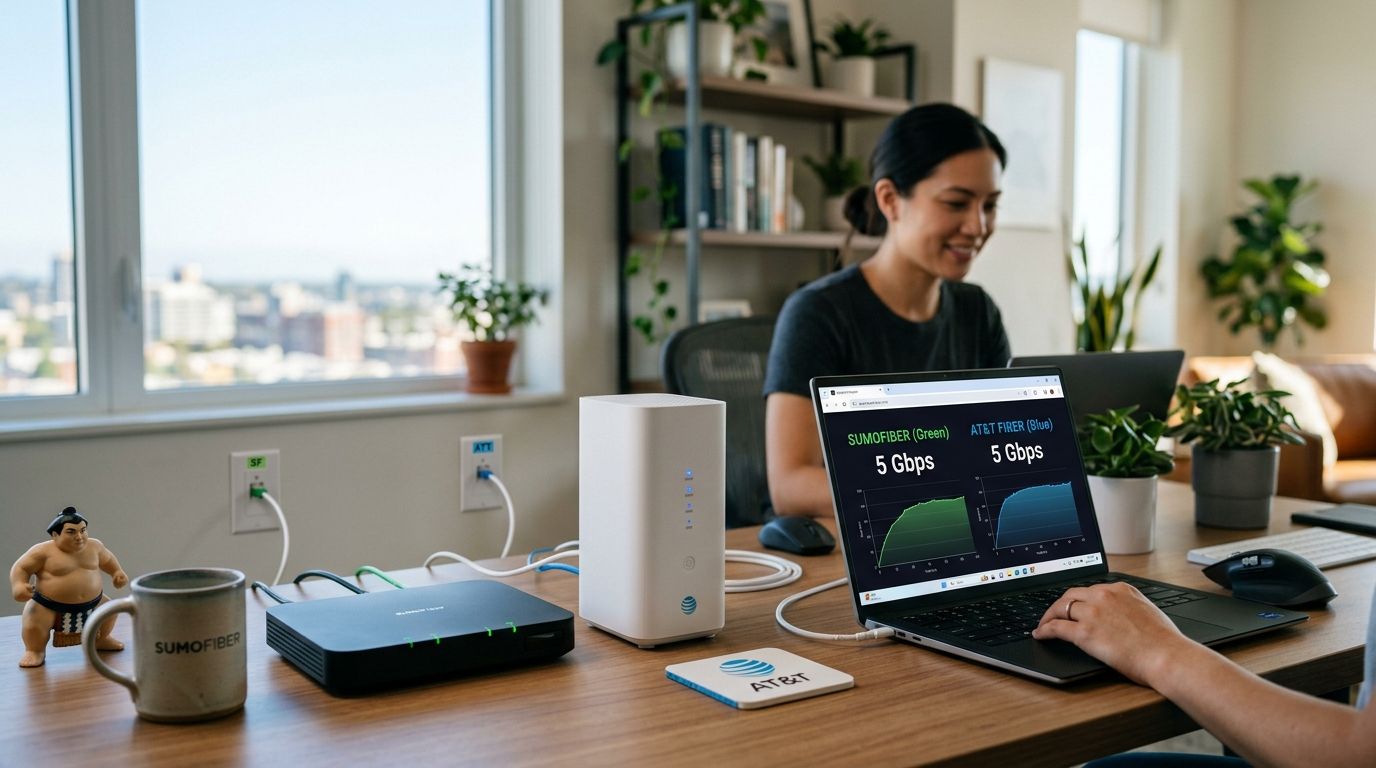
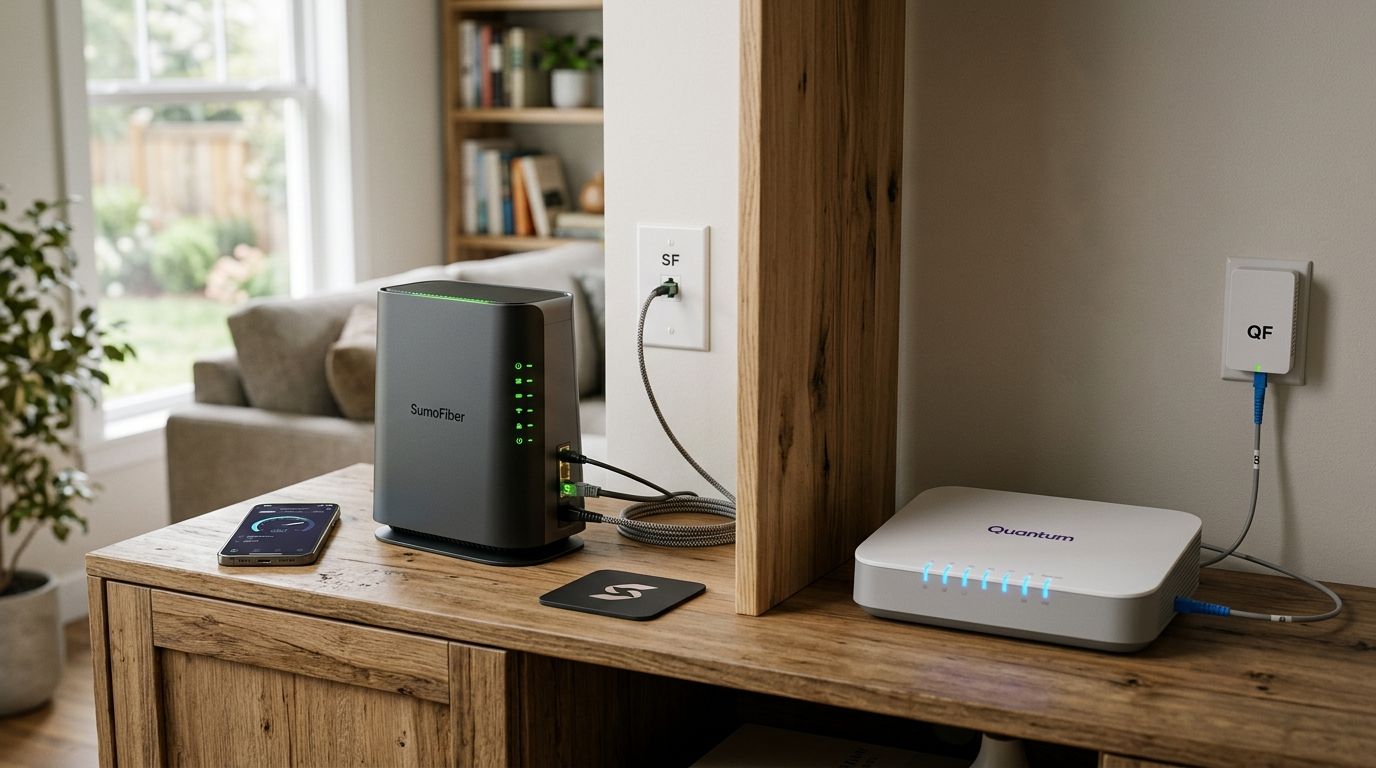
SumoFiber and Quantum Fiber are both fiber-optic providers building fixed-price, no-annual-contract internet plans, but they compete on different ground: choose SumoFiber if you live in one of its build-out states (Utah, Idaho, Montana, Colorado, California, Wisconsin, Illinois, or New York) and want a real person answering support calls at 2am; choose Quantum Fiber if you're in a metro area where Quantum has laid fiber and you want a nationwide-brand name on the bill. Neither company wins on every front, and the right pick in 2026 comes down to where you actually live and how you use support.
- SumoFiber vs Quantum Fiber in 2026 comes down to footprint and support model, not raw speed.
- SumoFiber runs no-contract, no-data-cap plans with 24/7 human phone support across 8 states.
- Quantum Fiber's edge is metro-market density in cities where Lumen has already built fiber.
- Bundling matters: SumoFiber pairs internet with managed WiFi, TV, home phone, and mobile in one bill.
- Business customers should compare managed WiFi and phone-system support, not just download speed.
Why this matters
Fiber internet plans all look similar on a spec sheet: symmetrical up/down speeds, no data caps, no long-term contract. The differences that actually affect your day-to-day are coverage, what happens when something breaks, and whether you're paying four separate vendors or one.
If you're comparing SumoFiber vs Quantum Fiber because you moved, switched providers, or your bill got confusing, the decision usually hinges on three things: is the provider actually available at your address, do you need more than internet (TV, phone, mobile), and how much do you value talking to a person instead of a chatbot when the WiFi drops during a work call. For a wider look at what else is available in your area, the quantum fiber alternatives roundup covers more than these two.
At a glance: SumoFiber vs Quantum Fiber
| Dimension | SumoFiber | Quantum Fiber |
|---|---|---|
| Best for | Households and businesses in UT, ID, MT, CO, CA, WI, IL, NY wanting one bill for everything | Renters and homeowners inside Quantum's built-out metro fiber zones |
| Contract terms | No annual contracts, no data caps | Marketed as no annual contract in most fiber markets |
| Coverage footprint | 8 states, residential and business | Select metro markets tied to Lumen's fiber build-out |
| Customer support model | 24/7 human phone support | Standard business-hours plus digital support channels |
| Bundled services | Internet, managed WiFi, TV, home phone, mobile | Internet-first, limited bundling in some markets |
| Business internet | Dedicated business plans and managed WiFi for offices | Business fiber plans in select markets |
| Standout feature | One provider for internet, WiFi, TV, phone, and mobile | Backed by a large, established telecom parent brand |
| Pricing model | Flat monthly rate, no data caps | Flat monthly rate, no data caps in most markets |
SumoFiber wins on support availability (by a lot)
When your internet goes down at 11pm before a deadline, hold time is the whole ballgame. SumoFiber staffs support around the clock, so a dropped connection during a late shift or an early-morning video call gets a live person, not a queue that opens at 8am. That matters more in smaller towns across Montana or Idaho, where a local outage doesn't always climb to the top of a national queue.
Quantum Fiber's support runs on more conventional hours in most markets, backed by large telecom infrastructure. That's a fine tradeoff if your issues are rare and self-service tools handle most of what you need.
Both handle core fiber speed reliably
Fiber-optic lines from either provider deliver symmetrical upload and download performance, which is the main reason fiber beats cable or DSL for video calls, cloud backups, and multiplayer gaming. Neither company changes the underlying physics: a fiber connection with enough headroom handles a household of streamers and remote workers without one device choking another. If speed for a specific use case is your top concern, the fiber internet providers comparison breaks performance down by use case.
SumoFiber offers more bundled services
This is the clearest split between the two. SumoFiber packages internet with managed WiFi, TV, home phone, and mobile service, so a household or small business can consolidate every connectivity bill into one provider. Quantum Fiber, in most of its markets, leads with internet as the core product and doesn't match that breadth of bundled TV, phone, and mobile in one account.
If you're running a restaurant's guest WiFi and a back-office phone line, or a household juggling four streaming devices and a landline for grandma, fewer vendors means fewer places for something to go wrong.
“The provider that answers the phone at 11pm on a Tuesday is the one that matters when your WiFi drops mid-shift.”
Quantum Fiber has the edge in metro market density
Quantum Fiber's build-out has concentrated on larger metro areas tied to Lumen's existing infrastructure, which in some cities means it reaches more buildings and multi-unit properties than a regional fiber provider can match yet. If you live in one of those metro zones and SumoFiber doesn't serve your address, Quantum Fiber is a legitimate no-contract fiber option worth checking.
SumoFiber's footprint is concentrated across specific communities in Utah, Idaho, Montana, Colorado, California, Wisconsin, Illinois, and New York, including smaller cities and rural stretches that larger national providers sometimes skip. Check the best rural internet providers list if a metro fiber build hasn't reached your address yet.
Both skip contracts and data caps
Neither provider locks you into a term commitment or throttles you for using too much data in a billing cycle, which puts both ahead of cable providers still selling 12- and 24-month contracts with early termination fees. If contract flexibility is your top filter, either name clears that bar in 2026. For a dedicated look at every no-contract option, see best internet providers with no contract.
Pricing model: predictability vs. flexibility
Both providers use flat monthly pricing with no data caps, so your bill doesn't spike because your teenager binge-watched a season of something over the weekend. Rates vary by plan tier, promotional period, and location — check the current pricing on each provider's site before you commit, and confirm whether an introductory rate increases later.
What's worth comparing beyond the sticker number: does the monthly rate include equipment, is managed WiFi bundled or an add-on, and does a mobile line bundled with internet actually save you money versus running two separate bills.
Check SumoFiber availability at your address
See plans for internet, WiFi, TV, phone, and mobile in one account.
Final verdict
Choose SumoFiber if: you live in Utah, Idaho, Montana, Colorado, California, Wisconsin, Illinois, or New York, you want internet, managed WiFi, TV, home phone, and mobile under one provider, and you value a real person on the phone at any hour. That fits a family running multiple streaming and work-from-home devices, or a small business that can't afford a WiFi outage during business hours in 2026.
Choose Quantum Fiber if: you live in one of Quantum's established metro fiber markets outside SumoFiber's footprint and you're comfortable running internet as a standalone service with TV, phone, and mobile handled elsewhere. That fits a renter in a dense metro building who mainly wants a fast, no-contract internet line and no bundled extras.
Scorecard recap
| Dimension | Winner |
|---|---|
| Support availability | SumoFiber |
| Core fiber speed | Tie |
| Bundled services (TV, phone, mobile) | SumoFiber |
| Metro market density | Quantum Fiber |
| No contract / no data cap | Tie |
| Rural and small-town coverage | SumoFiber |
FAQ
Is SumoFiber better than Quantum Fiber in 2026?
SumoFiber is the stronger pick if you're in one of its 8 states and want internet bundled with managed WiFi, TV, phone, and mobile plus 24/7 human support. Quantum Fiber can be the better call in metro markets outside SumoFiber's footprint.
Does SumoFiber have data caps or contracts?
No. SumoFiber runs no annual contracts and no data caps across its residential and business internet plans in 2026.
Which states does SumoFiber serve?
SumoFiber serves households and businesses in Utah, Idaho, Montana, Colorado, California, Wisconsin, Illinois, and New York as of 2026.
Can I bundle TV and phone with SumoFiber internet?
Yes. SumoFiber offers managed WiFi, TV, home phone, and mobile service alongside internet, so households can consolidate into one bill.
How much does SumoFiber or Quantum Fiber cost?
Pricing varies by plan tier, location, and promotional offers for both providers. Check current pricing directly on each provider's site before signing up.
Is Quantum Fiber available in the same areas as SumoFiber?
Not typically. Quantum Fiber's build-out concentrates on select metro markets, while SumoFiber focuses on communities across its 8-state footprint, including smaller cities and rural areas.
Does SumoFiber offer 24/7 support?
Yes. SumoFiber provides round-the-clock human phone support, which matters most when an outage hits outside normal business hours.
Which provider is better for a small business?
SumoFiber's business plans bundle managed WiFi and phone service in one account, which simplifies vendor management for a small office compared with running separate providers for internet, WiFi, and phone.
One last thing
The detail people miss when comparing SumoFiber vs Quantum Fiber: it's rarely a speed fight. Both run fiber, both skip data caps, both skip long contracts in 2026. The real difference shows up during an outage, when one company's support desk is staffed at 3am and the other isn't — and for households or businesses that can't afford downtime, that single detail decides more than any spec sheet.