
Best overall: AT&T Fiber. Best for large uploads: Google Fiber. Best for existing Verizon households: Verizon Fios. For households comparing fiber with managed WiFi, include Sumofiber in your search, but confirm the plan’s data policy before choosing it as a no-cap option in 2026.
- AT&T Fiber is the default pick among internet providers with no data caps for everyday household use.
- Google Fiber suits upload-heavy households; Verizon Fios suits households already considering Verizon services.
- Sumofiber offers fiber internet and managed WiFi; confirm the selected plan’s data policy before ordering.
- Unlimited data does not guarantee unlimited speed, whole-home WiFi coverage, or permission for every business use.
Why this matters
A data cap limits how much data you transfer during a billing period. A speed limit controls how quickly you transfer it. Removing the first does not remove the second.
That distinction matters when someone is uploading work files while the kids stream and a console downloads an update. You need enough speed for simultaneous activity, but you also want a plan that does not make you ration monthly usage.
Choose a no-cap plan for freedom from a monthly allowance—not as a promise that every connection problem disappears. The provider comparison below separates those questions so you can choose the right service in 2026.
What makes the best internet providers with no data caps?
Use these criteria before comparing names:
- An explicit residential data policy. Look for a statement that the selected plan has no monthly data cap. A large allowance is not the same thing.
- Clear service identification. Fiber, cable, fixed wireless, and mobile plans from the same company can have different terms.
- Useful upload capacity. Video meetings, cloud backups, and sending large files need upload speed, not just downloads.
- Manageable home networking. Your router and its placement determine whether the connection reaches the rooms where you use it.
- Support and service fit. Decide whether you want internet alone or help coordinating WiFi, TV, phone, and mobile services.
- Separate contract checks. No data cap does not automatically mean no contract, no equipment obligations, or unrestricted business use.
For your 2026 shortlist, treat the first two criteria as pass-or-fail checks. Use the remaining criteria to choose between plans that pass.
No-cap internet providers at a glance
| Provider | Best for | Standout feature | Key limitation |
|---|---|---|---|
| AT&T Fiber | Everyday households wanting a straightforward default | Residential fiber service has no monthly data cap | The recommendation does not extend to every AT&T internet product |
| Google Fiber | Households sending large files and running cloud backups | Unlimited data with symmetrical speeds on applicable fiber plans | Check the exact plan’s upload speed rather than assuming every tier is identical |
| Verizon Fios | Households already considering Verizon services | Fiber home internet without a monthly data cap | Fios and Verizon wireless home internet are different services |
| Sumofiber | Households comparing fiber and managed WiFi together | Residential fiber, managed WiFi, and other household services | Confirm the selected plan’s data policy before treating it as a no-cap choice |
The first three recommendations concern the providers’ residential fiber services. The fourth is a conditional service-fit recommendation, not a substitute for checking its plan terms.
1. AT&T Fiber: best no-cap internet for everyday households
AT&T Fiber is the default recommendation for a household that wants to stream, work, download games, and back up devices without tracking a monthly data allowance. AT&T’s residential fiber data policy provides unlimited internet data.
The important word is Fiber. Do not apply the same conclusion to every service carrying the AT&T name; check the service type on the order summary.
AT&T Fiber pros:
- No monthly data cap on residential fiber service.
- Fiber plans suit households combining uploads and downloads.
- A straightforward starting point when your priority is removing the monthly usage allowance.
AT&T Fiber cons:
- The no-cap recommendation is specific to fiber, not every AT&T access service.
- Unlimited data does not fix weak WiFi in a distant bedroom or upstairs office.
- You still need to compare the selected plan’s upload speed, equipment terms, and service conditions.
Best for: Families and shared households that want a general-purpose home connection without monthly data budgeting.
Before ordering, read the plan’s Broadband Facts label alongside its service terms. The label helps you compare speeds and data allowances without relying on a headline alone. Save the documents associated with the plan you select.
Verdict: Buy AT&T Fiber if its plan fits your household and the order confirms the expected no-cap terms.
2. Google Fiber: best no-cap internet for large uploads
Google Fiber is the strongest fit here for people who regularly send large files, sync cloud storage, or back up a household’s devices. Google Fiber’s residential service includes unlimited data, and applicable fiber plans provide symmetrical upload and download speeds.
Symmetry matters because sending files can otherwise become the bottleneck. A fast download figure alone does not tell you how quickly a work project leaves your computer.
Google Fiber pros:
- Unlimited data supports repeated backups and large transfers without a monthly allowance to manage.
- Symmetrical speeds on applicable plans make upload performance easier to compare.
- A clear fit for households whose internet use involves creating and sending, not just watching.
Google Fiber cons:
- Check the selected tier’s specifications; do not assume every plan has identical upload and download speeds.
- Your device, router, and connection method can limit actual transfer speed.
- A faster connection does not overcome limits imposed by the cloud service receiving your files.
Best for: Photographers, video creators, and remote workers moving large files from home.
For a useful comparison, list the tasks that send data: cloud backup, file sharing, video calls, and security-camera uploads. Then compare upload specifications directly. That exercise is more useful than choosing solely by the biggest download number.
Verdict: Buy Google Fiber when large uploads are the deciding factor and the selected plan matches that need.
3. Verizon Fios: best no-cap internet for Verizon households
Verizon Fios is the natural comparison for households already considering Verizon services and wanting fiber home internet without a monthly data cap. Fios is a wired fiber service; it is not another name for Verizon’s wireless home internet products.
Keep the home internet decision separate from the mobile decision. A familiar provider name makes comparison easier, but it does not replace reading each service’s terms.
Verizon Fios pros:
- Residential Fios internet does not impose a monthly data cap.
- A fiber connection fits households combining streaming, work calls, and downloads.
- An obvious service to evaluate alongside an existing Verizon relationship.
Verizon Fios cons:
- Fios policies should not be assumed to apply to Verizon’s mobile or wireless home internet services.
- A shared provider name does not guarantee that all services share one set of conditions.
- Whole-home WiFi performance still depends on equipment and placement.
Best for: Households that want to evaluate Verizon fiber alongside their other Verizon services.
Ask for the exact service name on the order confirmation. Then check its data allowance, upload speed, equipment requirements, and cancellation terms independently of any mobile plan. Keeping those checks separate prevents an unlimited phone plan from becoming an accidental substitute for understanding your home connection.
Verdict: Buy Verizon Fios when you specifically want Verizon’s fiber service, not merely a Verizon-branded connection.
4. Sumofiber: best service-fit comparison for managed WiFi
Sumofiber offers residential and business fiber internet, managed WiFi, TV, home phone, and mobile services. That makes it relevant when your decision includes the connection inside the home as well as the line coming into it.
Sumofiber is best for households comparing fiber internet and managed WiFi from one provider. Confirm the selected internet plan’s monthly data policy before putting it on your final no-cap shortlist.
Sumofiber pros:
- Fiber internet and managed WiFi are both part of its service offering.
- Residential and business services give you separate options to discuss for home and work needs.
- TV, home phone, and mobile services are relevant if you want to compare several household services together.
Sumofiber cons:
- The selected plan’s data policy needs confirmation before a no-cap recommendation.
- A broader service offering does not establish what is included in an individual internet plan.
- Managed WiFi and internet access address different needs; ask what each service covers.
Best for: Households that want to compare fiber internet and help managing their home WiFi together.
Describe the actual problem when asking about service. A television that buffers in a back room is a different issue from a monthly usage allowance. Ask about both, rather than assuming an unlimited-data plan resolves either automatically.
Verdict: Hold until the selected plan’s data policy and managed WiFi scope match your requirements.
What “no data cap” does—and does not—mean
A no-cap plan removes the monthly data allowance. It does not promise unlimited bandwidth, identical performance on every device, or exemption from acceptable-use rules.
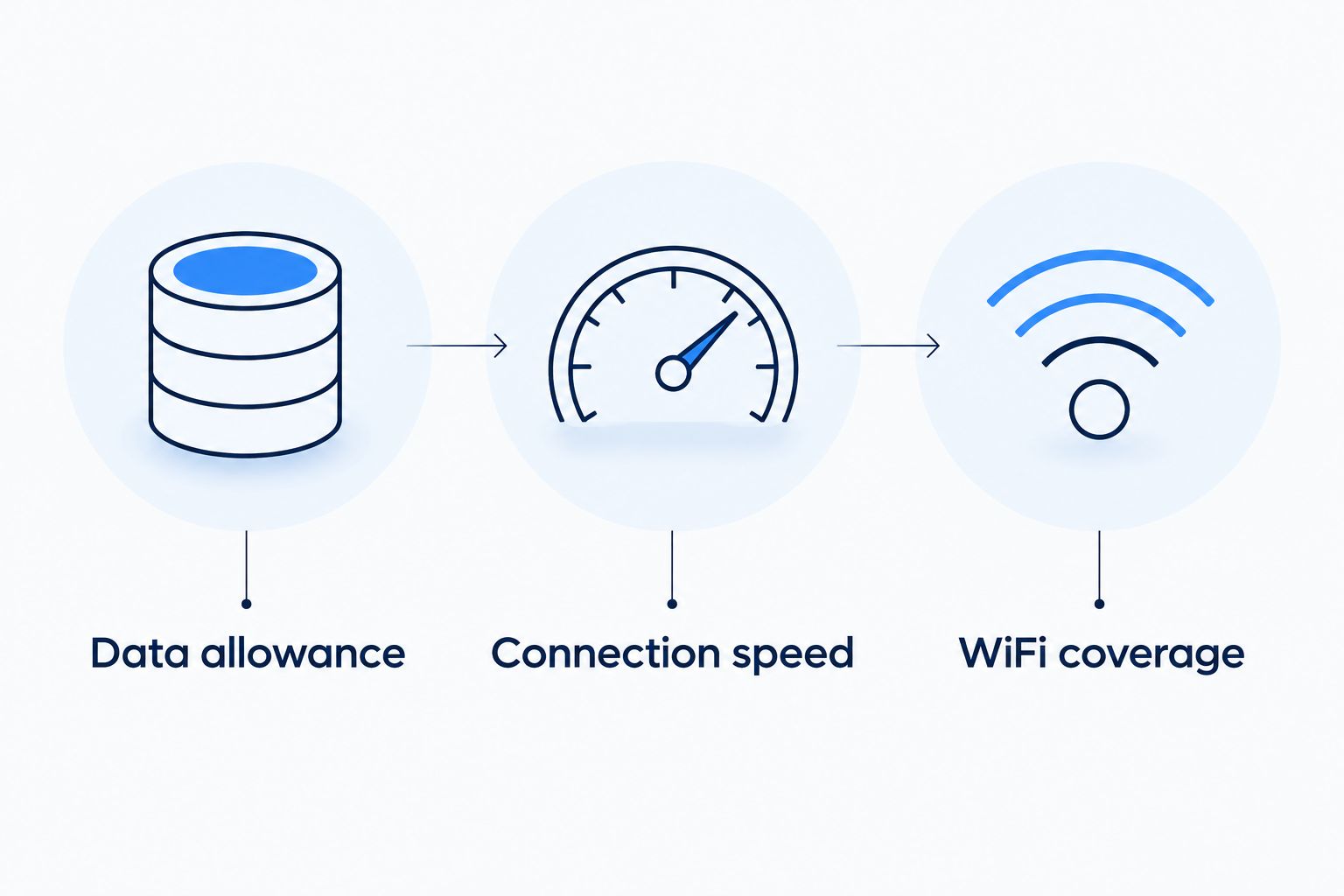
Keep these three ideas separate:
- Data allowance: How much you transfer during the billing period.
- Connection speed: How quickly the connection transfers data.
- WiFi coverage: How well your wireless network reaches your devices.
The units help you tell them apart. There are 8 bits in 1 byte. A 100 Mbps connection therefore has a theoretical transfer rate of 12.5 MB/s, before network overhead and other limits.
A monthly allowance uses a quantity such as GB or TB instead. Under decimal units, 1 TB equals 1,000 GB. Neither figure tells you whether the router reaches your kitchen.
For your 2026 comparison, ask what happens after heavy usage as well as whether a cap exists. A monthly allowance, traffic-management policy, and acceptable-use policy answer different questions.
How to check a plan before ordering
Use this sequence for every provider, even when its website says unlimited:
- Identify the service. Confirm fiber rather than assuming the company’s other internet products follow the same policy.
- Read the data allowance. Check the Broadband Facts label and the terms attached to the selected plan.
- Check usage conditions. Ask about usage-based restrictions, traffic management, and residential-use rules.
- Match the household. Compare uploads, simultaneous activity, WiFi coverage, and support needs.
- Save the confirmation. Keep the plan details and order summary together.
In 2026, the useful question is not just whether a provider sells unlimited internet. It is whether your selected service has no monthly allowance and fits how your household uses it.
How we ranked
The ranking prioritizes explicit no-cap residential fiber policies, then separates recommendations by household need. AT&T Fiber takes the general-purpose slot; Google Fiber takes upload-heavy use; Verizon Fios takes the existing-Verizon comparison.
The managed WiFi candidate remains conditional on its selected plan’s data policy. This is a policy-and-service-fit comparison, not a measured speed, outage, or customer-satisfaction ranking.
Which no-cap internet provider should you choose?
Start with AT&T Fiber if you want a default for everyday home use. Choose Google Fiber when uploading large files drives the decision, or compare Verizon Fios when you already want Verizon services.
If home WiFi management is the bigger problem, compare that service separately rather than buying more speed by reflex. Keep any candidate off your final no-cap shortlist until its plan terms confirm the data policy.
FAQ
What's the best internet provider with no data caps in 2026?
AT&T Fiber is the default recommendation here for everyday household use. Google Fiber is the stronger fit for upload-heavy households, while Verizon Fios suits households already considering Verizon services.
Does unlimited internet mean unlimited speed?
No. Unlimited data concerns how much you transfer, while your plan's speed determines how quickly you transfer it. Devices, WiFi, and the receiving service also affect performance.
Do all fiber internet plans have no data caps?
Do not assume every fiber plan has no data cap. Check the selected plan's Broadband Facts label and service terms for its monthly data allowance.
Is Sumofiber a no-data-cap option?
Confirm the selected Sumofiber plan's data policy before choosing it as a no-cap option. Compare managed WiFi separately if you also need help with wireless coverage inside your home.
Is no data cap the same as no contract?
No. A data allowance and a contract commitment are separate terms. Check both before ordering rather than treating unlimited data as a promise about cancellation conditions.
Will unlimited internet stop my TV from buffering?
Not by itself. Buffering can involve connection speed, WiFi coverage, device performance, or the streaming service. Removing a monthly data cap does not fix those problems.
Can I use unlimited residential internet for my business?
Check the residential service terms before using it for business purposes. Unlimited data does not automatically permit hosting servers or provide business support commitments.
One last thing
Before you replace a connection because it feels slow, compare a wired Ethernet test with WiFi in the room where the problem happens. A clear difference points you toward the home network rather than the monthly data allowance.
For your final 2026 decision, separate unlimited usage from a well-functioning home network. You need both—not one mistaken for the other.