
Yes, fiber internet handles multiple gamers and streamers running at the same time because it carries symmetrical upload and download speeds and latency low enough that one heavy connection doesn't starve the others. The bottleneck almost never shows up on the fiber line itself in 2026 — it shows up in an underpowered router, a weak Wi-Fi signal reaching the bedroom where the console sits, or an internet plan that never accounted for upload traffic in the first place.
- Fiber internet handles multiple gamers and streamers because upload and download speeds are symmetrical, unlike cable.
- A household with 4-5 people gaming and streaming at once typically needs 100-200 Mbps of combined bandwidth in 2026.
- Latency, not raw speed, is what makes online games feel laggy when someone else starts a 4K stream.
- SumoFiber pairs fiber lines with managed WiFi so bandwidth gets split evenly instead of hogged by one device.
- A cheap router is the most common reason a fast fiber plan still feels slow with several people online.
Why this matters
Most households in 2026 aren't running one device at a time. A teenager streaming a match on Twitch, a partner on a video call, a kid watching a show in 4K, and a smart TV doing background updates all pull from the same connection simultaneously. Cable and DSL connections split that load unevenly because their upload speeds are a fraction of download speeds — so the moment someone streams or uploads gameplay, everyone else's latency spikes.
Fiber doesn't have that asymmetry problem. Checking a gaming-focused internet provider before you sign a contract tells you more about real-world performance than a headline speed number ever will.
Can fiber internet handle multiple gamers and streamers at once?
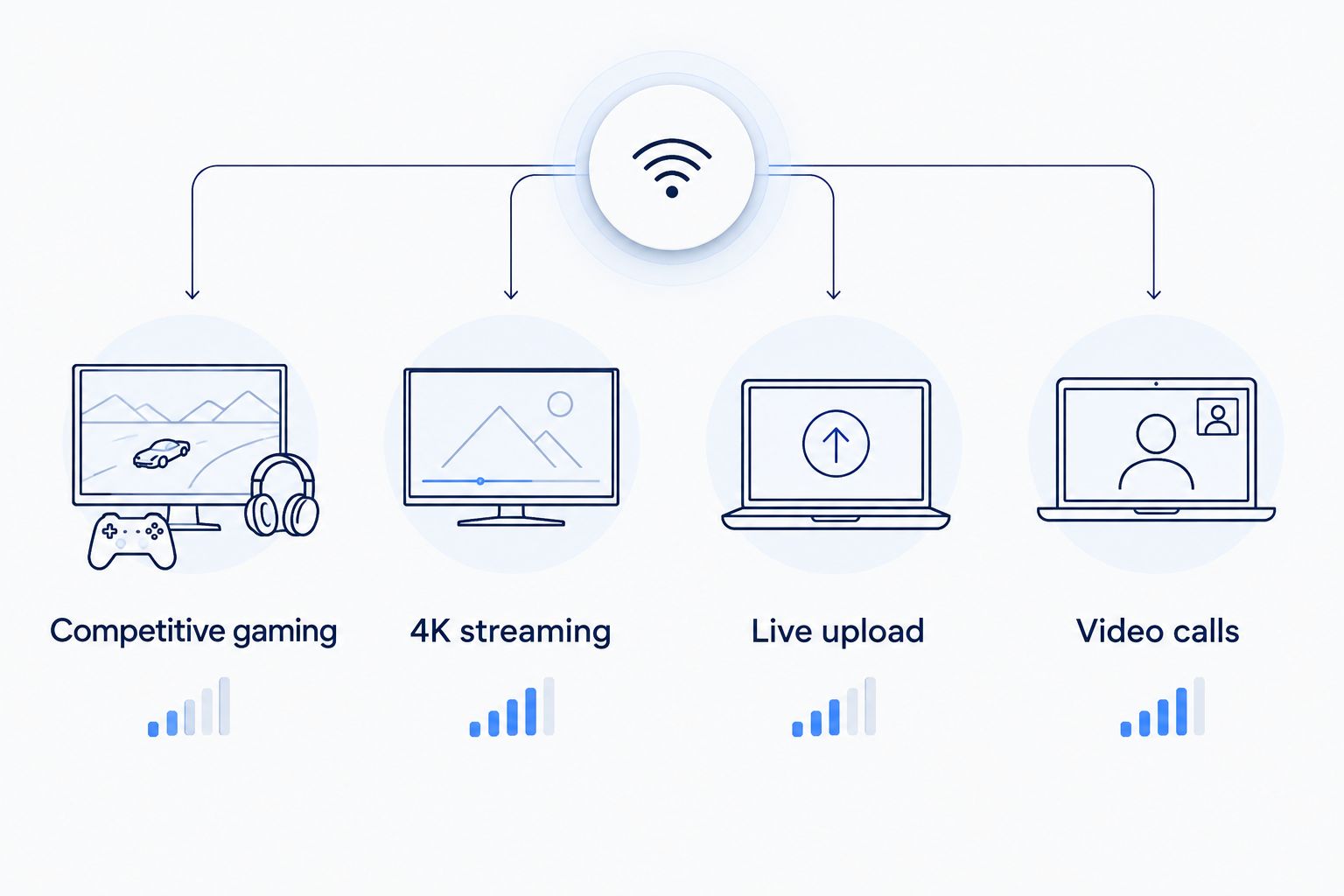
Here's the breakdown by activity, based on published per-stream and per-session bandwidth benchmarks used across the industry in 2026:
| Activity | Typical bandwidth need | Latency sensitivity |
|---|---|---|
| Competitive online gaming | 3-6 Mbps download | High — needs low, stable latency |
| 4K video streaming | 15-25 Mbps download per stream | Low — buffers instead of lagging |
| Live streaming/uploading gameplay | 5-10 Mbps upload | High — upload speed is the limit |
| Video calls | 1-4 Mbps up and down | Medium |
Stack a few of these together and the math adds up fast. Two people gaming, one person streaming in 4K, and someone on a video call lands you around 40-55 Mbps of simultaneous demand — comfortably inside what a mid-tier fiber plan delivers, but often more than a legacy cable connection can hold steady without buffering or lag spikes.
1-2 gamers or streamers: under 50 Mbps needed
A single gamer paired with one 4K streamer needs roughly 20-30 Mbps combined, well under what most fiber plans offer even at entry tiers. Verdict: any fiber plan handles this load without a second thought.
3-4 gamers or streamers: 50-100 Mbps needed
This is the range where cable connections start to strain, especially if someone is uploading or live streaming rather than just watching. Fiber's symmetrical upload keeps latency steady even with four devices pulling at once. Verdict: fiber is the right call here; cable is a gamble.
5+ gamers or streamers: 100-200 Mbps needed
Household or shared-living situations with several consoles, a couple of streamers, and background devices push combined demand toward 150-200 Mbps. At this level, the router matters as much as the plan — a fiber connection feeding a weak router still bottlenecks. Managed WiFi that actively balances device load, rather than a router that just broadcasts a signal, closes that gap. Verdict: fiber plus managed WiFi, not fiber alone.
See if fiber covers your household load
Check gaming-focused fiber options in your area for 2026.
Why bandwidth needs vary from house to house
- Number of simultaneous heavy users — two gamers pull less than five gamers plus a streamer, obviously, but the jump from 3 to 5 users is where most connections start to show it.
- Upload-heavy activity — watching a stream costs almost nothing on upload; broadcasting one costs 5-10 Mbps that a lot of plans never budget for.
- Router age and Wi-Fi congestion — a five-year-old router struggling to manage device handoffs will bottleneck a fast connection long before the fiber line does.
- Distance from the router — a console two rooms away on Wi-Fi sees more packet loss than one plugged into ethernet, regardless of plan speed.
- Background devices — smart TVs, doorbell cameras, and phones doing automatic updates quietly eat bandwidth nobody accounts for.
- ISP network congestion at peak hours — some providers oversubscribe their local nodes, so speeds dip in the evening even when your plan says otherwise.
Does fiber internet lag when multiple people are gaming?
Fiber internet shouldn't lag when multiple people game because its latency stays low and consistent even under load, unlike cable connections where latency climbs as more devices compete for the same limited upload channel. Lag during shared gaming is far more often caused by a congested router or Wi-Fi interference than by the fiber line itself. If lag appears only when someone else starts streaming, the fix is usually the router's traffic handling, not the internet plan.
How much upload speed do you need for streaming and gaming at the same time?
You need roughly 5-10 Mbps of upload speed to live stream gameplay smoothly while someone else games on the same connection, since gaming itself uses very little upload bandwidth. Cable plans often cap upload speeds at a fraction of their download speeds, which is exactly where multi-user households run into trouble. Fiber's symmetrical design means the upload side isn't an afterthought.
“Upload speed, not download speed, is what breaks first in a house with more than one gamer or streamer.”
Is fiber better than cable for multiple gamers?
Fiber is generally better than cable for multiple gamers because it delivers matched upload and download speeds and steadier latency under simultaneous load, while cable's shared-node architecture and asymmetric speeds make it more prone to slowdowns during peak hours. For a single gamer with no other heavy users on the network, the difference is smaller. For three or more simultaneous heavy users, fiber's advantage becomes noticeable within the first evening of use.
Will a router upgrade fix lag before I switch providers?
A router upgrade fixes lag caused by device congestion or weak Wi-Fi coverage, but it can't add bandwidth a plan doesn't have — if you're already maxing out a slower connection, a new router won't create capacity that isn't there. Managed WiFi services that automatically flag when a device drops off the network catch the router-side problems before they turn into a support call. Checking whether your WiFi setup alerts you to dropped devices is a faster diagnostic step than assuming the internet plan is the problem.
One last thing
The household that complains loudest about lag in 2026 is rarely the one with the most gamers — it's the one with the oldest router pushed past its device limit. Before upgrading a fiber plan, run a quick speed test to see what your WiFi is actually delivering to each room, because a plan bump won't fix a signal that never reaches the console in the first place.
FAQ
Can fiber internet handle multiple gamers and streamers at once?
Fiber internet handles multiple gamers and streamers at once because it delivers symmetrical upload and download speeds and steady latency under load. A household with 3-4 heavy users typically needs 50-100 Mbps combined, which most fiber plans clear easily in 2026.
How much does fiber internet cost per month?
Fiber internet pricing varies by provider and plan tier, so check current rates directly on a provider's site rather than relying on outdated figures. Details on typical cost structure are covered in a dedicated pricing guide.
Is fiber internet worth it for a gaming household?
Fiber internet is worth it for a gaming household with 3 or more simultaneous heavy users because upload-heavy activity like streaming gameplay competes far less with gaming traffic than it does on cable. Households with a single light user see less of a practical difference.
Does the number of devices on WiFi affect gaming lag?
The number of devices on WiFi affects gaming lag when the router can't manage traffic priority across all of them, not because the fiber connection itself runs out of capacity. Managed WiFi that balances device load reduces this specific failure point.
What internet speed do I need for 4 people gaming and streaming?
Four people gaming and streaming typically need 50-100 Mbps combined in 2026, based on roughly 3-6 Mbps per gamer and 15-25 Mbps per 4K stream. Upload-heavy activity like live streaming pushes that estimate higher.
Why does my internet lag only when someone else streams?
Your internet lags only when someone else streams most often because upload bandwidth is being consumed by that stream, and on non-fiber connections upload capacity is limited. Fiber's symmetrical speeds are specifically designed to prevent this exact scenario.
Is fiber better than cable for a house with multiple gamers?
Fiber is better than cable for a house with 3 or more gamers because its matched upload and download speeds keep latency steady during simultaneous heavy use. A single-gamer household may not notice much practical difference between the two.