
Business fiber internet costs more than cable every month, but for offices juggling video calls, cloud backups, or a handful of people online at once, that extra cost buys speed and stability cable can't deliver in 2026. The hidden cost cable hides is upload speed: most cable plans give you a fraction of your download speed for uploads, and that's exactly the bandwidth video calls, file backups, and cloud-based point-of-sale systems need most.
- Business fiber internet is worth the extra cost over cable for offices running video calls, backups, or multiple devices at once in 2026.
- Cable delivers fast downloads but throttles uploads, the exact traffic type video calls and cloud backups depend on.
- Fiber runs on a dedicated line, so it doesn't slow down when neighboring businesses get busy at the same hour.
- A single-employee office doing light email and browsing may not see enough benefit to justify the switch from cable.
- SumoFiber pairs symmetrical fiber speeds with managed WiFi and 24/7 human support across its coverage states.
Why this matters
Cable was built for households streaming shows and browsing at night, not offices running four video calls and a backup job at the same time. That mismatch shows up the moment your team logs on Monday morning and someone's call freezes while a file finishes syncing in the background.
Looking at business internet providers side by side, the same pattern repeats almost everywhere in 2026: fiber plans cost more upfront, cable plans cost more later in stalled calls, slow uploads, and support tickets. The question isn't whether fiber is faster on paper. It's whether your business actually uses the kind of bandwidth cable can't provide.
Is business fiber internet worth the extra cost over cable?
The honest answer depends on how many people use your connection at once and what they're doing with it. Here's how the two compare on the factors that actually affect a workday:
| Factor | Fiber | Cable |
|---|---|---|
| Upload speed | Matches download speed (symmetrical) | Much slower than download (asymmetrical) |
| Speed during peak hours | Stays steady on a dedicated line | Can slow down when nearby businesses are online too |
| Video calls & cloud backups | Handles several calls and large uploads without slowdown | Struggles once uploads and downloads compete for bandwidth |
| Best for | Offices with calls, POS systems, telehealth, remote teams | One-person offices with light browsing and email |
Fiber wins for any business where more than one person is online at once, or where the connection carries video, backups, or payment processing. Cable is fine for one person answering email in a back office and not much else.
“If more than one person in your office needs to be on a video call at the same time, cable is the wrong tool for the job.”
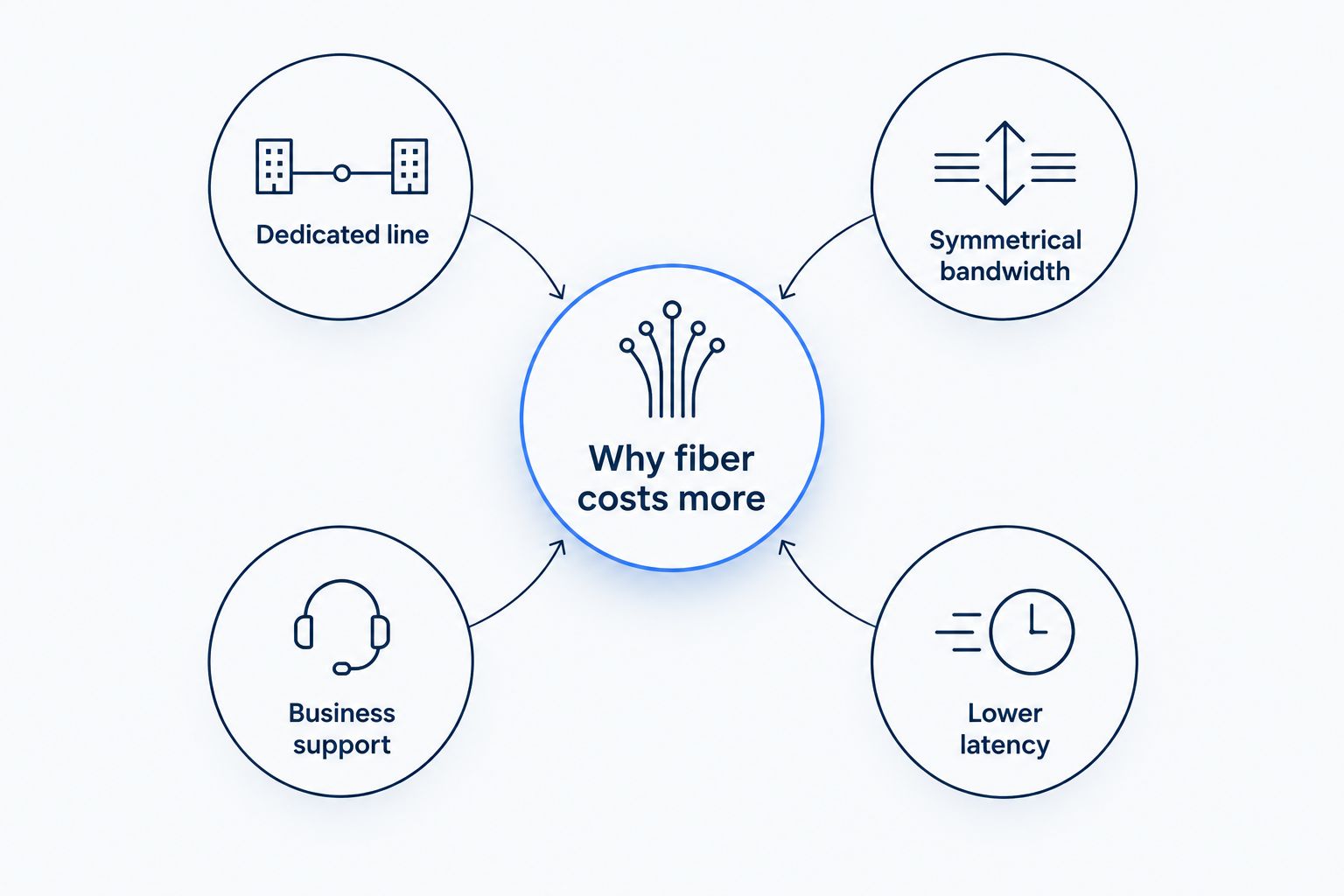
Why fiber costs more than cable
The price difference isn't arbitrary. A handful of real factors drive it:
- Dedicated line vs. shared loop — fiber runs a private connection to your building; cable shares a local line with other businesses and homes nearby.
- Symmetrical bandwidth engineering — fiber is built to push upload and download traffic equally, which costs more to deploy than cable's download-heavy design.
- Business-grade support — fiber providers built for commercial customers typically staff support around the clock instead of routing you through a residential queue.
- Lower latency — fiber's signal travels with less delay, which matters for VoIP phone systems and real-time video, not just file transfers.
- Fewer outages tied to neighborhood congestion — because fiber isn't shared with the block, one business having a busy day doesn't slow another business down.
When cable might still work for your business
Fiber isn't the right call for every business in 2026. Cable still makes sense when:
- Your office has one or two people doing email, browsing, and light cloud tool use
- You run a seasonal or pop-up location where a short-term connection makes more sense than a long-term fiber build
- You already have a fiber line and just want a backup connection for outages, not a primary line
- Your building isn't fiber-ready yet and cable is the only option available today
For everyone else — restaurants running card processing and a guest WiFi network, medical offices syncing records, construction sites coordinating with a remote office — the extra monthly cost of fiber buys back the hours lost to stalled calls and slow uploads. Check current fiber internet cost per month figures against what an hour of downtime actually costs your business, and the comparison usually settles itself.
SumoFiber runs fiber networks for households and businesses across Utah, Idaho, Montana, Colorado, California, Wisconsin, Illinois, and New York, and pairs symmetrical business connections with managed WiFi, phone, and 24/7 human support instead of a residential help line. That combination matters more than the monthly bill once you're relying on the connection for calls, payments, or a cloud-based system every single day.
Check business fiber availability
See if symmetrical fiber speeds are available at your business address.
Does cable internet slow down when several employees are online at once?
Yes — cable connections share bandwidth with other users on the same local loop, so speeds can dip when your office and a nearby business or apartment building get busy at the same hour. Fiber runs a dedicated line to your building, so what your neighbors do has no effect on your connection speed.
Is fiber internet more reliable for video calls than cable?
Fiber is more reliable for video calls because its symmetrical upload speed keeps the outbound audio and video stream steady under load. Cable's much slower upload speed is usually the first thing to bottleneck once a call, a cloud backup, and a phone system are all running at the same time.
Can a growing business outgrow a cable connection?
A cable connection that felt fine with three employees often struggles once a fourth or fifth person joins a video call or a POS system starts syncing in real time. Fiber's symmetrical bandwidth scales with headcount and device use in a way cable's shared, download-heavy design doesn't.
FAQ
Is business fiber internet worth it over cable in 2026?
Business fiber internet is worth the extra cost in 2026 for any office running video calls, cloud backups, or a POS system, since cable's slow upload speed bottlenecks all three. A single-person office with light email use may not see enough benefit to justify switching.
What's the main difference between fiber and cable internet for a business?
Fiber delivers matching upload and download speeds, while cable's upload speed is a fraction of its download speed under the technology cable providers use. That gap is the biggest factor separating the two for business use.
Does cable internet slow down during business hours?
Cable can slow down during business hours because it shares bandwidth with other users on the same local line, so a busy building nearby affects your speed. Fiber runs a dedicated line, so it doesn't share capacity with neighboring businesses.
Is fiber internet better than cable for a restaurant or retail business?
Fiber is generally better for restaurants and retail because it handles card processing, guest WiFi, and back-office systems running at the same time without one slowing the others down. Cable can work for a very small operation with minimal simultaneous device use.
Can a business use cable as a backup to fiber?
Yes, some businesses keep cable as a backup connection that takes over automatically if the fiber line drops. That setup gives redundancy without paying for two full business-grade connections.
How long does it take to install business fiber internet?
Installation timelines depend on the building and how close the existing fiber line runs, and can range from a quick appointment to a longer build-out. Ask the provider for a site-specific estimate before committing to a switch.
Do all businesses need symmetrical upload speeds?
Not every business needs symmetrical speeds — a one-person office doing email and browsing rarely notices the difference. Businesses running video calls, large file transfers, or cloud-based systems notice it immediately.
One last thing
The fastest way to tell if your business needs fiber isn't to compare speed numbers — it's to count how many things happen on your connection at the exact same moment. A business running one video call, one card swipe, and one cloud backup simultaneously is already past what a cable upload connection was built to handle in 2026, no matter what the download number on the plan says.