

Not always: signing up for fiber internet requires a credit check only when the provider's application policy calls for one. The fiber connection itself does not require a credit inquiry, and a provider can use identity verification without checking your credit report. Before you apply, confirm whether the application involves a hard inquiry, a soft inquiry, or no credit inquiry—and whether equipment or bundled services have separate requirements.
- Does fiber internet require a credit check? The provider's application policy determines the answer, not the fiber connection.
- A soft credit inquiry does not affect credit scores; a hard inquiry can affect them.
- Identity verification and credit checks are different. Ask what the application authorizes before submitting it.
- Sumofiber offers fiber internet and managed WiFi; confirm the application requirements directly before signing up.
Why this matters
You want internet for video calls, homework, and streaming—not an unexpected credit inquiry. Check the application terms before you submit your personal information. Finding out afterward gives you less control over what you authorized.
Start by checking whether fiber internet is available at your address. Network access and account approval answer different questions: a connection at your property does not tell you how a provider screens applicants.
For a 2026 signup, separate three decisions: whether the address can receive service, whether you meet the account requirements, and whether you accept the agreement. Getting a clear answer to each keeps a confusing checkout page from making the decision for you.
Does signing up for fiber internet require a credit check?
Fiber internet does not automatically require a credit check. A credit check is an account-opening requirement set by the provider, not a technical requirement of delivering internet over fiber.
The important distinction is what the provider means by a check. A request to confirm your identity is not, by itself, proof that the provider will access your credit report. Likewise, a promise of no long-term contract does not answer whether a credit inquiry occurs.
Use this comparison when reading an application or talking with a representative. These are screening approaches, not claims about any named provider's policy.
| Application approach | What it does | Credit-score effect | Best for | Benefit and limitation |
|---|---|---|---|---|
| No credit inquiry | Opens the application without accessing your credit report | No inquiry-related score effect | Applicants prioritizing no credit-report access | Avoids a credit inquiry; identity and payment requirements still need clarification |
| Soft credit inquiry | Accesses credit information without a hard inquiry | Does not affect credit scores | Applicants who accept credit review but want to avoid a hard inquiry | Preserves the score from inquiry effects; does not guarantee approval |
| Hard credit inquiry | Accesses credit information through an inquiry associated with an application | Can affect credit scores | Applicants willing to authorize a hard inquiry after reviewing the terms | Allows the stated credit review; creates a potential score impact |
| Identity verification | Checks that the applicant is the person opening the account | Identity verification alone is not a hard credit inquiry | Applicants establishing a legitimate account | Helps verify the applicant; the application can separately include credit authorization |
Do not choose based only on a label such as quick approval or easy signup. Ask whether submitting the application authorizes a hard inquiry. That question is more useful than asking whether signing up is easy.
How do I check the signup requirements before applying?
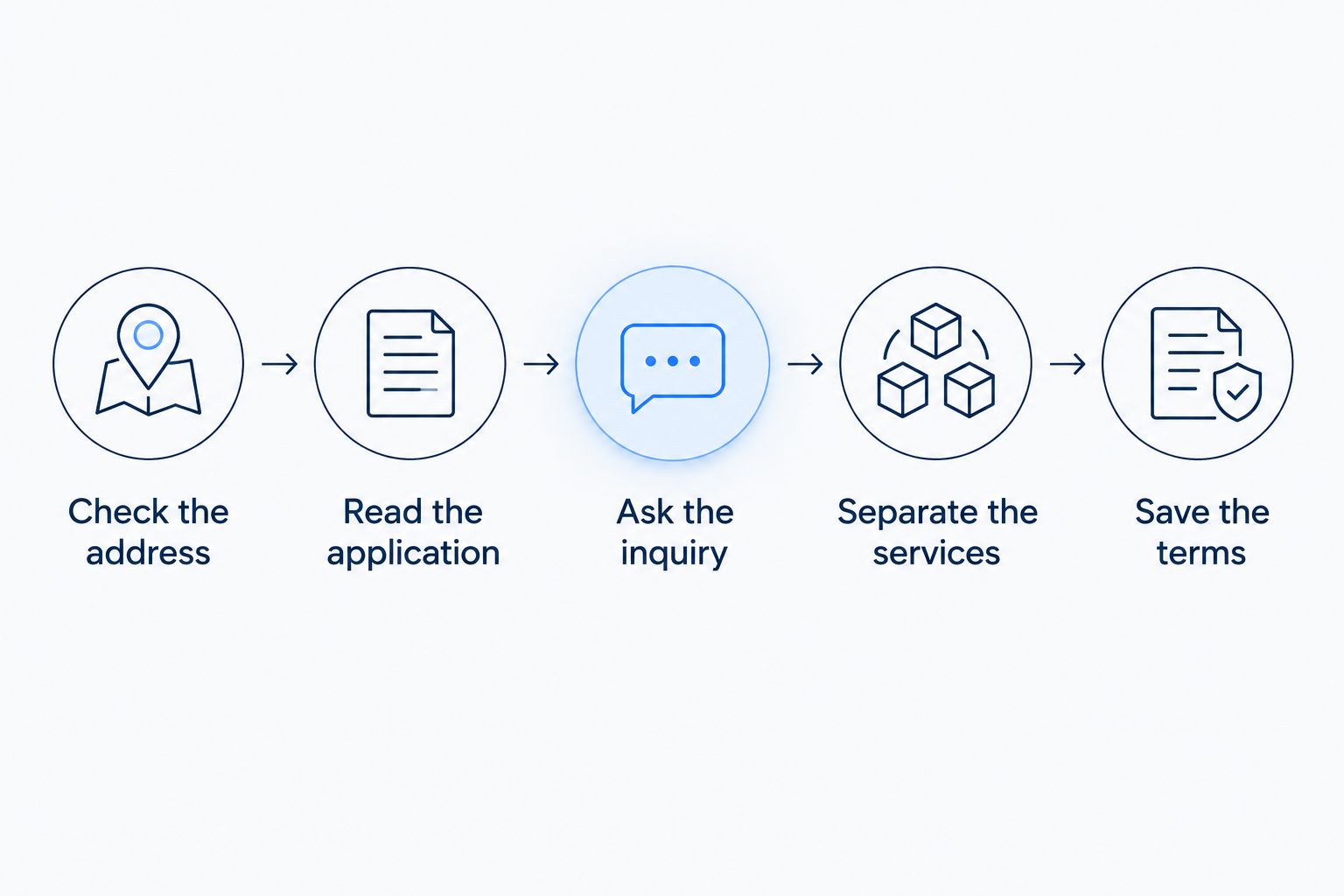
Follow this sequence before opening a fiber internet account in 2026. You do not need to understand every term in a credit report; you need to understand what you are authorizing.
- Check the address. Confirm that the provider can serve your exact property, including your apartment or unit where relevant. Do this before treating a general coverage statement as confirmation for your home.
- Read the application. Look for language about credit reports, consumer reports, credit authorization, and identity verification. A payment form alone does not explain the provider's screening policy.
- Ask the inquiry question. Request a direct answer: does submitting this application trigger a hard inquiry, a soft inquiry, or neither? Avoid accepting a general reassurance that the check is routine.
- Separate the services. Ask whether internet, equipment, home phone, TV, and mobile services share one application or have different requirements. Do not assume the answer for internet applies to everything in a bundle.
- Save the terms. Keep the application disclosures and any written explanation before you submit. Record which services the answer covers so you can distinguish the internet account from another application.
The order matters. First establish whether the service fits your address, then review account screening, then decide whether to authorize it. You should not need to guess which step includes permission to access your credit report.
What is the difference between a hard and soft credit check?
A soft inquiry does not affect your credit scores; a hard inquiry can. That difference matters more than whether a representative calls the process a credit check, account check, or routine screening.
FICO's consumer guidance explains that its scores consider hard inquiries from the preceding 12 months, although inquiries can remain on a credit report for 2 years. Those periods describe credit reporting and scoring, not how long an internet provider takes to approve an account. The effect of a hard inquiry is not a fixed number of points for every applicant.
Use that distinction when reviewing a 2026 application. If you expect to apply for other credit, identify the inquiry type before submitting rather than relying on a general statement that the check is small.
A soft inquiry also does not mean automatic approval. The provider still applies its account requirements, and credit review is only one possible part of that process. Ask what happens if the application does not meet those requirements.
Why credit-check requirements differ
The relevant question is not whether fiber is different from cable. It is what the provider needs to open the particular account you are requesting.
Review these five factors rather than assuming all applications work the same way:
- Provider policy. The company opening the account sets its screening requirements. Another provider's signup experience does not establish the policy for your application.
- Billing arrangement. Confirm whether you pay before or after the service period and what account requirements apply. Do not infer a no-credit-check policy from the payment schedule alone.
- Equipment agreement. Ask whether the router or other equipment is covered by the service agreement or a separate financing application. Financing and internet service need separate scrutiny when separate agreements appear.
- Bundled services. Check whether a mobile line, home phone, or TV service introduces another application. One checkout can contain more than one set of terms.
- Account type. Ask whether you are applying as an individual or a business. The application should make clear whose information and authorization are required.
None of these factors proves that a hard inquiry will occur. They identify the places where you need an explicit answer. The application disclosure—not the connection type—is the document to check.
Does no-contract fiber internet mean no credit check?
No-contract service does not establish a no-credit-check policy. Contract length describes the service commitment; credit screening describes how the provider evaluates an application.
Keep those questions separate during a 2026 comparison. Ask about the commitment, cancellation terms, and credit inquiry individually instead of treating one favorable answer as an answer to all three.
The same applies to a claim about no data caps. That describes usage limits, not credit authorization or identity verification. Read each condition for what it actually says.
Can I get fiber internet if I have bad credit?
A low credit score does not tell you whether every fiber internet provider will accept or reject your application. You need the provider's account-opening requirements and the inquiry type to assess the application.
Ask whether the provider offers a signup route that does not access a credit report and what other requirements apply. If an application is declined, request the explanation and any notices associated with the decision rather than assuming fiber internet itself is unavailable to you.
Do not interpret an alternative arrangement as guaranteed approval. Get its conditions in writing, including whether it changes equipment terms or the way you pay for service.
Can I sign up with a frozen credit report?
A credit freeze can block access needed for a credit-based application. First ask whether the provider needs access to a credit report and, if so, which credit bureau it uses.
The Consumer Financial Protection Bureau's consumer guidance identifies 3 nationwide credit bureaus: Equifax, Experian, and TransUnion. Freezes are managed separately with each bureau. That is why you should identify the bureau involved rather than assume changing one freeze changes all of them.
For a 2026 application, arrange any necessary access directly through the relevant bureau's official process. Do not lift a freeze simply because a signup form asks for personal information; first establish whether the application actually requires credit-report access.
A freeze is also not a substitute for reading the authorization. You still need to understand what the provider plans to request and which service application the request covers.
What should I ask Sumofiber before signing up?
Sumofiber fits households and businesses seeking fiber internet and managed WiFi from one provider. It also offers TV, home phone, and mobile services, making the scope of the application an important question when you want more than internet alone.
The benefit is being able to consider those services through one provider. The limitation for this decision is that the service list does not establish the credit-screening requirements for your chosen account. Ask for the requirements instead of drawing a conclusion from the bundle.
When discussing Sumofiber fiber internet, request answers to these questions:
- Does submitting my internet application authorize a credit inquiry?
- If it does, is the inquiry hard or soft?
- Is identity verification separate from credit screening?
- Does adding equipment or another service change the application requirements?
- Where can I review the authorization before submitting?
Describe what you actually need: internet for a household, connectivity for a business, or internet with additional services. A precise request helps keep the answer tied to your application rather than a different account type.
Review your internet signup
Ask about credit inquiries, identity verification, and the requirements for your selected services.
FAQ
Does fiber internet require a credit check in 2026?
Fiber internet requires a credit check only when the provider's application policy calls for one. Confirm whether the application involves a hard inquiry, a soft inquiry, or no credit inquiry before submitting.
Will signing up for fiber internet lower my credit score?
Signing up can affect your credit score if the application triggers a hard inquiry. A soft inquiry does not affect credit scores, and identity verification alone is not a hard credit inquiry.
Does no-contract internet mean there is no credit check?
No-contract internet does not establish that there is no credit check. Contract length and application screening are separate conditions, so ask about both.
Can I get fiber internet without providing my Social Security number?
The provider's identity-verification and application requirements determine whether you must provide a Social Security number. Ask what information is required, why it is needed, and whether an alternative verification method exists.
Can I apply for fiber internet with a credit freeze?
A credit freeze can prevent access needed for a credit-based application. Ask whether the provider needs credit-report access and which bureau it uses before changing a freeze.
Does Sumofiber run a hard credit check for fiber internet?
Confirm the inquiry type directly with Sumofiber before submitting your fiber internet application. Ask whether the answer covers internet alone or also covers equipment and any additional services you select.
Is checking my address the same as applying for internet?
Checking network coverage and applying for an account are different tasks. Read the form's disclosures to confirm whether a particular submission only checks the address or also starts an application.
One last thing
An application can ask for sensitive information without making the purpose obvious. Ask what the information will be used for before you provide it. Identity verification, billing, and credit screening are different activities, even when they appear on the same form.
Before your 2026 signup, save the answer to one clear question: does submitting this application authorize a hard credit inquiry? That gives you a useful decision point before you act—not a surprise after the account request is already submitted.


