The cost to run fiber internet to a rural property requires a site-specific construction quote in 2026; the information here does not support a reliable average or range. Your total can include more than the line itself, including work on your property and any permissions needed along the route. Start by checking whether fiber is available at your address, then ask who would pay for any extension.
- The cost to run fiber internet to a rural property needs an address-specific construction quote in 2026.
- Confirm where the existing network ends before discussing work on your land.
- Ask for separate responsibility for the network extension, property work, permissions and installation.
How much does it cost to run fiber internet to a rural property?
There is no defensible price for your property without a route and a written scope. In 2026, the first question is whether a provider can serve the address from its existing network or must extend that network before installing service. A standard installation description does not, by itself, tell you whether construction to reach a rural property is included.
| Situation | What to confirm | Best for | Advantage | Limitation |
|---|---|---|---|---|
| Service is already available at the address | Where the provider's line enters the property and what installation covers | A property with a confirmed serviceable address | You can discuss installation without assuming a new network extension | The route across your land still needs confirmation |
| A network extension is required | Who plans, approves, builds and pays for the extension | A property a provider agrees to evaluate for construction | You can get a scope tied to the actual route | Service cannot be assumed until the provider confirms the build |
| The provider cannot offer fiber at the address | Whether another provider serves the address | A property with no confirmed fiber route | You can avoid planning around an unavailable connection | A different service may not meet the same needs |
The table separates availability, construction and installation because a quote that covers one does not automatically cover the others. If you receive a single total, ask the provider to identify which work it includes and which work would be yours to arrange.
Why this matters
A rural mailing address does not tell you where a provider's usable network ends. Nor does seeing fiber along a road establish that the line can reach your building. In 2026, an answer tied to the exact service address is more useful than a general coverage claim.
The distinction matters most when you are planning other property work. If you are opening a driveway, arranging utility work or choosing where equipment will go, get the proposed fiber route confirmed before treating those plans as settled. Do not start excavation on the assumption that a provider will use the route you prefer.
What should a rural fiber quote include?
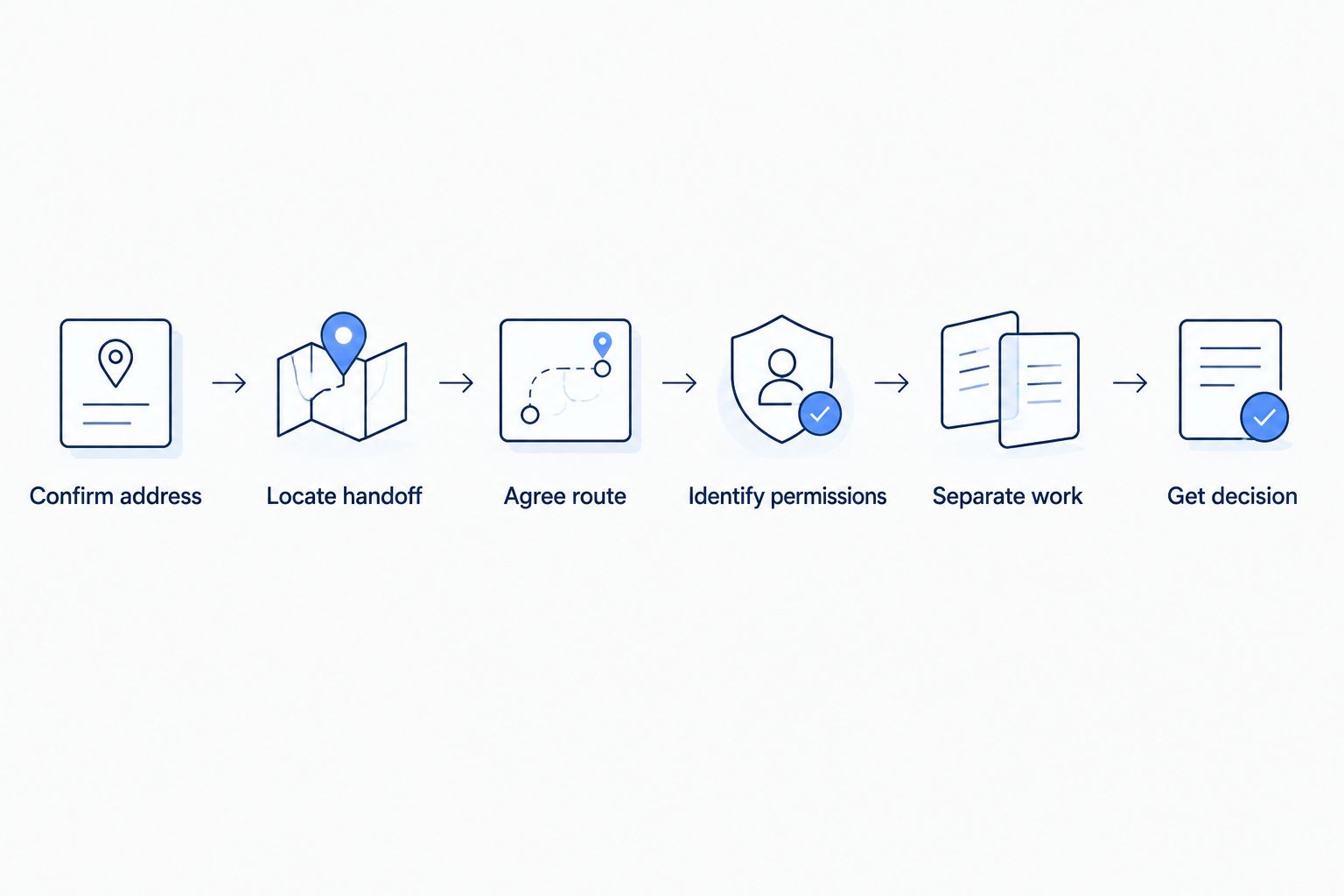
Ask for a written scope that answers these questions in order. The aim is to make clear which decisions belong to the provider and which, if any, belong to you.
- Confirm the service address. Give the provider the exact address and identify the building that needs internet. If the property has more than one building, name the one you want connected rather than assuming a single availability answer covers the whole property.
- Locate the network handoff. Ask where the provider proposes to connect the property to its existing network. If that location is not confirmed, the route and construction responsibility are not settled either.
- Agree on a route. Ask how the line would reach the building, which parts of the route the provider would handle and whether any route remains subject to approval. A line along a road and a connection inside your home or business are different pieces of work.
- Identify permissions. Ask who will secure any access, easement or other permission required for the proposed route. Do not assume that permission to work on your property covers land between your property and the network.
- Separate the work. Have the provider distinguish network-extension work, work across your property and installation at the building. Ask which items are included in its quote and which require separate arrangements.
- Get the decision in writing. Request the proposed scope, customer responsibilities and any conditions that must be resolved before service can be installed. If the provider cannot confirm a route, treat the quote as incomplete.
A useful quote gives you a route and a division of responsibility, not just a monthly service choice. It should also make clear whether the provider has approved construction or is still assessing it. That difference keeps a preliminary conversation from turning into a mistaken installation plan.
If you own a farm or another property with several buildings, say which building needs service first. An answer for a home does not establish a route to a barn, workshop or office. The same applies to a business operating from a separate building on the property: identify the intended connection point when requesting the scope.
Why does the cost to extend fiber vary?
The cost to run fiber internet to a rural property depends on the work a provider confirms for that address. These are the factors to ask about in 2026, not a substitute for an estimate:
- Where the usable network ends. A provider first needs to establish the point from which it can serve the property. Distance to something that looks like a fiber line is not the same as a confirmed connection point.
- The proposed route. The path from the network to the building determines what ground or structures the work would cross. Ask the provider to show the route it is actually considering.
- Property access. Work confined to land you control presents different permission questions from work crossing land you do not control. Have the provider identify who handles those questions.
- Work on your property. Clarify where responsibility changes from provider construction to any work you would arrange. Do not assume that an installation appointment covers preparation across a long property.
- The building being connected. The route to a house is not necessarily the route to a separate business or outbuilding. State the destination building before accepting a scope.
- Approval status. A route under review is not an approved build. Ask what must be decided before the provider can commit to installation.
These factors can change what is included, not just the eventual quote. If two providers describe different responsibilities, their proposals are not directly comparable until you put the same questions to both.
How do you compare rural internet options?
Start with availability at the building you need to connect. Then compare the work needed to reach it, rather than treating an advertised service as a completed connection. For a 2026 decision, keep a short record of each provider's answer to the same questions:
- Is service available at the exact address and intended building?
- Does the provider need to extend its network?
- Who handles the route across the property?
- Who handles access or permission outside the property?
- What remains unapproved or outside the written scope?
SumoFiber is best for a household or business that wants to ask one provider about fiber internet alongside managed WiFi, TV, home phone or mobile service. Those services are part of SumoFiber's offering; they do not establish that fiber is available at a particular rural address. Confirm the address and any construction requirements with SumoFiber before planning around a connection. Its 24/7 human support gives you a contact point for those questions, but a support conversation is not a substitute for a written route and scope.
If another provider confirms an installable route while SumoFiber cannot confirm one, the confirmed route is the stronger basis for a near-term decision. If both can serve the building, compare their written scopes before choosing based on the services you want. Availability comes before the service comparison.
Can you install fiber yourself to avoid extension work?
You cannot assume that installing a line on your property will connect it to a provider's network. The provider must confirm where and how service would connect, as well as what customer-arranged work it will accept. Ask before arranging excavation or buying materials.
There is a useful distinction between preparing a route and making a live network connection. Even if you can arrange part of the property work, that does not establish that the provider has approved the route or agreed to provide service. Get its requirements in writing first.
Does fiber at the road mean your rural property is covered?
No. Fiber visible near a rural property does not confirm that a provider can install service at the building. In 2026, ask the provider to verify the exact address, identify the connection point it can use and explain whether a network extension is needed. A roadside line alone answers none of those questions.
This is especially important when the building sits away from the road or the route would cross land you do not control. Describe the property's layout when requesting an availability check. That gives the provider the destination it needs to evaluate rather than just a street name.
Is a monthly fiber plan the same as a construction quote?
No. A monthly service plan describes ongoing service; a construction quote addresses the work needed to reach your property. In 2026, ask for those decisions separately so you know whether service can actually be installed and which work is included.
A provider can discuss service choices before a route is final. Do not treat that discussion as approval for a rural extension. The practical next move is to obtain the construction scope, then assess the ongoing service that would use it.
FAQ
What is the cost to run fiber internet to a rural property in 2026?
The cost to run fiber internet to a rural property requires a site-specific construction quote in 2026. Confirm the network connection point, route and responsibility for each part of the work before relying on a total.
Can I get a rural fiber estimate from my address alone?
An address is the starting point for a rural fiber estimate, not a confirmed construction scope. Tell the provider which building needs service and ask it to verify the route and any required approvals.
Does a fiber line near my property mean I can get connected?
No, a nearby fiber line does not confirm service at your building. The provider must verify a usable connection point and an approved route to the property.
Who pays to extend fiber to a rural home?
The responsible party must be stated in the provider's written scope. Ask it to separate network-extension work, work on your property and building installation rather than assuming one party covers everything.
Can I arrange my own trenching for rural fiber?
Ask the provider before arranging trenching. It must confirm the proposed route, what work it accepts and how that work connects to its network.
Does a rural fiber installation include the line across my property?
Do not assume the installation includes all work across your property. Ask where the provider's responsibility begins and ends, and get that division in writing.
What if fiber is not available at my rural address?
Ask the provider whether it will evaluate a network extension, then check which other providers can serve the exact building. Do not plan around fiber until a provider confirms an installable route.
One last thing
The question that can save you the most back-and-forth is not how far is fiber from my house? It is where does the provider's responsibility end, and where would mine begin? Ask it alongside the exact building address. In 2026, that answer makes a rural fiber quote useful for a real decision rather than an estimate built on assumptions.