
Yes. In 2026, qualifying U.S. households can get help with internet service through Lifeline, while some providers offer separate income-qualified plans. Eligibility does not guarantee service at your address, and an approved benefit does not automatically cover equipment, installation, or every item on your bill.
- Lifeline is the starting point for low income government assisted internet; confirm eligibility and provider participation separately.
- Provider income-qualified plans are separate from federal benefits and have their own application rules.
- Sumofiber offers fiber internet, but you must confirm any assistance-program participation before enrolling.
- Compare the full service terms, not just whether an application receives approval.
For questions about a specific service address or application requirements, contact the provider before placing an order. Ask whether the assistance applies to the exact internet plan you are considering.
Is low-income or government-assisted internet available?
Yes, but government benefits and provider-run assistance are different routes. Lifeline is a federal benefit administered by the Universal Service Administrative Company, or USAC, under Federal Communications Commission rules. A provider's income-qualified plan is a separate offer with its own eligibility requirements.
| Route | Best for | Main advantage | Main limitation |
|---|---|---|---|
| Lifeline | Households meeting federal eligibility rules | Established federal eligibility process | Requires a participating provider and eligible service |
| Provider income-qualified plan | Households meeting a provider's specific requirements | Another route to investigate alongside federal assistance | Rules differ by provider and location |
| Local assistance, where offered | Households seeking help through a school, housing organization, or community agency | Connects you with locally administered resources | A referral does not guarantee an ongoing internet benefit |
Start with the route whose rules match your household. Then check the address, plan, and enrollment process. Approval from a benefits program and acceptance by an internet provider are separate steps; you need both before assuming the benefit will appear on your account.
Why this matters
A household needs a working connection, not just an approval notice. If your child needs school access while you join a video call, the practical questions are whether service reaches your home and whether the plan supports what happens there.
For a 2026 application, use current FCC and USAC Lifeline guidance rather than an old advertisement or a search-result snippet. Keep the eligibility decision separate from the service order so you can check both without committing too early.
Lifeline: federal eligibility comes first
Lifeline eligibility includes household income at or below 135% of the Federal Poverty Guidelines, or participation in a qualifying assistance program. The income amount depends on household size and the applicable guidelines; there is no single income cutoff for every applicant.
Qualifying programs include SNAP, Medicaid, Supplemental Security Income, Federal Public Housing Assistance, and the Veterans Pension and Survivors Benefit. Additional qualifying programs apply to eligible residents of Tribal lands. Use USAC's current list to check the exact program name on your paperwork.
Lifeline allows 1 benefit per household, not a separate benefit for every person. Under Lifeline rules, a household consists of people who live together and share income and expenses. That makes the household question more specific than simply counting everyone at an address.
Lifeline generally requires eligibility recertification every 12 months, unless the program can confirm continued eligibility automatically. Watch for official notices after enrollment. Approval is not a reason to ignore later requests for information.
What Lifeline approval does not establish
An eligibility decision does not establish that every nearby provider participates. It also does not establish that the plan you want qualifies, that installation is possible, or that the provider has attached the benefit to your account.
Ask the provider to confirm the eligible service and the enrollment status in writing. Keep that confirmation with your approval notice. If the provider needs another step from you, finish it before treating the application as complete.
Provider income-qualified plans: check separate rules
A provider-run assistance plan does not automatically follow Lifeline rules. Ask which benefit programs or income documents it accepts, whether existing customers can apply, and whether the application covers the service address where you actually live.
The advantage is another route to investigate when federal eligibility does not settle your situation. The drawback is that a familiar program name on an advertisement does not explain every condition. You still need the provider's current requirements and service terms.
Do not assume a provider's plan combines with Lifeline. Ask whether the provider accepts Lifeline, whether the selected service qualifies, and whether any separate assistance can be used on the same account. Get a direct answer rather than combining offers yourself.
If a provider asks for school-meal participation or another document, follow that plan's instructions. Do not assume that a document accepted for a provider-run plan also proves federal Lifeline eligibility.
Local assistance: ask what the help actually covers
Your school, public library, housing organization, or local social-service agency is a place to ask about local connectivity resources. Ask whether it administers assistance, lends equipment, or simply refers residents to another organization. Those are different kinds of help.
A referral is useful, but it is not an internet-service approval. Likewise, a borrowed hotspot does not establish that your home qualifies for a fixed connection. Ask who makes the final decision and what happens after the referral.
For any local resource, confirm whether the help is ongoing or temporary and whether you must renew it. Keep a record of the organization, the program name, and the documents requested. That prevents a helpful conversation from becoming an application you cannot track.
Why assistance eligibility and your final bill vary
There is no universal assisted-internet offer that applies to every household and every address. These factors determine which route fits and what you need to confirm:
- Household income: Lifeline's income route uses household size and the applicable Federal Poverty Guidelines.
- Benefit participation: A qualifying assistance program provides another eligibility route, subject to verification.
- Household arrangement: Sharing an address is not the same as sharing income and expenses under Lifeline rules.
- Provider participation: Your chosen provider must support the relevant benefit or administer its own qualifying plan.
- Service address: Eligibility does not make an unavailable connection installable at your home.
- Service terms: Ask separately about equipment, installation, optional services, and any requirements attached to the plan.
For 2026, check the current application instructions before gathering paperwork. An old checklist can send you looking for a document the current process does not request.
How do I apply for internet assistance?
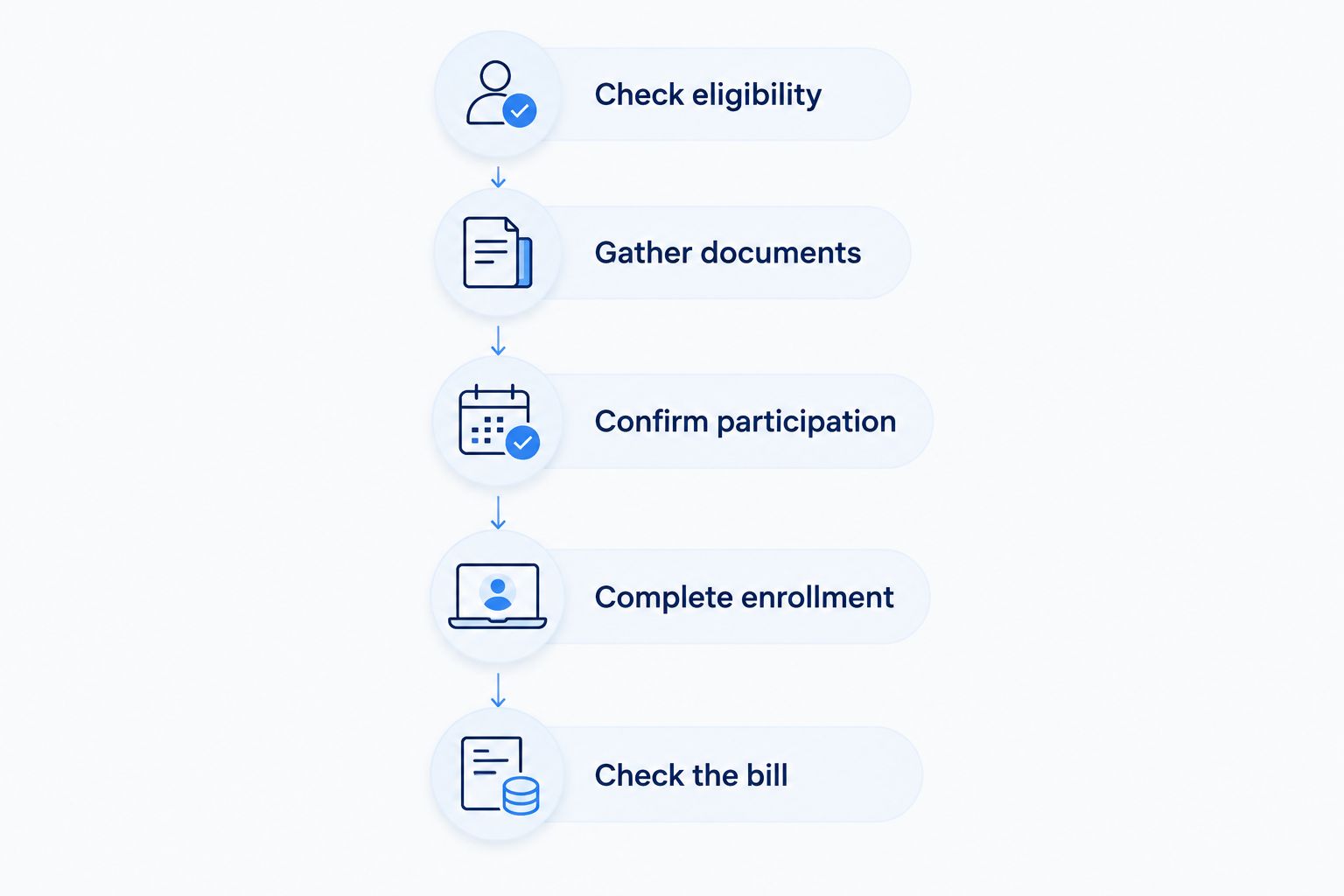
Check eligibility first, then confirm the provider, then complete enrollment. Do not cancel your current connection just because you have started an application.
- Check eligibility. Review the current Lifeline requirements through USAC or the relevant state process. Identify whether you are applying through income or a qualifying benefit.
- Gather documents. Follow the application's instructions for identity, address, income, or program-participation evidence. Submit only what the official process requests.
- Confirm participation. Ask the internet provider whether it accepts the benefit for your service address and selected plan. An eligibility approval alone is not this confirmation.
- Complete enrollment. Finish both the program application and the provider's service enrollment. Keep copies of decisions and account confirmations.
- Check the bill. Compare the first statement with the written terms. Ask about any unexpected item rather than assuming the assistance application failed.
This sequence keeps the benefits decision separate from the connection decision. It also gives you a clear place to follow up: eligibility questions go to the program administrator, while installation and account questions go to the provider.
What should I ask before choosing a plan?
Ask for the terms for internet service by itself before considering TV, phone, or other additions. A household trying to keep an essential connection needs to see which items are necessary and which are optional.
Use these questions during the conversation:
- Does this exact internet service accept my approved benefit?
- What equipment do I need, and which equipment is included?
- What happens if I lose eligibility or miss a recertification request?
- Are installation, activation, or equipment-return requirements separate?
- Can I keep internet service without adding other services?
- What must happen before I disconnect my current provider?
Sumofiber is a fiber internet option for households that also want WiFi, TV, phone, or mobile services. Those service categories do not establish assistance eligibility. Confirm participation directly, and compare the internet-only terms before deciding whether additional services fit your needs.
Choose the connection you can maintain, not a bundle you do not need. A wider service selection is useful when you want those services; it is not a substitute for a confirmed benefit and a manageable household commitment.
Can I use Lifeline for both home internet and mobile service?
Lifeline provides 1 benefit per household, which can support eligible phone or internet service, including a qualifying bundled service. It is not a separate federal benefit for each connection you own.
Before transferring a benefit, ask which account currently receives it and what changes after the transfer. Keep your home and mobile needs in view so that solving one problem does not create another.
Do roommates count as the same household?
The 1-benefit-per-household rule depends on shared income and expenses, not just a shared street address. Roommates who do not share income and expenses can be separate households under Lifeline rules.
USAC uses a household worksheet when additional clarification is needed. Answer those questions accurately rather than assuming that either everyone at the address qualifies separately or nobody else can qualify.
Do I need to renew my eligibility?
The general Lifeline recertification cycle is 12 months, with automatic verification used where possible. If you receive an official request to recertify, respond by the deadline stated in that notice.
Keep your contact details current and retain enrollment records. For your 2026 application, use the administrator's instructions for reporting changes rather than relying on advice from an unrelated provider advertisement.
FAQ
Can I get government-assisted internet if I receive SNAP?
SNAP participation is a qualifying route for Lifeline eligibility. You still need to complete the eligibility process and enroll with a participating provider for an eligible service.
Does Medicaid qualify me for internet assistance?
Medicaid is a qualifying program for Lifeline. Provider-run assistance plans have separate rules, so confirm which program you are applying for.
Can I get Lifeline based on income alone?
Yes. Lifeline's income-based route covers households at or below 135% of the applicable Federal Poverty Guidelines, subject to verification and the program's other rules.
Can everyone in my family receive a separate Lifeline benefit?
No. Lifeline allows 1 benefit per household, not one for each family member. Household status depends on living arrangements and shared income and expenses.
Does Lifeline automatically pay for my current internet plan?
No. Your provider must participate, your service must qualify, and enrollment must be completed. Confirm the benefit's application to your account before assuming your current plan is covered.
Does Sumofiber offer government-assisted internet?
Confirm assistance-program participation directly with Sumofiber before ordering. Offering residential fiber internet does not by itself establish that a provider accepts Lifeline or operates an income-qualified plan.
Do I have to cancel my current internet before applying?
Do not cancel your current internet simply to start an assistance application. Confirm eligibility, provider enrollment, and the new connection's status before arranging a change.
One last thing
Approval and activation are not the same event. Before ending an existing connection, confirm that the new service works at home and that the provider has completed the benefit enrollment. Keep both confirmations; each answers a different question.