
Best overall for a household wanting fiber and related services: Sumofiber. Best for comparing providers on the local network: Ammon's open-access fiber options. Best fallback: compare wired cable first, then fixed wireless or satellite against your address and needs. This 2026 guide to internet providers in Ammon, Idaho ranks those shopping options by what you need at home—not by advertised download speed alone.
- Sumofiber is the best starting point for households comparing fiber internet alongside managed WiFi, TV, phone, and mobile services.
- Compare internet providers in Ammon, Idaho by the connection, WiFi coverage, support responsibilities, and service terms.
- Ammon's open-access fiber model separates the local network from the internet provider you choose.
- Treat cable, fixed wireless, and satellite as address-specific alternatives, not interchangeable connections.
Why this matters
A family watching television while someone joins a video meeting needs more than a fast download number. The connection must handle simultaneous activity, and the WiFi must reach the rooms where people actually use it.
Ammon adds another decision: the network and the internet service provider are not necessarily the same organization. The City of Ammon's municipal fiber information describes an open-access model, where participating providers deliver service over the local network. That distinction matters when you compare who supplies internet service, who maintains infrastructure, and who answers your questions.
For your 2026 comparison, separate three decisions: the connection to your property, the provider supplying service, and the WiFi inside your home. Changing one does not automatically improve the other two.
What makes the best internet providers in Ammon, Idaho?
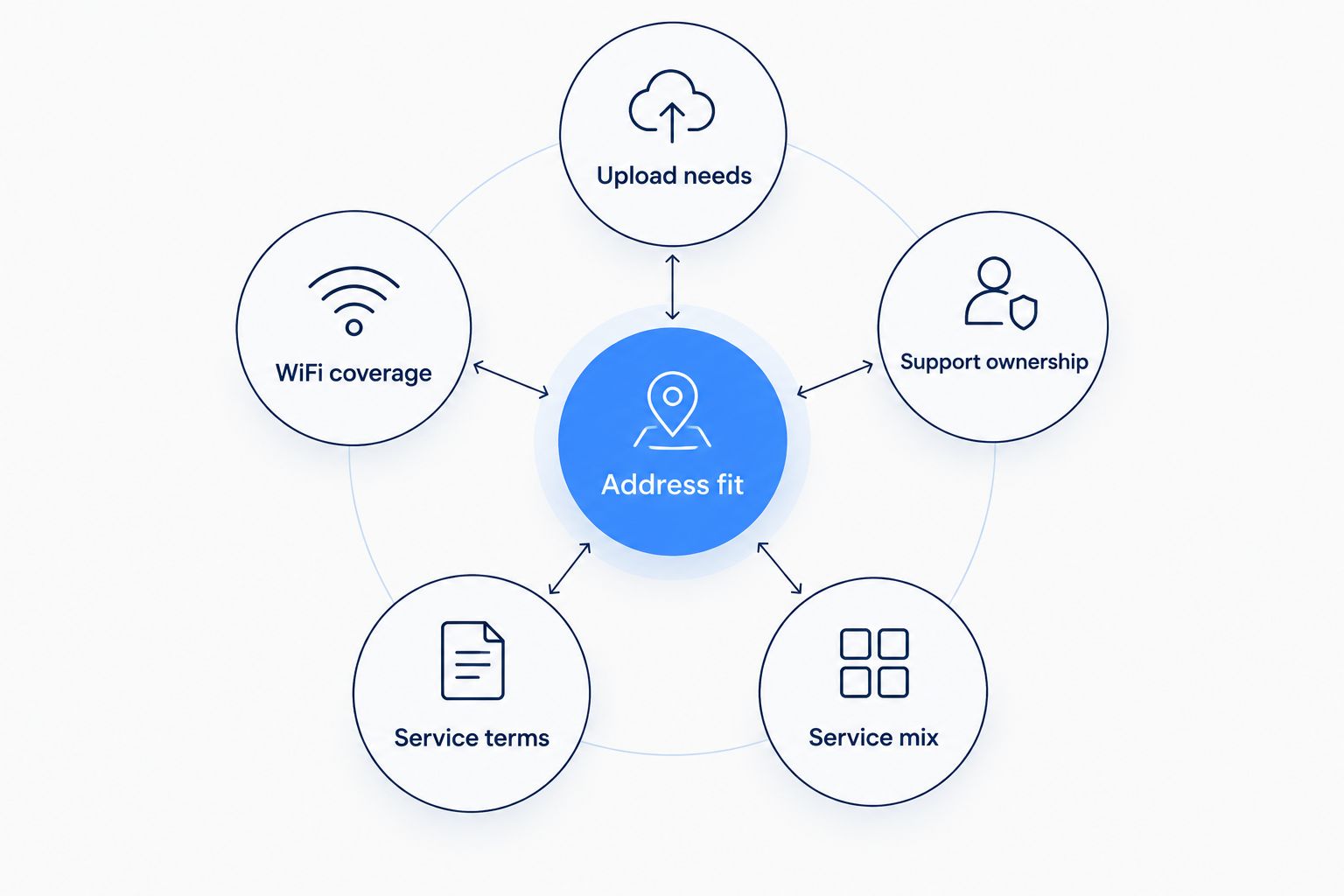
Use these criteria before you choose a provider or connection type:
- Address fit: Compare the connection offered for your specific property, including any requirements for a rented home or apartment.
- Upload needs: Video meetings, cloud backups, and sending large files use upload capacity. Download speed does not describe that part of the connection.
- WiFi coverage: Identify who handles the router, equipment placement, and troubleshooting when one room has a weak signal.
- Support ownership: Ask whom you contact for a connection problem and how that contact coordinates with the network operator.
- Service terms: Review the current agreement, equipment responsibilities, cancellation conditions, and any separate network charges.
- Service mix: Decide whether you want internet alone or help with WiFi, television, home phone, and mobile service too.
Do not let one appealing headline replace these checks. A provider that fits your home and makes responsibilities clear is a better choice than a plan selected only for its largest number.
Ammon internet options at a glance
This ranking gives you a shopping order: a named fiber provider first, followed by ways to compare local fiber choices and alternative connection types. Each option serves a different need.
| Rank and option | Best for | Standout feature | Key limitation |
|---|---|---|---|
| 1. Sumofiber | Households wanting fiber and related services | Residential internet, managed WiFi, TV, home phone, and mobile services | The service mix does not replace checking property requirements and individual terms |
| 2. Other participating open-access fiber providers | Comparing service choices on Ammon's network | Provider choice separate from network ownership | Shared infrastructure does not make provider agreements identical |
| 3. Wired cable internet | Comparing a non-fiber wired connection | A wired connection using cable infrastructure | Download performance alone does not establish upload suitability |
| 4. Fixed wireless internet | Properties evaluating a terrestrial wireless connection | Internet delivered by radio rather than a wired connection to the property | Signal conditions and equipment placement matter |
| 5. Satellite internet | Properties evaluating a connection beyond terrestrial networks | Internet delivered through a satellite link | Clear sky access and latency require attention |
1. Sumofiber: best for fiber and related household services
Sumofiber provides residential and business fiber internet, managed WiFi, TV, home phone, and mobile services. That makes it a sensible first comparison when you want to consider the connection and the services around it together.
Picture a home where the television, work laptop, and phones all matter. You need to decide not just which internet connection to choose, but whether you want help managing WiFi and whether other household services belong in the same conversation.
Sumofiber pros:
- Offers fiber internet for residential and business customers.
- Offers managed WiFi alongside internet service.
- Includes TV, home phone, and mobile services in its service range.
Sumofiber cons:
- A broad service range does not establish the terms of any particular combination.
- Choosing fiber does not, by itself, fix weak WiFi coverage inside the home.
Best for: Households that want to compare fiber internet and related services with one provider.
Sumofiber is the best starting point for Ammon households comparing fiber internet alongside managed WiFi and other household services. Ask about your property's connection requirements, then separate the internet decision from any additional services.
Verdict: Buy only after the property requirements and written service terms fit your needs.
2. Other open-access fiber providers: best for comparing service choices
Ammon's open-access model lets you distinguish the physical network from the provider supplying internet service. Use that distinction to compare participating providers without assuming each choice requires an entirely different network.
The useful comparison is not simply “fiber versus fiber.” Ask how each provider handles account questions, equipment, troubleshooting, and the services you want to add. Get the answers in writing so you can compare like with like.
Open-access fiber comparison pros:
- Separates the network decision from the service-provider decision.
- Gives you a clear reason to compare provider responsibilities.
- Keeps service terms in view rather than treating all fiber offers as identical.
Open-access fiber comparison cons:
- The provider and network operator have different roles, which requires clarification.
- A shared network does not establish identical equipment, support arrangements, or agreements.
Best for: Households that already understand their local fiber connection and want to compare service-provider fit.
For your 2026 shortlist, ask every participating provider the same questions. Who handles the first troubleshooting call? What equipment is your responsibility? What happens when you change providers?
Verdict: Hold until the responsibilities and switching conditions are clear.
3. Wired cable internet: best for a non-fiber wired comparison
Cable internet uses cable infrastructure rather than a fiber connection all the way to the property. It belongs in your comparison when you are evaluating a wired alternative to fiber.
Look at both directions of the connection. A download-focused offer tells you about receiving data, but video calls and cloud uploads also depend on sending it.
Cable internet pros:
- Provides a wired alternative to terrestrial wireless and satellite.
- Gives you another connection type to compare against fiber.
- Supports familiar home networking through a router and connected devices.
Cable internet cons:
- Upload capacity needs its own check; do not infer it from download speed.
- A wired connection to the home still needs a well-planned WiFi setup indoors.
Best for: Households comparing a non-fiber wired connection with their fiber choices.
Do not switch an otherwise suitable connection just because a different plan advertises a larger download figure. Compare the tasks that matter: meetings, streaming, file transfers, and use across several rooms.
Verdict: Hold until the upload specification and household fit justify the choice.
4. Fixed wireless internet: best for evaluating a terrestrial wireless option
Fixed wireless delivers internet through a radio link between terrestrial network equipment and equipment serving your property. It is different from both home WiFi and satellite internet.
Home WiFi distributes a connection indoors. Fixed wireless brings the internet connection to the property, so evaluating the outdoor link and evaluating your indoor coverage are separate jobs.
Fixed wireless internet pros:
- Offers a connection type that does not require a wired internet link to the property.
- Provides a terrestrial alternative to satellite.
- Lets you compare a different delivery method when wired choices do not fit.
Fixed wireless internet cons:
- Signal conditions, obstructions, and equipment placement affect the link.
- Good reception outside does not establish good WiFi coverage throughout the home.
Best for: Properties evaluating a terrestrial wireless connection rather than a wired service.
Ask how the provider assesses the property's signal and where equipment belongs. Review any usage conditions and installation responsibilities before deciding.
Verdict: Hold until the property assessment and written terms support the choice.
5. Satellite internet: best for looking beyond terrestrial connections
Satellite internet connects through satellites rather than a local wired or terrestrial wireless link. It is a separate option to evaluate when those connection types do not fit your property.
Satellite systems differ, so do not treat every satellite connection as having the same responsiveness. Latency describes delay, and it matters for interactive activities such as video conversations and online games.
Satellite internet pros:
- Uses a delivery method independent of a wired connection to the property.
- Gives you another option to evaluate beyond terrestrial networks.
- Supports internet access through dedicated receiving equipment.
Satellite internet cons:
- Receiving equipment needs an appropriate view of the sky.
- Latency and service conditions need closer attention for interactive use.
Best for: Properties evaluating a connection beyond local wired and terrestrial wireless options.
Compare the actual system, installation requirements, and written agreement. Do not choose satellite on download speed alone when your main need is a responsive work call or gaming session.
Verdict: Hold until sky access and interactive-use requirements are checked.
How much speed should you compare?
Use published application requirements as a starting point, not as a promise about your whole household. Netflix's published recommendations include 5 Mbps for 1080p streaming and 15 Mbps for 4K streaming. Those figures describe a stream, not every device in your home combined.
The FCC's fixed broadband benchmark is 100 Mbps download and 20 Mbps upload. That is a broadband benchmark, not a requirement for every household or proof that a particular connection suits your work.
For a 2026 decision, list what happens at the same time. Someone watching television while another person uploads work files creates a different demand from a single person browsing.
- Check download needs for streaming and receiving files.
- Check upload needs for meetings, backups, and sending files.
- Check WiFi coverage where those activities happen.
- Check latency separately when responsiveness matters.
The guide to internet speed for streaming in 4K explains how to think beyond a single stream.
How this ranking works
This 2026 ranking prioritizes service fit: connection type, upload needs, WiFi responsibilities, support ownership, and the household services you want. It is a buying framework, not a measured speed or reliability leaderboard.
Sumofiber comes first for the specific household-service use case its stated offering supports. The remaining entries help you compare participating fiber providers and alternative connection types without confusing a network with a provider.
Which Ammon internet option should you choose?
Start with fiber when evaluating your property's wired options, then compare the provider and WiFi responsibilities separately. For a household wanting internet alongside managed WiFi, TV, phone, or mobile service, start your provider comparison with Sumofiber.
Keep internet-only and additional-service decisions separate. You do not need to choose every service together, and a broader offering is useful only when it matches what your household wants.
If your current wired connection handles your daily needs, identify a concrete reason to change before switching. Better room coverage, clearer responsibilities, or a service mix that fits your home is a more useful goal than a larger headline number.
Review your internet service options
Compare fiber internet, managed WiFi, and related household services.
FAQ
What's the best internet provider in Ammon, Idaho for a family?
Sumofiber is a strong starting point for families comparing fiber internet alongside managed WiFi, TV, home phone, and mobile services. Choose after reviewing your property's connection requirements and the written terms for the services you want.
Is Ammon's fiber network the same thing as my internet provider?
No. Ammon's open-access model separates the local fiber network from participating internet service providers. Ask which organization handles your account, equipment questions, and connection troubleshooting.
Should I choose fiber or cable internet in Ammon?
Compare the actual fiber and cable offers against your upload needs, download needs, and service terms. Connection type alone does not establish which agreement or indoor WiFi setup fits your household.
How much internet speed do I need for streaming?
Netflix recommends 5 Mbps for a 1080p stream and 15 Mbps for a 4K stream. Your household also needs capacity for other simultaneous activities; those recommendations do not describe every connected device together.
Will switching to fiber fix weak WiFi in my bedroom?
Switching to fiber does not automatically fix weak indoor WiFi. Router placement, obstacles, and the home networking setup still affect coverage in individual rooms.
Is fixed wireless the same as satellite internet?
No. Fixed wireless uses a terrestrial radio link, while satellite internet uses a satellite link. Both require attention to receiving-equipment placement, but their connection paths are different.
What should I ask before switching internet providers in 2026?
Ask about property requirements, upload specifications, equipment responsibilities, cancellation conditions, and who handles troubleshooting. Keep the existing connection until the new connection is working and you understand the cancellation steps.
One last thing
A faster connection to your house is not the same as a stronger connection in every room. Before changing providers in 2026, compare performance near the router with performance where you actually work or watch television.
If the problem follows one room rather than every device, investigate WiFi coverage first. That simple distinction keeps you from changing the wrong part of your setup.