
Yes, you can get fiber internet in a rural area in 2026 if a provider can serve your exact address. A fiber line nearby does not confirm that your home or business can be connected; the provider must verify the property and explain what installation would involve.
- Can I get fiber internet in a rural area? Yes, if a provider confirms service at the exact address.
- SumoFiber is worth checking where you want fiber internet and other household or business services from one provider.
- A nearby fiber line is not proof that a rural property is ready for installation.
- If fiber is unavailable, compare the connection types providers confirm for your address.
Can I get fiber internet in a rural area?
Yes—but check the address, not just the town. In 2026, the useful answer is whether a provider can connect your property. A neighbor's service, a roadside cable, or coverage elsewhere in your county cannot settle that question.
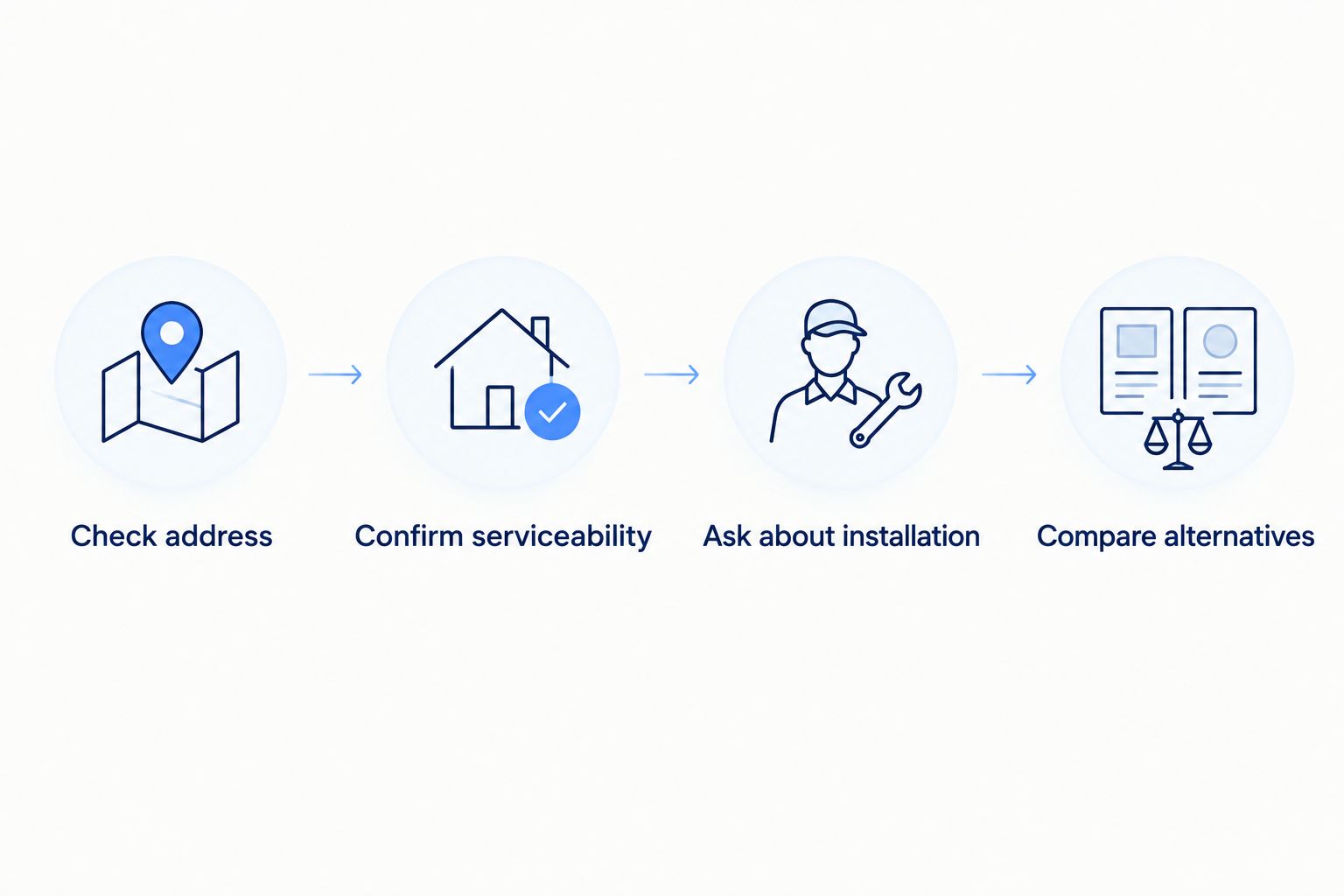
- Check your exact address. Use the street address and any unit or building details the provider requests. The guide to checking fiber availability at your address explains what to verify before treating a coverage result as a service commitment.
- Confirm serviceability. Ask whether the provider can connect the specific home, farmhouse, shop, or business building you intend to use. If the answer is unclear, ask what information is needed to confirm it.
- Ask about installation. Find out whether work is needed between the existing network and your building, what access the installer needs, and when the provider can confirm the installation plan. Do not cancel your current connection on the strength of a coverage result alone.
- Compare alternatives. If fiber cannot be installed at that address, check which other connection types providers actually offer there. Keep your current service until a replacement is ready to use.
The distinction matters most when a property has more than 1 building. Service at the house does not automatically mean service at a detached office or workshop; tell the provider which building needs the connection.
Why this matters
Rural availability is easy to misread. A provider can operate in your region without serving every road, and a line visible from your property does not tell you whether a connection to the building is available. In 2026, the practical question is not whether fiber exists somewhere nearby. It is whether a provider will confirm service at the place where you need it.
That answer affects more than browsing. If you work from home, you need to know whether the connection reaches the building where you take calls. If you run a business on the property, you need to check the building that uses its internet service—not assume that an address match covers every structure.
SumoFiber fiber internet is best for rural households and businesses whose addresses qualify and who want to check internet alongside managed WiFi, TV, home phone, or mobile service. Its limitation is the same one that matters for every provider in this decision: you must confirm service at your exact address before planning a switch. SumoFiber offers services across Utah, Idaho, Montana, Colorado, California, Wisconsin, Illinois, and New York; that list does not establish availability at every property in those states.
If fiber is available at your address
Best for: A home or business that has received a clear serviceability confirmation and an installation plan it can accommodate.
Ask the provider to identify the building that will receive service and describe the next step. If you have a long driveway, multiple buildings, or an unusual property entrance, give those details before scheduling. The aim is to resolve access questions before you rely on a proposed installation date.
The advantage of an available fiber option is straightforward: you can assess a real offer for your address instead of comparing coverage maps. The drawback is that an availability result alone leaves important questions unanswered, including the route to the building, any work you must arrange, and when service can begin. Get those answers from the provider before you change your existing connection.
If fiber is nearby but not confirmed for your property
Best for: A household or business willing to ask for a property-specific review while keeping its current service.
Tell the provider what makes you think fiber is nearby, then ask whether that network can serve your address. A line along the road, a neighbor's connection, or service in the next town is useful context for the conversation. None is confirmation that your property can be connected.
The advantage of asking for a review is that it replaces a guess with a provider decision. The drawback is that the answer can still be no, or the provider can require more information before giving you a firm answer. Do not make plans around a connection the provider has not confirmed.
If fiber is not available at your address
Best for: A property that needs a working connection now rather than an unconfirmed future installation.
Check cable, fixed wireless, satellite, or other services only where a provider confirms they serve your address. Each has a practical trade-off to investigate: what connection type reaches the property, where equipment would go, and whether the service fits the way your household or business uses the internet. Do not choose by technology name alone.
The advantage of comparing available services is that you can act on an offer that exists today. The drawback is that choosing an alternative does not tell you when fiber will arrive. If fiber is still your preference, ask providers how to check the address again later without treating an expansion estimate as an installation commitment.
| Address result | Best for | What you gain | What remains unresolved |
|---|---|---|---|
| Fiber confirmed | Properties ready to discuss installation | A provider-specific next step | Building access and installation details |
| Fiber nearby, service unconfirmed | Properties seeking a direct review | A chance to resolve an unclear coverage result | Whether the provider will connect the property |
| Fiber unavailable | Properties that need service now | A reason to compare confirmed alternatives | Whether or when fiber becomes available |
Why rural fiber availability varies
A regional coverage claim is a starting point, not an address-level verdict. In 2026, these are the details to put in front of a provider:
- Exact address. A result for a town, ZIP code, or nearby road does not confirm your property.
- Building to be served. A house, detached workspace, and farm outbuilding are different installation destinations.
- Connection from the network to the property. Nearby infrastructure is relevant, but the provider must confirm that it can make the connection.
- Access for installation. Tell the provider about gates, long driveways, or separate buildings so it can assess the right location.
- Provider confirmation. An online result and a property-specific serviceability decision answer different questions. Ask which one you have received.
Keep the discussion tied to the address and building you need connected. That gives the provider a concrete question to answer and keeps you from treating a broad coverage map as a promise.
Can I get fiber if my neighbor has it?
Your neighbor's connection is evidence that fiber serves their property, not proof that it serves yours. Give the provider your exact address and ask it to confirm your building separately. In 2026, that direct check is more useful than assuming two nearby properties have the same installation options.
Does a fiber line along my road mean I can sign up?
No. A visible line does not confirm a connection to your building. Ask the provider whether the line is part of a network it can use to serve your address and what must happen before installation. Keep your current internet service until the new connection is ready.
What if I have a home and a business building on the same land?
Name the building that needs service when you ask about availability. If both buildings need a connection, ask the provider to assess both rather than assuming service at the home covers the business building. That is especially important when calls, payments, or day-to-day work depend on the second location.
FAQ
Can I get fiber internet in a rural area in 2026?
Yes, if a provider confirms that it can serve your exact address. Rural coverage in a region does not establish availability at every property.
How do I know whether fiber reaches my rural home?
Check your full address with a provider and ask for a property-specific serviceability confirmation. Tell the provider which building needs the connection.
Is fiber available if it is installed at my neighbor's house?
Not necessarily. Your neighbor's installation confirms service for their property; the provider must check yours separately.
What should I ask before scheduling rural fiber installation?
Ask which building will be connected, what property access is needed, and what work must happen before service begins. Get answers before cancelling your current connection.
Can I get fiber for a farm or ranch outbuilding?
Ask the provider to check that specific outbuilding. Service confirmed at a farmhouse does not, by itself, confirm a connection to another building.
What should I do if fiber is not available at my address?
Compare connection types that providers confirm are available at your address. Keep your existing service while you arrange and verify a replacement.
Does SumoFiber serve every rural address in its states?
No state-level service list confirms every address. Ask SumoFiber to verify the exact property and building before making plans around fiber service.
One last thing
The question that saves the most confusion is which building are you checking? In 2026, an address result is not the end of the conversation when you need internet in a detached office, workshop, or business space. Identify that building when you contact the provider, then wait for a serviceability answer that covers it. SumoFiber can be part of that check where its services are offered; your decision should rest on a confirmed address, not a nearby line or a regional coverage claim.