
No. In 2026, fiber is the better choice for a rural address where it is available: it usually offers lower delay and does not need a clear view of the sky. Satellite internet is the practical choice when fiber does not reach your address, though trees, weather and the type of satellite service can affect your connection.
- Is satellite internet better than fiber in rural areas? No—choose fiber where your address can get it.
- Satellite internet remains useful where fiber is unavailable; a clear sky view matters.
- Check address-level availability before comparing plans. A provider serving your region might not serve your road.
Is satellite internet better than fiber in rural areas?
Fiber wins when both services are available at the same rural address. Satellite wins on reach: it can be an option where no fiber line has been built. The right answer starts with checking whether fiber is available at your address, not with a provider’s regional coverage map.
| Option | Best for | Main advantage | Main drawback |
|---|---|---|---|
| Fiber internet | Rural homes and businesses with service at their address | Low-delay connection for calls, gaming and uploads | Unavailable until a network reaches the property; a damaged line or power loss can interrupt service |
| Low-Earth-orbit satellite | Properties without a suitable wired connection | Can serve places beyond a fiber network | Needs a suitable installation site and clear sky view; performance can vary |
| Geostationary satellite | Remote properties with limited alternatives | Can reach places without a nearby wired network | Longer signal travel increases delay, which matters for live conversations and gaming |
The distinction between satellite types matters. Geostationary satellites orbit about 35,786 km above Earth, so signals travel much farther than they do with low-Earth-orbit service. Do not treat every satellite plan as having the same delay or the same equipment requirements.
Speed alone does not settle the question. The Federal Communications Commission’s fixed-broadband benchmark is 100 Mbps download and 20 Mbps upload, but those figures are a benchmark, not a promise that a plan will perform that way at your house. In 2026, compare the connection you can actually order, where you can place the equipment and what happens when the whole household gets online.
Why this matters in 2026
A rural address can have several internet options on a coverage map and still have only one that can be installed. A road may pass through a provider’s service area without every property on it being connected. Satellite has a different constraint: the service can cover your area while trees or buildings block the dish’s view.
That difference changes the order of your search. Confirm availability at the exact address first. Then compare how each usable connection handles the things you do every day: a video call while someone streams, an upload that cannot wait, or a business payment system that needs to stay connected. A headline download speed does not answer all of those questions.
Do not rule out fiber because you live outside town, and do not assume it is available because a provider serves your county. In 2026, the property—not the town name—is the useful unit of comparison.
When is fiber the better rural choice?
Choose fiber when a provider confirms it can connect your address and its plan fits the work you need to do. Fiber carries data through a physical line rather than a radio path to an orbiting satellite. That makes it the stronger choice for activities where delay is noticeable, including live video conversations and online gaming.
Uploads matter too. If you send large work files, share videos or back up devices, compare upload speeds alongside download speeds. The FCC’s 20 Mbps upload benchmark gives you a reference point, but your household’s needs depend on what runs at the same time. Ask for the specific plan details rather than assuming every fiber connection has identical speeds.
Fiber has limits. A connection cannot help you until the network reaches your property and installation is possible. Once connected, a damaged line or a local power outage can still interrupt service. If staying online during an interruption is essential for your home or business, ask about a separate backup connection and the power needed to run your equipment.
When is satellite the better rural choice?
Choose satellite when a suitable wired connection cannot be installed at your address. It gives remote households and businesses a way to get online without waiting for a fiber build. The trade-off is that the equipment must communicate with satellites overhead, and the experience depends in part on the satellite system and installation site.
A clear sky view is a practical requirement, not a detail to leave until installation day. Trees, rooflines and terrain can affect where equipment goes. Check the proposed placement before committing, especially if your property has dense trees or sits against a slope. Ask the provider what the site needs and what installation involves.
Satellite is not one uniform category. Low-Earth-orbit and geostationary systems have different signal paths; the 35,786 km orbit of a geostationary satellite explains why its delay is a particular concern for real-time tasks. If your main use is browsing or watching video, you will judge the connection differently than someone taking calls or playing online games. Match the service to the task instead of buying by a single speed figure.
Satellite has another useful role in 2026: it can be a separate connection for a property that already has wired internet. That does not make every satellite plan a good backup. Check how your equipment switches connections and whether both systems will have power during the interruption you are preparing for.
Why rural internet performance varies
- Address-level availability. A provider can operate nearby without being able to install service at your property. Get an address-specific answer before comparing its plans.
- Satellite sky view. A usable installation position matters as much as broad satellite coverage. Look at trees, buildings and terrain where the equipment would sit.
- Type of satellite system. Low-Earth-orbit and geostationary services do not have the same signal travel distance. Ask which type a plan uses when delay matters to you.
- Upload requirements. Sending files or joining calls uses the connection differently from watching a stream. Compare upload details, not just the advertised download figure.
- Local equipment and WiFi. A weak wireless signal inside the house can make a usable internet connection feel slow in one room. Check the connection and the in-home network separately.
- Outage exposure. Fiber lines, satellite equipment and home networking gear can all be affected by interruptions. Ask what each provider can tell you about installation, support and restoring service.
None of these factors produces one answer for every rural property. They give you questions you can put to a provider before you switch. In 2026, a confirmed installation and a connection that handles your real workload are more useful than a service-area claim.
How do you choose between fiber and satellite?
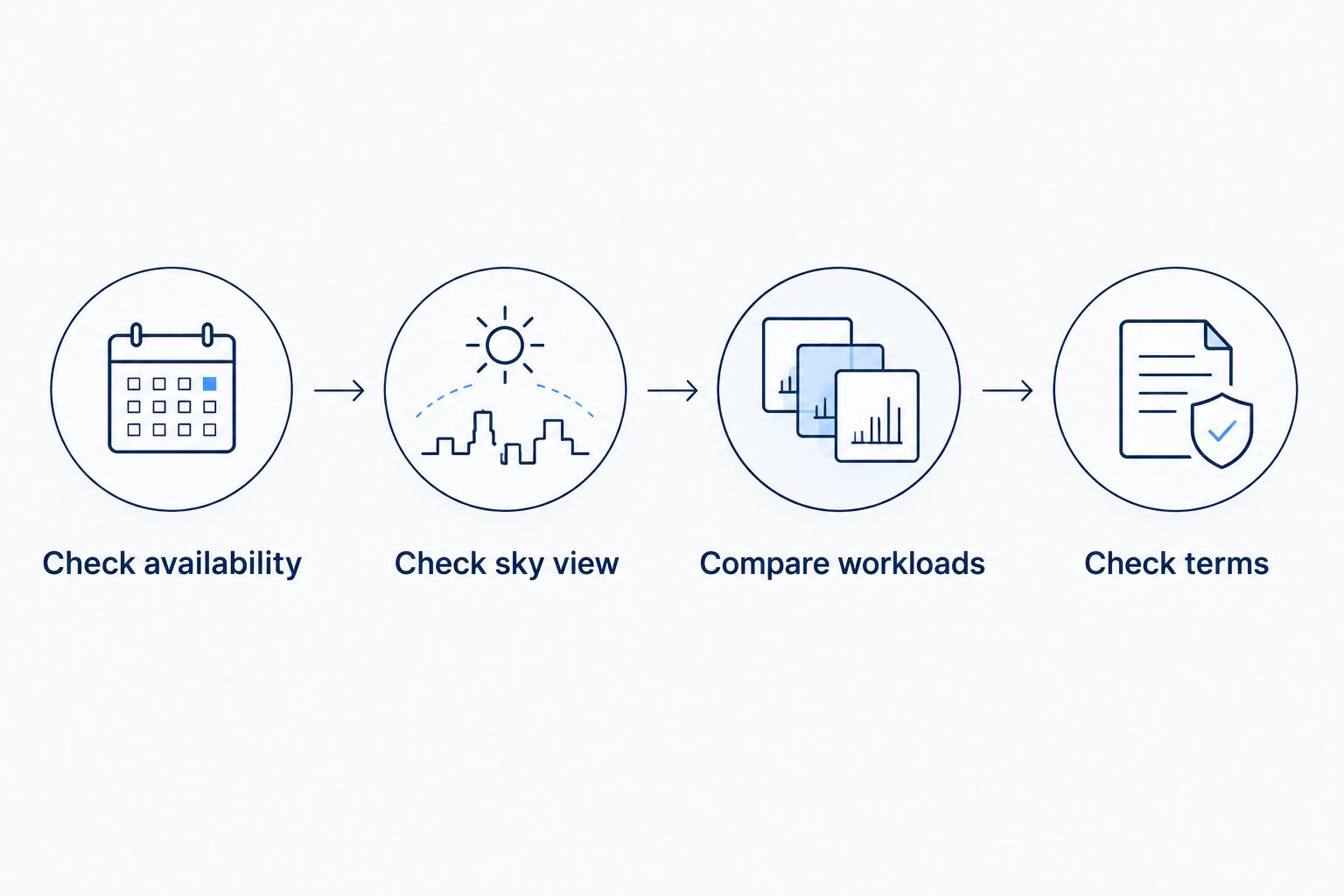
- Check availability. Give each provider your full service address and ask whether installation can be completed there. Do not use a neighboring address as confirmation.
- Check sky view. If satellite is an option, identify a possible equipment location and ask the provider to assess it. Do not assume an open yard means every position works.
- Compare workloads. List the activities that must work at the same time: calls, streaming, gaming, uploads or business systems. Compare upload information and delay as well as download speed.
- Check terms. Read the plan and installation details you are offered. Ask how support works and what happens if your connection goes down.
These steps keep the decision grounded in your property. They also prevent an avoidable mistake: cancelling an existing connection before the replacement has been installed and used for the tasks that matter to you.
Test the connection where you use it, not only beside the router. If calls fail in a back room while the connection works elsewhere, ask whether the problem is the internet service or the WiFi inside the building. Changing providers will not automatically fix poor coverage between rooms.
Where does SumoFiber fit?
SumoFiber provides fiber internet for homes and businesses, alongside managed WiFi and other communications services. SumoFiber fiber internet is best for a rural home or business only where its service can be installed at that address. If it cannot, satellite remains a practical option; a provider name does not change the reach of the network.
For a property considering SumoFiber in 2026, ask for an address-specific availability answer before weighing fiber against satellite. SumoFiber also offers managed WiFi, which is relevant if the connection reaches your home or business but wireless coverage inside it is the problem. Keep those decisions separate: the service that brings internet to the property and the equipment that distributes it indoors do different jobs.
Related questions
Is satellite internet good enough for video calls in rural areas?
Satellite can support video calls, but delay and interruptions depend on the type of service and the view from the installed equipment. If calls are central to your work, compare the specific satellite plan against any fiber service confirmed for your address, then assess it during the hours you normally call.
Does fiber work during a rural power outage?
Fiber service does not keep your home equipment running when that equipment loses power. A provider’s network and the equipment at your property both matter, so ask what would need backup power before treating any connection as an outage solution.
Should I keep satellite as a backup after getting fiber?
Keep a separate connection when an internet outage would disrupt work or essential operations and the backup addresses the failures you face. Confirm how you would switch between services and whether both sets of equipment can run during a power outage.
FAQ
Is satellite internet better than fiber in rural areas?
No—fiber is the better choice where it can be installed at your address. Satellite is valuable where no suitable wired connection reaches the property.
Is fiber available at every rural address?
No. A provider serving your town or county does not confirm installation at your property; ask for an address-specific availability check.
Is low-Earth-orbit satellite the same as geostationary satellite?
No. They use satellites at different distances from Earth, which affects signal travel time. Ask which system a proposed service uses if live calls or gaming matter to you.
Does satellite internet need a clear view of the sky?
Yes, the equipment needs a suitable view to communicate with its satellite network. Ask the provider to assess placement around trees, buildings and terrain.
Is fiber better than satellite for working from home?
Fiber is the stronger choice when it is available at your address and your work depends on responsive calls or uploads. Compare the specific plans and confirm that your in-home WiFi covers your workspace.
Can I get SumoFiber fiber internet at a rural address?
SumoFiber fiber internet depends on availability at your exact address. Confirm that installation is possible before comparing it with a satellite plan.
Can satellite back up a fiber connection?
Yes, satellite can serve as a separate connection where its equipment can be installed. Check connection switching and backup power before relying on it during an outage.
One last thing
Before you change service in 2026, write down the task your current connection fails to handle. If the failure happens only in one room, investigate WiFi first. If the whole property loses connectivity, compare available connections and backup options. The best rural internet choice fixes the failure you actually have, whether that means fiber at a confirmed address or satellite where wired service cannot reach.