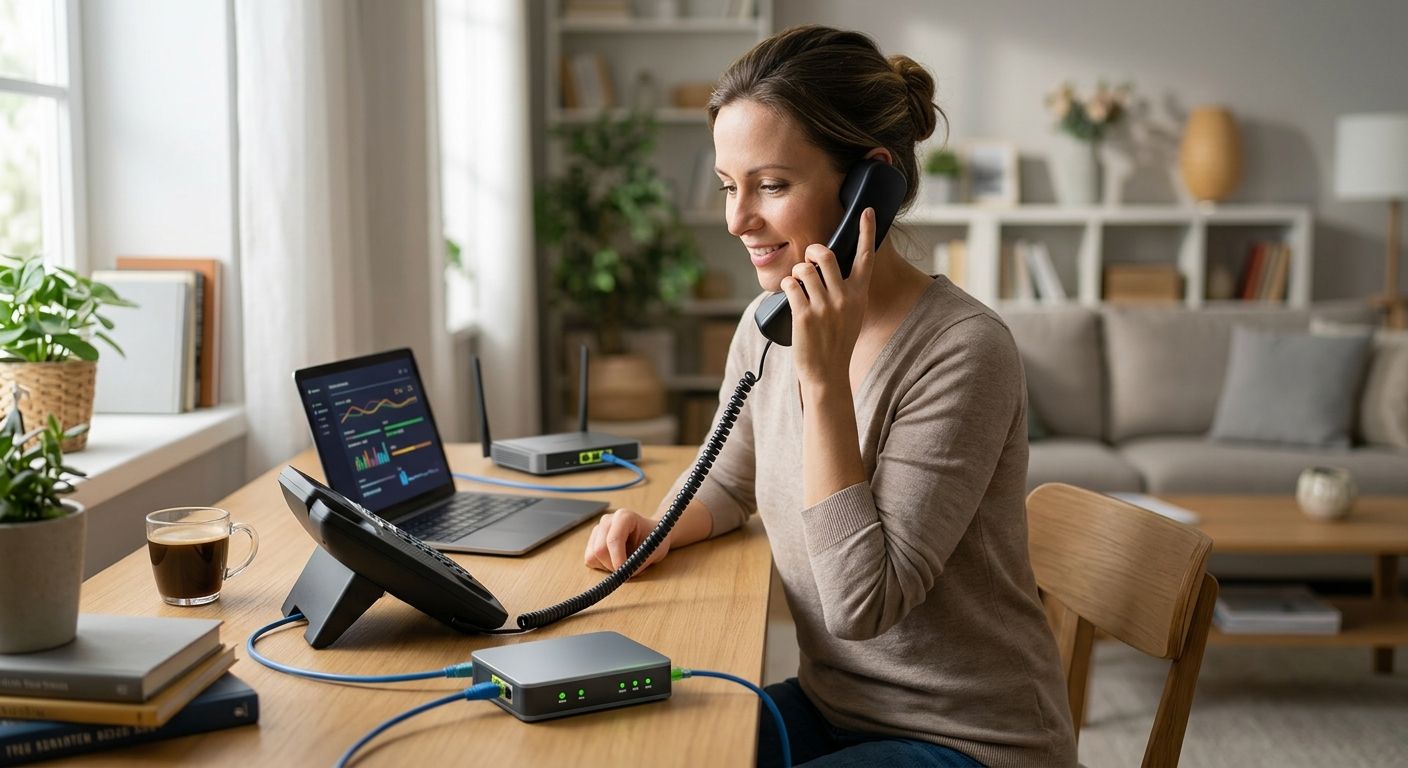
VoIP home phone service converts your voice into digital data packets and sends them over your internet connection instead of copper phone lines. A small adapter or an app digitizes the call, routes it through SIP (Session Initiation Protocol) to your provider's network, then reconnects it to the standard phone system on the other end. Call quality depends entirely on your internet connection's speed and stability, not on a dedicated phone wire the way a landline worked. And because VoIP rides on your internet line, a power outage that takes down your router also takes down your phone unless you've got battery backup in place.
- VoIP turns your voice into digital packets and sends them over your internet connection using SIP.
- Call quality tracks your internet's bandwidth and jitter, not a dedicated copper phone line.
- A power outage kills VoIP unless your router and adapter have battery backup.
- SumoFiber pairs fiber internet with home phone service so VoIP runs on a wired, symmetrical connection.
- You keep your existing phone number in almost every VoIP switch through number porting.
Why this matters
Most households switching off a traditional landline in 2026 don't realize their phone now depends on the same connection that streams Netflix and runs the kids' video calls. That's a real shift: a landline worked in a blackout because the phone company sent low-voltage power down the copper wire itself. VoIP doesn't do that. If your internet drops, so does your phone call, unless the equipment has a battery.
This matters more now than it did five years ago because more providers are retiring copper networks outright, pushing customers onto VoIP whether they planned to switch or not. Understanding how the technology actually behaves before you sign up prevents the surprise of a dead phone during a storm. SumoFiber runs home phone service over its fiber network rather than copper, which changes some of the tradeoffs discussed below.
How does VoIP home phone service work, step by step?
Here's the path a call takes, start to finish:
- Your voice hits the adapter or app. An Analog Telephone Adapter (ATA) plugs your existing corded phone into your router, or a softphone app on your mobile device captures the audio directly.
- The audio gets digitized and compressed. A codec breaks your voice into small digital packets, similar to how a music file gets compressed for streaming.
- SIP signaling sets up the call. SIP acts like a switchboard, finding the number you're dialing and establishing a connection path across the internet.
- Packets travel over your internet connection. The data moves through your router, out to your ISP's network, and across the internet backbone to your provider's servers.
- The call reconnects to the phone network. If you're calling a traditional landline or mobile number, your VoIP provider hands the call off to the standard telephone network at that point.
- Audio decodes on the receiving end. The packets get reassembled and converted back into sound in real time, ideally with no perceptible delay.
The entire round trip needs to happen in well under a second to sound natural. That's why bandwidth and network stability matter more for VoIP than they ever did for a copper landline.
ATA-based VoIP vs. app-based VoIP vs. IP desk phones
| Setup type | How it connects | Best for |
|---|---|---|
| Analog Telephone Adapter (ATA) | Plugs your existing corded phone into the router | Households keeping their current phone and number |
| Softphone app | Runs on a smartphone or computer, no adapter needed | People who want to answer home calls anywhere |
| IP desk phone | A phone built with VoIP hardware, connects directly to the network | Home offices needing multiple lines or extensions |
All three send calls the same way described above. The difference is where the digitizing happens, not how the call travels once it's on the network.
Why VoIP call quality varies
VoIP doesn't fail randomly. The factors that cause dropped calls and choppy audio are consistent and mostly fixable:
- Available bandwidth. A VoIP call typically needs at least 100 Kbps of upload bandwidth to sound clear; if several devices are uploading large files or on video calls at once, voice quality is the first thing to suffer.
- Jitter. This is variation in how fast packets arrive. Once jitter passes roughly 30 milliseconds, calls start sounding robotic or start cutting out.
- WiFi signal strength. A phone adapter or app on a weak WiFi signal drops packets before they even leave the house, regardless of how fast your internet plan is.
- Router quality and congestion. An older router struggling to manage multiple devices adds delay to every call, even on a fast connection.
- Upload speed, not just download. Most home internet plans emphasize download speed; VoIP calls are far more sensitive to upload, which is where cable connections often fall short compared to fiber.
- Power availability. Since VoIP equipment relies on electricity to function, an outage disables the phone line entirely unless there's a battery backup on the router and adapter.
A fiber connection's symmetrical upload and download speeds are one reason fiber-based home phone service tends to hold up better under load than cable-based VoIP, where upload speeds are usually a fraction of download. If you're weighing whether fiber internet is worth it for your address, VoIP call quality is a concrete, everyday reason the answer often comes back yes.
“If your WiFi signal drops in one room, that's the room where your VoIP call will drop too.”
Does VoIP work during a power outage?
No, standard VoIP stops working the moment your router or modem loses power, because unlike a copper landline, VoIP equipment doesn't receive power through the phone line itself. A battery backup on your router and any adapter is the only way to keep VoIP running through a short outage in 2026. Cell service is the fallback most households actually use once the battery runs out.
Can I keep my old phone number with VoIP?
Yes, keeping your existing phone number when switching to VoIP is standard through a process called number porting, and it works whether you're moving from a landline or another carrier. The transfer typically completes within a business cycle after you provide your account details to the new provider. Some households set up call forwarding from their home phone to a mobile number once the port is complete, so the same number rings on the go.
Do I need special equipment for a VoIP home phone?
You need at minimum an internet connection and either an adapter for your existing corded phone or an app on a mobile device — a desk phone is optional, not required. Most home phone plans include the adapter as part of setup rather than requiring you to buy separate hardware. Households worried about outages should also look at automatic cellular backup when fiber drops, which keeps a connection alive even when the primary line goes down.
Check fiber availability at your address
See if fiber internet and VoIP home phone service reach your home.
FAQ
How does VoIP home phone service work?
VoIP converts your voice into digital packets and sends them over your internet connection using SIP, then hands the call off to the standard phone network on the other end. Quality depends on your internet's bandwidth and stability rather than a dedicated copper wire.
Is VoIP the same as a landline?
No, VoIP runs over your internet connection while a traditional landline runs on dedicated copper wiring with its own low-voltage power. That difference is why VoIP needs battery backup to survive a power outage and a landline typically didn't.
What internet speed do I need for VoIP?
A single VoIP call needs roughly 100 Kbps of upload bandwidth, which almost any broadband plan meets on its own. The bigger factor in 2026 households is whether that bandwidth is shared with streaming, gaming, and video calls at the same time.
Does VoIP home phone work with WiFi?
Yes, VoIP works over WiFi, but a weak signal causes dropped packets and choppy calls before the issue ever reaches your internet plan's speed. A wired connection to the adapter, when possible, avoids that variable entirely.
Can I use VoIP with my existing corded phone?
Yes, an Analog Telephone Adapter (ATA) lets you plug your current corded or cordless phone into the router and use it exactly as before. No new handset is required for this setup.
What happens to VoIP calls during an internet outage?
VoIP calls stop entirely during an internet outage because the service depends on that connection to route audio. Backup options like cellular failover or a battery-backed router keep basic connectivity alive until service is restored.
Is VoIP cheaper than a landline?
VoIP is generally bundled with an internet plan rather than billed as a separate copper line, which is why most households moving to fiber drop their landline entirely. Exact costs vary by provider and plan, so check current pricing directly with your internet provider.
Do I need a special router for VoIP?
No special router is required, but an older or congested router adds delay that shows up as choppy audio on VoIP calls. A router that handles multiple devices well matters more for VoIP than for basic browsing.
One last thing
The detail most households miss isn't call quality, it's the outage gap. A copper landline worked when the power went out because the phone company powered it remotely; VoIP has no equivalent unless you add battery backup to your router and adapter yourself. Before you drop a landline in 2026, confirm what your provider does when the power blinks, because that's the scenario where the two technologies stop behaving the same way.